
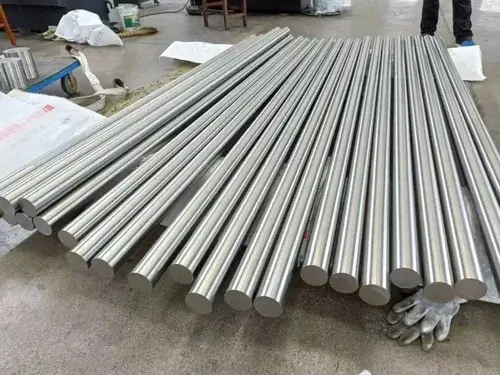
Nimonic 80A Round Bar
➡️ Alloy 80A | UNS N07080 | EN 2.4952 | ASTM B637
➡️ ASTM, EN, JIS & International Standards
➡️ Supply Conditions
➡️ Multiple Diameters & Supply Lengths
➡️ Global Export & International Delivery
Country of Origin:
Europe, Japan, USA
Material Type:
Nickel Alloy
UNS Number:
N07080
Wr. No.:
2.4952
MTC Available:
EN 10204 3.1
Product Description for Nimonic 80A Round Bar
Nimonic 80A Round Bar is made from a wrought, age-hardenable nickel-chromium alloy strengthened by titanium, aluminium and carbon. It is designated UNS N07080 and is known in Germany as 2.4952 and 2.4631 (NiCr20TiAl). Bars are supplied to ASTM B637 and to UK aerospace specifications such as BS HR 1.
The alloy is similar to Nimonic 75 but contains more titanium and aluminium. These elements form a fine gamma prime precipitate during ageing, which gives high tensile and creep-rupture strength at temperatures up to about 815°C. The 20% chromium base also gives good resistance to oxidation and hot corrosion.
Air-melted material is often extruded, while electroslag-refined and vacuum-refined versions are used for forged and critical parts. The alloy is usually supplied solution treated, then aged by the user after machining, or supplied fully heat treated for direct use.
Nimonic 80A is essentially non-magnetic. It machines more slowly than stainless steel and needs rigid set-ups and suitable tools. It can be welded in the solution-treated condition with suitable procedures.
Common applications include gas turbine blades, discs and rings, high-temperature bolts and fasteners, automotive and marine engine exhaust valves, nuclear boiler tube supports, and die-casting inserts and cores. It remains a common choice for exhaust valves and high-temperature bolting where a proven age-hardened nickel alloy is required. It is one of the most widely used alloys for high-temperature bolts and exhaust valves in aircraft, diesel and marine engines. Bars can be supplied solution treated for machining, or fully heat treated when the buyer needs ready-to-use properties.
Common Applications of Nimonic 80A Round Bar
➡️ Machined shafts, spindles, valve stems, pump sleeves and pins for food, beverage, dairy and pharmaceutical equipment, where the passive chromium oxide film resists both product acids and caustic clean-in-place chemicals.
➡️ Fasteners, studs, bolts, threaded rod and anchor components produced from bar stock, chosen for corrosion resistance combined with the ductility needed for cold heading and thread rolling.
➡️ Chemical, water treatment and general process plant parts such as agitator shafts, flange blanks, nozzles and support components handling water, steam and mildly corrosive media free of significant chlorides.
➡️ Architectural and structural hardware including handrail stanchions, balustrade fittings, tension rods and bollards, where a bright ground or polished bar finish provides both appearance and low maintenance.
International Equivalent Grade for Alloy 80A Round Bar
Standard
Country / Region
Grade
UNS
USA
UNS N07080
ASTM B637 / ASME SB637
USA
Alloy 80A / UNS N07080
EN
Europe
EN 2.4952 / 2.4631 (NiCr20TiAl)
BS 3076 / BS HR1 / HR401 / HR601
United Kingdom
NA20 / N80A
GB/T
China
GH4080A
JIS G4901 / G4902
Japan
NCF80A
KS D3758
South Korea
NCF80A
DIN 17742 / DIN 17752
Europe
NiCr20TiAl
AFNOR
France
NC20TA
Technical Specification for Nimonic 80A Round Bar
Specification
Value
Unit
Material
Nickel alloy
-
Grade
Nimonic 80A / UNS N07080 / 2.4952
-
Standard
ASTM B637, BS HR 1
-
Product Form
Round bar / rod
-
Diameter (supply range)
6–250
mm
Length (random)
1–6
m
Manufacturing Process
Hot rolled, forged, extruded or cold drawn
-
Surface Finish
Descaled, pickled, peeled, turned, ground or bright
-
Heat Treatment / Delivery Condition
Solution treated, or solution treated and precipitation hardened
-
Tolerance Standard
Per ASTM B637 / ordered specification
-
Density
8.19
g/cm³
Melting Range
1320–1365
°C
Thermal Conductivity at 20°C
11.2
W/m·K
Coefficient of Thermal Expansion 20–100°C
12.7
µm/m·K
Specific Heat at 20°C
448
J/kg·K
Electrical Resistivity at 20°C
1.24
µΩ·m
Modulus of Elasticity at 20°C
222
GPa
Magnetic Properties
Essentially non-magnetic
-
Testing / Inspection
Chemical analysis, tensile, hardness, dimensional, UT and PMI on request
-
Certification
EN 10204 3.1 mill test certificate (3.2 on request)
-

Technical Specifications
Get the key technical specifications for Nimonic 80A Round Bar
Nimonic 80A Round Bar is supplied to ASTM B637, which covers precipitation-hardening nickel alloy bars and forgings, and to UK aerospace specifications such as BS HR 1. The chemistry of 2.4952 is given in DIN 17742, with bars covered by DIN 17752.
A common heat treatment is solution treatment at about 1080°C for 8 hours with air cooling, followed by precipitation hardening at about 700°C for 16 hours with air cooling. Other cycles are used in different specifications, so the order must state which one applies.
Physical values for Nimonic 80A are reference figures for the aged condition. Nimonic 80A is non-magnetic, which avoids interference in engine sensors. Tolerances follow ASTM B637 or the ordered specification.
Standard tests include chemical analysis, tensile test, hardness and dimensional checks. Stress-rupture testing, grain size checks, ultrasonic testing and third-party inspection are common for aerospace and power generation orders.
For fastener and valve work, buyers often add stress-rupture testing and grain size limits to the order, because these control creep life more than room-temperature strength does. If bars will be hot forged into valve heads or bolts, order them solution treated and do the full heat treatment after forging. State whether ASTM B637, a BS HR specification or an engine maker specification governs.
Chemical Composition for Nimonic 80A Round Bar
Element
Symbol
Min
Max
Unit
Carbon
C
-
0.10
%
Silicon
Si
-
1.0
%
Manganese
Mn
-
1.0
%
Sulfur
S
-
0.015
%
Chromium
Cr
18.0
21.0
%
Titanium
Ti
1.8
2.7
%
Aluminium
Al
0.50
1.80
%
Iron
Fe
-
3.0
%
Cobalt
Co
-
2.0
%
Copper
Cu
-
0.2
%
Boron
B
-
0.008
%
Zirconium
Zr
-
0.15
%
Nickel
Ni
Balance
-
%

Chemical Composition
View the chemical composition and applicable material limits for Alloy 80A Round Bar
The composition limits shown are those published for Nimonic 80A in the BS HR series and by the producer. ASTM B637 gives closely matching limits for UNS N07080, with aluminium set at 0.50–1.80%. Buyers should check the exact limits in the ordered specification.
Chromium at 18–21% gives resistance to oxidation and hot corrosion. Nickel forms the matrix and supports high-temperature strength.
Titanium at 1.8–2.7% and aluminium at 0.50–1.80% (ASTM B637; BS HR 1 uses 1.0–1.8%) are the key strengthening elements. During ageing they form a fine gamma prime phase, Ni3(Al,Ti), which blocks dislocation movement and gives high strength and creep resistance.
Carbon forms carbides at grain boundaries that help creep strength. Small amounts of boron and zirconium strengthen grain boundaries and improve rupture life. Iron, cobalt, copper, manganese and silicon are residuals. Sulfur is kept very low to protect hot workability and ductility. Titanium at 1.8–2.7% and aluminium at 0.50–1.80% combine with nickel to form a fine gamma prime phase, Ni3(Al,Ti), during ageing. This phase gives the alloy its high strength up to about 815°C. Boron and zirconium are kept small but help strengthen grain boundaries and improve creep life. Chromium at 18–21% provides oxidation resistance.
Mechanical Properties for Nimonic 80A Round Bar
Mechanical Property
Value
Unit
Tensile Strength (ASTM B637, solution + stabilise + age)
≥ 930
MPa
Yield Strength 0.2% (ASTM B637)
≥ 620
MPa
Elongation (ASTM B637)
≥ 20
%
Stress Rupture (ASTM B637, 760°C / 325 MPa)
≥ 23
h
Tensile Strength (aged)
1250
MPa
0.2% Proof Strength (aged)
780
MPa
Hardness (aged)
300–380
HV

Mechanical Properties
Check the key mechanical properties and performance requirements of Alloy 80A Round Bar
The first four rows are ASTM B637 minimum requirements for UNS N07080 after solution treatment at about 1066°C for 8 hours, stabilising at about 849°C for 24 hours and ageing at about 699°C for 16 hours, each followed by air cooling. The last three rows are reference values for guidance only. BS HR 1 and other specifications set their own minimums.
In the solution-treated condition the alloy is softer and easier to machine. Precipitation hardening then raises strength sharply through the formation of gamma prime. This allows high strength with useful ductility.
At high temperature the alloy keeps good creep and rupture strength up to about 815°C, which is why it is used for bolts, exhaust valves and turbine parts. Stress-rupture tests are often part of the order. Check that the Nimonic 80A certificate shows tensile, hardness and stress-rupture results for the exact heat treatment ordered. Stress-rupture testing at 760°C and 325 MPa in ASTM B637 checks that the heat treatment has worked and that the grain structure is sound. Room-temperature tensile tests alone cannot confirm this. For parts designed for long life at high temperature, buyers should request stress-rupture results on the certificate.
Dimension / Sizes for Nimonic 80A Round Bar
Dimension / Size
Value
Unit
Available Diameter Range (supply capability)
6–200
mm
Standard Length (random)
1–6
m
Custom / Cut-to-Length
Available on request
-
Diameter Tolerance
Per ASTM B637 or ordered specification
-
Length Tolerance
Per ordered standard or as agreed (commonly +50 / -0 mm for cut lengths)
-
Straightness Tolerance
Per ordered specification or as agreed
-
End Condition
Saw cut square, chamfered or as ordered
-
Surface Finish
Hot finished, descaled, pickled, peeled, turned, centreless ground or cold drawn bright
-

Dimensions & Sizes
Explore available diameters, lengths, and dimensional requirements for Alloy 80A Round Bar
Pricing for Nimonic 80A Round Bar
Round Bar Prices are generally quoted per kilograms or meters tonnes and can fluctuate with the global raw material and market prices. The final price will depend on a variety of factors, including the grade size, diameter, length, surface finish, the quantity and whether the bars are cut to length or in standard lengths.
For smaller quantities, we can also quote per metre or per piece basis once the required dimensions have been confirmed. Container-loads or orders that are larger in size are typically priced per tonne, based upon the specifications required and the supply conditions.
Please provide your desired dimensions, grades, length number, and end for a current quote including the lead time applicable and details for certification.

Pricing
Get current Nimonic 80A Round Bar pricing based on size, quantity, grade, finish, and delivery requirements.
Why Choose Us
Euro Steel Bars is an international distributor, stockist and exporter of stainless round steel bars that cover carbon, stainless alloy, special grades. We stock a variety of sizes and grades. We guarantee every order with mill test certificates as well as full quality-assurance documentation. Our name speaks to our roots: European-sourced materials that is backed by the certificates and rigor that buyers from Asia as well as the Gulf and Africa are looking for.
Each bar we deliver is accompanied by EN 10204 3.1 mill test certificates as well as complete documentation of quality, so what you receive corresponds to what’s written in the documents. We carry a selection of sizes and grades ready for transport, and cut length upon the request of customers, which results in quicker lead times, whether you’re ordering just a one-off spec or a complete project tonnage.
We operate an actual wholesale business that is that is supported with an internationally-operated supply chain therefore we are able to serve fabricators sourcing one grade the same way in the same way as an EPC contractor who is placing a large order. Our clients include manufacturers, fabricators EPC construction companies, engineers oil and gas projects as well as construction companies. we design our inventory as well as documentation to show what buyers need to bring projects forward.
Our customers trust us across Qatar, Oman, Bahrain, Kuwait, Jordan, Malaysia, Singapore, Thailand, Taiwan, Turkey, Italy and South Africa. If you’re looking to source an Gulf energy project, or a construction project within Southeast Asia, you get the same quality of certified material, the exact documentation, and the exact delivery procedure.
Frequently Asked Questions
When should I choose Nimonic 80A over Nimonic 75?
Why is Nimonic 80A used for exhaust valves and high-temperature bolts?
What heat treatment gives Nimonic 80A its strength?
Can Nimonic 80A be supplied fully heat treated?
How should Nimonic 80A be heat treated, welded and machined?
What are the limits of Nimonic 80A?
Request A Quote
Need a specific grade, size or quantity? Get pricing and availability for your requirement.