
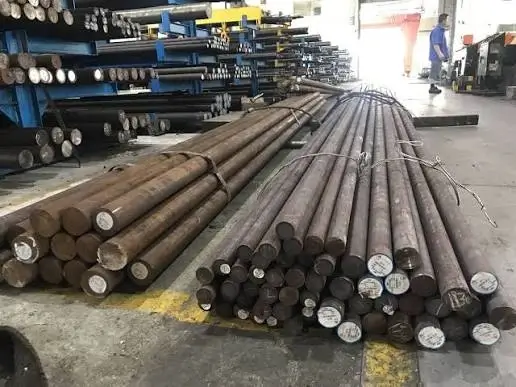
Alloy Steel 4340 Round Bar
➡️ AISI 4340 | UNS G43400 | EN 1.6582
➡️ ASTM, EN, JIS & International Standards
➡️ Supply Conditions
➡️ Multiple Diameters & Supply Lengths
➡️ Global Export & International Delivery
Country of Origin:
Europe, Japan, USA
Material Type:
Alloy Steel
UNS Number:
G43400
Wr. No.:
1.6582
MTC Available:
EN 10204 3.1
Product Description for Alloy Steel 4340 Round Bar
Alloy Steel 4340 Round Bar is a solid cylindrical bar produced from low-alloy nickel-chromium-molybdenum steel grade AISI/SAE 4340 (UNS G43400). Bar is supplied to ASTM A29 / A29M for general requirements and ASTM A322 for hot-wrought alloy steel bars, with cold-finished bar under ASTM A108 and aerospace material to AMS 6414 or AMS 6415.
The grade contains 0.38-0.43% carbon with 1.65-2.00% nickel, 0.70-0.90% chromium and 0.20-0.30% molybdenum. The three additions together give unusually deep hardenability, so bars of 150 mm and larger can be through-hardened with an oil quench and still come out uniform from surface to centre. It is regarded as the benchmark high-strength structural alloy steel and is used where strength, toughness and fatigue resistance must be combined in large sections.
After quenching and tempering, tensile strengths of 930-1080 MPa are routine, and vacuum melted material can be treated to 1800 MPa and above for aerospace applications. The nickel addition sustains impact toughness at low temperature better than the chromium-molybdenum grades, while molybdenum suppresses temper embrittlement.
Bars are supplied annealed, normalised, or quenched and tempered, in diameters from about 15 mm to 600 mm and lengths of 3 to 6 m. The grade also responds well to nitriding and induction hardening.
Applications include aircraft landing gear, airframe fittings, engine and gearbox shafts, crankshafts, connecting rods, heavy-duty gears, drive shafts, torsion bars, drilling and downhole tools, high-strength fasteners and forging dies. Industries served include aerospace and defence, oil and gas, automotive, mining, power transmission and heavy engineering.
Common Applications of Alloy Steel 4340 Round Bar
➡️ Machined shafts, spindles, valve stems, pump sleeves and pins for food, beverage, dairy and pharmaceutical equipment, where the passive chromium oxide film resists both product acids and caustic clean-in-place chemicals.
➡️ Fasteners, studs, bolts, threaded rod and anchor components produced from bar stock, chosen for corrosion resistance combined with the ductility needed for cold heading and thread rolling.
➡️ Chemical, water treatment and general process plant parts such as agitator shafts, flange blanks, nozzles and support components handling water, steam and mildly corrosive media free of significant chlorides.
➡️ Architectural and structural hardware including handrail stanchions, balustrade fittings, tension rods and bollards, where a bright ground or polished bar finish provides both appearance and low maintenance.
International Equivalent Grade for AS 4340 Round Bar
Standard
Country / Region
Grade
ASTM A29 / A29M
USA
Grade 4340 (UNS G43400)
ASTM A322
USA
Grade 4340 - hot-wrought alloy steel bar
ASTM A108
USA
Grade 4340 - cold-finished bar
SAE J404
USA
4340
AMS 6414 / AMS 6415
USA
4340 bar for aerospace applications
EN 10083-3
Europe / EU
34CrNiMo6 (1.6582)
BS EN 10083-3
United Kingdom
34CrNiMo6 (1.6582)
BS 970 Part 1 (superseded)
United Kingdom
817M40
JIS G4103
Japan
SNCM439
GB/T 3077
China
40CrNiMoA
KS D 3867
South Korea
SNCM439
ISO 683-2
International
34CrNiMo6
Technical Specification for Alloy Steel 4340 Round Bar
Specification
Value
Unit
Material
Alloy steel
-
Grade
4340 / UNS G43400 / 34CrNiMo6
-
Product Form
Round bar / rod / forged round
-
Standard
ASTM A29 / A29M and ASTM A322
-
Diameter
15 - 600 (available range)
mm
Length
3 - 6 (standard random or fixed)
m
Manufacturing Process
Hot rolled, forged, or hot rolled and cold drawn
-
Production Route
EAF melting with ladle refining, optional VAR or ESR remelting for aerospace, hot rolling or forging, heat treatment
-
Surface Finish
Hot-rolled black, peeled, rough turned, cold-drawn bright, turned ground and polished
-
Heat Treatment / Delivery Condition
Annealed, normalised, or quenched and tempered as ordered
-
Annealing Temperature
810 - 850 then furnace cool
°C
Normalising Temperature
870 - 900 then air cool
°C
Hardening Temperature
830 - 860 followed by oil quench
°C
Tempering Temperature
205 - 650 depending on required strength
°C
Nitriding Temperature
500 - 530 giving a case hardness of about 600 - 650 HV
°C
Tolerance Standard
ASTM A29 / A29M and ASTM A108
-
Carbon Equivalent (CEV)
0.83 (IIW formula)
-
Density
7.85
g/cm3
Melting Point
1427 - 1500 (approximate)
°C
Thermal Conductivity
44.5 at 100°C
W/m.K
Coefficient of Thermal Expansion
12.3 at 20 - 100°C
micro-m/m.K
Specific Heat
475 at 50 - 100°C
J/kg.K
Electrical Resistivity
0.248
micro-ohm.m
Modulus of Elasticity
205
GPa
Magnetic Properties
Ferromagnetic
-
Applicable Testing Standard
ASTM A370, ASTM E8 / E8M, ASTM E23, ASTM E10, ASTM E415, ASTM A388
-
Certification / Inspection Documents
EN 10204 Type 3.1 or 3.2 mill test certificate
-

Technical Specifications
Get the key technical specifications for Alloy Steel 4340 Round Bar
Alloy Steel 4340 Round Bar is ordered to ASTM A29 / A29M and ASTM A322 for hot-wrought bar and ASTM A108 for cold-finished bar. Aerospace material is normally specified to AMS 6414 or AMS 6415, which add requirements for melting practice, cleanliness, grain size and magnetic particle inspection. Where the European system applies, EN 10083-3 covers the nearest equivalent grade 34CrNiMo6 and imposes mandatory mechanical minima by ruling section.
Hardening is carried out from 830-860°C with an oil quench, followed by tempering between about 205 and 650°C. Because nickel, chromium and molybdenum all slow the transformation, a fully martensitic structure forms to considerable depth and sections of 150 mm and above can be through-hardened.
For very high strength aerospace applications the material is often vacuum arc remelted and tempered at low temperature, reaching tensile strengths of 1800 MPa or more. At those strength levels the steel becomes sensitive to hydrogen embrittlement and to stress-corrosion cracking, so plating and pickling processes must include a hydrogen bake-out.
Tempering between about 230 and 370°C should be avoided because of tempered martensite embrittlement, and slow cooling from tempering temperatures above 575°C should be avoided to limit classical temper embrittlement.
Testing includes analysis to ASTM E415, tensile testing to ASTM A370 and E8 / E8M, Charpy testing to ASTM E23, hardness to ASTM E10 and ultrasonic examination to ASTM A388.
Chemical Composition for Alloy Steel 4340 Round Bar
Element
Symbol
Min
Max
Unit
Carbon
C
0.38
0.43
%
Manganese
Mn
0.60
0.80
%
Silicon
Si
0.15
0.35
%
Phosphorus
P
-
0.035
%
Sulfur
S
-
0.040
%
Nickel
Ni
1.65
2.00
%
Chromium
Cr
0.70
0.90
%
Molybdenum
Mo
0.20
0.30
%
Iron
Fe
Balance
Balance
%

Chemical Composition
View the chemical composition and applicable material limits for AS 4340 Round Bar
Carbon at 0.38-0.43% determines the maximum attainable hardness of the martensite, allowing tensile strengths above 1800 MPa when the steel is tempered at low temperature. The carbon range is the same as 4140, so everything that separates the two grades comes from the alloying additions.
Nickel at 1.65-2.00% is what sets 4340 apart. It increases hardenability, but toughness is where it really earns its place. Nickel lowers the ductile-to-brittle transition temperature and raises fracture toughness at any given strength level, and that is the reason 4340 goes into landing gear and other parts where a fracture would be catastrophic.
The 0.70-0.90% chromium pushes hardenability up further by delaying the transformation to ferrite and pearlite. It also forms stable carbides that resist tempering and improves wear resistance and nitriding response.
Molybdenum at 0.20-0.30%, slightly higher than in 4140, adds further hardenability, contributes secondary hardening during tempering and suppresses temper embrittlement. Its role in preventing phosphorus segregation to prior austenite grain boundaries is essential in a steel containing this much nickel, since nickel and phosphorus together promote embrittlement.
Manganese at 0.60-0.80% adds hardenability and ties up sulphur, with silicon at 0.15-0.35% acting as the deoxidiser. Phosphorus and sulphur are limited to 0.035% and 0.040%, and are commonly restricted much further for aerospace material, where cleanliness directly governs fatigue life.
Mechanical Properties for Alloy Steel 4340 Round Bar
Mechanical Property
Value
Unit
Tensile Strength (annealed)
745
MPa
Yield Strength (annealed)
470
MPa
Hardness (annealed)
217 max
HBW
Tensile Strength (normalised)
1280
MPa
Yield Strength (normalised)
860
MPa
Tensile Strength (quenched and tempered, general engineering condition)
930 - 1080
MPa
Yield Strength 0.2% Proof (quenched and tempered, general engineering condition)
835
MPa
Elongation in 50 mm (quenched and tempered)
12
%
Reduction of Area (quenched and tempered)
45
%
Hardness (quenched and tempered)
269 - 331
HBW
Charpy V-Notch Impact Energy at room temperature (quenched and tempered)
40
J
Tensile Strength (aerospace condition, low temperature temper)
1790 - 1930
MPa
Modulus of Elasticity
205
GPa

Mechanical Properties
Check the key mechanical properties and performance requirements of AS 4340 Round Bar
ASTM A29 / A29M and ASTM A322 define composition and quality for Alloy Steel 4340 Round Bar but do not set mandatory mechanical minima, so the values listed for the stated condition. Guaranteed properties are obtained either by specifying the required condition and property range on the order, or by invoking EN 10083-3 for the nearest equivalent grade 34CrNiMo6, which tabulates mandatory minima by ruling section, or AMS 6414 for aerospace material.
The tempering temperature is the primary control. A general engineering quench and temper condition gives 930-1080 MPa tensile strength with 835 MPa yield, 12% elongation and 269-331 HBW. Low-temperature tempering near 205-230°C produces the aerospace condition at 1790-1930 MPa, but ductility drops well down and the steel becomes far more notch sensitive.
The defining practical characteristic is hardenability. Because nickel, chromium and molybdenum all delay the transformation to ferrite and pearlite, an oil quench produces martensite to great depth. Properties in a 150 mm bar remain close to those at the surface, which no plain carbon or chromium-molybdenum grade can match.
Two ranges must be avoided during tempering. Tempering between roughly 230 and 370°C causes tempered martensite embrittlement, and slow cooling from above 575°C causes classical temper embrittlement. At very high strength levels, hydrogen embrittlement becomes a serious concern after plating or pickling.
Dimension / Sizes for Alloy Steel 4340 Round Bar
Dimension / Size
Value
Unit
Diameter (available range)
15 - 600
mm
Standard Length
3 - 6
m
Custom Length
Cut to length on request
-
Diameter Tolerance (hot-rolled)
Per ASTM A29 / A29M
-
Diameter Tolerance (cold-finished)
Per ASTM A108, h9 / h10 / h11 or as agreed
-
Length Tolerance
Per ASTM A29 / A29M or as agreed
-
Straightness Tolerance
Per ASTM A29 / A29M or as agreed
-
End Condition
Square cut, saw cut, chamfered or as ordered
-
Surface Finish
Hot-rolled black, peeled, rough turned, cold-drawn bright, turned ground and polished
-
Cut-to-Length Availability
Available
-
Dimensional Standard
ASTM A29 / A29M and ASTM A108
-

Dimensions & Sizes
Explore available diameters, lengths, and dimensional requirements for AS 4340 Round Bar
Pricing for Alloy Steel 4340 Round Bar
Round Bar Prices are generally quoted per kilograms or meters tonnes and can fluctuate with the global raw material and market prices. The final price will depend on a variety of factors, including the grade size, diameter, length, surface finish, the quantity and whether the bars are cut to length or in standard lengths.
For smaller quantities, we can also quote per metre or per piece basis once the required dimensions have been confirmed. Container-loads or orders that are larger in size are typically priced per tonne, based upon the specifications required and the supply conditions.
Please provide your desired dimensions, grades, length number, and end for a current quote including the lead time applicable and details for certification.

Pricing
Get current Alloy Steel 4340 Round Bar pricing based on size, quantity, grade, finish, and delivery requirements.
Why Choose Us
Euro Steel Bars is an international distributor, stockist and exporter of stainless round steel bars that cover carbon, stainless alloy, special grades. We stock a variety of sizes and grades. We guarantee every order with mill test certificates as well as full quality-assurance documentation. Our name speaks to our roots: European-sourced materials that is backed by the certificates and rigor that buyers from Asia as well as the Gulf and Africa are looking for.
Each bar we deliver is accompanied by EN 10204 3.1 mill test certificates as well as complete documentation of quality, so what you receive corresponds to what’s written in the documents. We carry a selection of sizes and grades ready for transport, and cut length upon the request of customers, which results in quicker lead times, whether you’re ordering just a one-off spec or a complete project tonnage.
We operate an actual wholesale business that is that is supported with an internationally-operated supply chain therefore we are able to serve fabricators sourcing one grade the same way in the same way as an EPC contractor who is placing a large order. Our clients include manufacturers, fabricators EPC construction companies, engineers oil and gas projects as well as construction companies. we design our inventory as well as documentation to show what buyers need to bring projects forward.
Our customers trust us across Qatar, Oman, Bahrain, Kuwait, Jordan, Malaysia, Singapore, Thailand, Taiwan, Turkey, Italy and South Africa. If you’re looking to source an Gulf energy project, or a construction project within Southeast Asia, you get the same quality of certified material, the exact documentation, and the exact delivery procedure.
Frequently Asked Questions
What is Alloy Steel 4340 Round Bar?
What standard does Alloy Steel 4340 Round Bar comply with?
What are the equivalent grades of Alloy Steel 4340?
What is the difference between 4340 and 4140?
What are the key mechanical properties of 4340?
Can Alloy Steel 4340 be welded?
Why is 4340 sensitive to hydrogen embrittlement?
What sizes and finishes are available?
Request A Quote
Need a specific grade, size or quantity? Get pricing and availability for your requirement.