
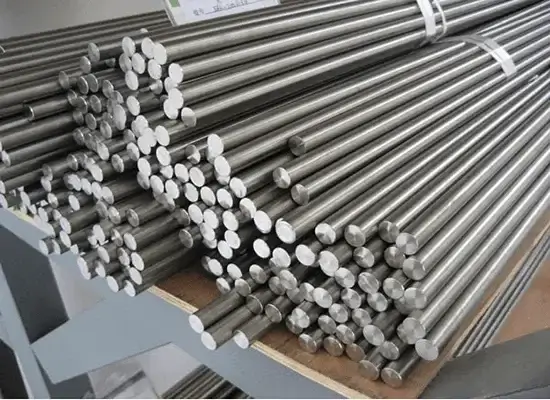
Haynes 242 Round Bar
➡️ Alloy 242 | UNS N10242 | EN 2.4665
➡️ ASTM, EN, JIS & International Standards
➡️ Supply Conditions
➡️ Multiple Diameters & Supply Lengths
➡️ Global Export & International Delivery
Country of Origin:
Europe, Japan, USA
Material Type:
Nickel Alloy
UNS Number:
N10242
Wr. No.:
2.4665
MTC Available:
EN 10204 3.1
Product Description for Haynes 242 Round Bar
Haynes Alloy 242 Round Bar is made from nickel-molybdenum-chromium alloy UNS N10242. Rod is covered by ASTM B573 and ASME SB573, which also cover related Ni-Mo-Cr alloys, and the grade is a registered product of Haynes International.
The alloy was designed in the 1990s for parts that need both high strength and low thermal expansion. Its strength does not come from gamma prime, as in most age-hardenable nickel alloys. Instead, a long ageing treatment makes the nickel, molybdenum and chromium atoms arrange into a fine ordered Ni2(Mo,Cr) phase. This roughly doubles yield strength while keeping good elongation.
Low thermal expansion is a key benefit. In a gas turbine, seal rings and containment rings must keep tight clearances as the engine heats up. An alloy that grows less with temperature helps maintain those clearances and improves efficiency.
Alloy 242 also has good oxidation resistance up to about 815°C, excellent resistance to hydrogen embrittlement and good resistance to fluorine and hydrogen fluoride at high temperature. These properties make it useful in some chemical and energy applications as well as aerospace.
Bar is non-magnetic and is supplied solution annealed, or annealed and aged, turned or ground, with EN 10204 3.1 certification. It is made into seal rings, containment rings, bolts, studs and shafts for turbines and compressors, and into parts for hydrogen and fluorine handling.
Ageing at 650°C for about 48 hours forms an ordered Ni2(Mo,Cr) phase. This roughly doubles yield strength while keeping thermal expansion low, a mix that few alloys offer. The main users are gas turbine and aerospace makers who need tight clearances at moderate heat.
Common Applications of Haynes 242 Round Bar
➡️ Machined shafts, spindles, valve stems, pump sleeves and pins for food, beverage, dairy and pharmaceutical equipment, where the passive chromium oxide film resists both product acids and caustic clean-in-place chemicals.
➡️ Fasteners, studs, bolts, threaded rod and anchor components produced from bar stock, chosen for corrosion resistance combined with the ductility needed for cold heading and thread rolling.
➡️ Chemical, water treatment and general process plant parts such as agitator shafts, flange blanks, nozzles and support components handling water, steam and mildly corrosive media free of significant chlorides.
➡️ Architectural and structural hardware including handrail stanchions, balustrade fittings, tension rods and bollards, where a bright ground or polished bar finish provides both appearance and low maintenance.
International Equivalent Grade for Alloy 242 Round Bar
Standard
Country / Region
Grade
UNS
USA
UNS N10242
EN
Europe
EN 2.4665
ASTM / ASME
USA
ASTM B573 / ASME SB573
GB/T
China
NiMo25Cr8 / NS3405
JIS
Japan
JIS H4553
KS
South Korea
KS D 5575
Technical Specification for Haynes 242 Round Bar
Specification
Value
Unit
Material
Nickel alloy
-
Grade
242 / UNS N10242
-
Standard
ASTM B573 / ASME SB573
-
Product Form
Round bar / rod
-
Diameter (supply range)
6–250
mm
Length (random)
1–6
m
Manufacturing Process
Hot rolled, forged, extruded or cold drawn
-
Surface Finish
Descaled, pickled, peeled, turned, ground or bright
-
Heat Treatment / Delivery Condition
Solution annealed or solution annealed and aged
-
Tolerance Standard
Per ASTM B573 tolerance tables
-
Density
9.05
g/cm³
Melting Range
1290–1375
°C
Thermal Conductivity at 20°C
11.3
W/m·K
Coefficient of Thermal Expansion 20–100°C
10.3
µm/m·K
Specific Heat at 20°C
386
J/kg·K
Electrical Resistivity at 20°C
1.20
µΩ·m
Modulus of Elasticity at 20°C
229
GPa
Magnetic Properties
Non-magnetic
-
Testing / Inspection
Chemical analysis, tensile, hardness, dimensional, UT and PMI on request
-
Certification
EN 10204 3.1 mill test certificate (3.2 on request)
-

Technical Specifications
Get the key technical specifications for Haynes 242 Round Bar
ASTM B573 and ASME SB573 cover UNS N10242 rod in the solution annealed condition. Because the alloy is usually aged after machining, the order should state whether bar is wanted annealed for later ageing or supplied already aged, and what properties must be proven in each case.
Solution annealing is done at about 1065°C followed by rapid cooling. The standard ageing cycle is about 650°C for 48 hours, followed by air cooling. This long cycle is needed because the ordering reaction is slow, and it must be controlled closely to reach consistent strength.
Density is about 9.05 g/cm³. Mean thermal expansion is low compared with most nickel superalloys, which is the main reason the grade is chosen. The physical values in the table are producer data.
Testing to ASTM B573 includes heat chemistry, tension tests on annealed material and dimensions. For aged parts, buyers usually add tensile and hardness tests on aged coupons from the same heat and lot, ultrasonic testing and PMI.
Bar is ordered either solution annealed, for machining and forming, or in the aged condition for final parts. The heat-treat condition must be written on the purchase order and on the certificate.
Chemical Composition for Haynes 242 Round Bar
Element
Symbol
Min
Max
Unit
Molybdenum
Mo
24.0
26.0
%
Chromium
Cr
7.0
9.0
%
Iron
Fe
-
2.0
%
Cobalt
Co
-
1.0
%
Manganese
Mn
-
0.80
%
Silicon
Si
-
0.80
%
Aluminium
Al
-
0.50
%
Carbon
C
-
0.03
%
Boron
B
-
0.006
%
Copper
Cu
-
0.50
%
Phosphorus
P
-
0.030
%
Sulfur
S
-
0.015
%
Nickel
Ni
Balance
-
%

Chemical Composition
View the chemical composition and applicable material limits for Alloy 242 Round Bar
The composition table shows ASTM B573 limits for UNS N10242. Molybdenum at 24.0–26.0% and chromium at 7.0–9.0% are the two elements that form the ordered strengthening phase.
The balance between them matters. Enough molybdenum is needed to form the ordered structure and keep thermal expansion low, while chromium joins the ordered phase and also gives oxidation resistance up to about 815°C. Too little chromium would leave the alloy with poor oxidation resistance, like the Ni-Mo B family.
Iron is limited to 2.0% and cobalt to 1.0%, as they would disturb the ordering reaction. Manganese and silicon are each capped at 0.80%, and aluminium at 0.50%.
Carbon is limited to 0.03% to avoid carbides that would reduce ductility and interfere with ageing. Boron up to 0.006% helps grain-boundary strength. Copper, phosphorus and sulfur are controlled as residuals.
Because ageing response depends on exact chemistry, the certificate should show molybdenum and chromium within range for every heat.
The molybdenum-to-chromium ratio is what lets the long-range ordered phase form during ageing. Carbon is held very low, and small limits on aluminium, silicon and boron keep the ordering reaction clean and predictable.
Mechanical Properties for Haynes 242 Round Bar
Mechanical Property
Value
Unit
Tensile Strength (ASTM B573, annealed)
≥ 725
MPa
Yield Strength 0.2% (ASTM B573, annealed)
≥ 310
MPa
Elongation (ASTM B573, annealed)
≥ 40
%
Yield Strength 0.2% (aged)
850
MPa
Tensile Strength (aged)
1290
MPa

Mechanical Properties
Check the key mechanical properties and performance requirements of Alloy 242 Round Bar
ASTM B573 requires solution annealed N10242 rod to reach at least 725 MPa tensile strength, 310 MPa yield strength and 40% elongation. These are the acceptance values for bar as delivered in the annealed condition.
After the standard 650°C / 48-hour ageing treatment, yield strength rises to about 850 MPa and tensile strength to about 1290 MPa, with elongation still around 30% in producer data. These aged values are guidance only, not ASTM requirements, so any minimums for aged parts must be written on the order.
The alloy keeps much of this strength up to about 705°C, which is its normal upper service limit. Above that temperature, the ordered phase begins to coarsen or dissolve and strength falls.
Machining is easiest in the annealed condition, before ageing. Aged parts are much harder and need carbide tools and slower speeds. Low cycle fatigue and creep data for design should be taken from the producer.
Aged strength relies on the full 48-hour cycle, and shorter cycles give lower results. Above about 705°C the ordered phase dissolves and strength falls, which sets the service ceiling. Hardness after ageing is far higher than in the annealed bar.
Dimension / Sizes for Haynes 242 Round Bar
Dimension / Size
Value
Unit
Available Diameter Range (supply capability)
6–250
mm
Standard Length (random)
1–6
m
Custom / Cut-to-Length
Available on request
-
Diameter Tolerance
Per ASTM B573 tolerance tables
-
Length Tolerance
Per ordered standard or as agreed (commonly +50 / -0 mm for cut lengths)
-
Straightness Tolerance
Per ASTM B573 or as agreed
-
End Condition
Saw cut square, chamfered or as ordered
-
Surface Finish
Hot finished, descaled, pickled, peeled, turned, centreless ground or cold drawn bright
-
Diameter Range Covered by Standard
7.94–88.9 (ASTM B573 rod scope, larger diameters supplied to agreed specification)
mm

Dimensions & Sizes
Explore available diameters, lengths, and dimensional requirements for Alloy 242 Round Bar
Pricing for Haynes 242 Round Bar
Round Bar Prices are generally quoted per kilograms or meters tonnes and can fluctuate with the global raw material and market prices. The final price will depend on a variety of factors, including the grade size, diameter, length, surface finish, the quantity and whether the bars are cut to length or in standard lengths.
For smaller quantities, we can also quote per metre or per piece basis once the required dimensions have been confirmed. Container-loads or orders that are larger in size are typically priced per tonne, based upon the specifications required and the supply conditions.
Please provide your desired dimensions, grades, length number, and end for a current quote including the lead time applicable and details for certification.

Pricing
Get current Haynes 242 Round Bar pricing based on size, quantity, grade, finish, and delivery requirements.
Why Choose Us
Euro Steel Bars is an international distributor, stockist and exporter of stainless round steel bars that cover carbon, stainless alloy, special grades. We stock a variety of sizes and grades. We guarantee every order with mill test certificates as well as full quality-assurance documentation. Our name speaks to our roots: European-sourced materials that is backed by the certificates and rigor that buyers from Asia as well as the Gulf and Africa are looking for.
Each bar we deliver is accompanied by EN 10204 3.1 mill test certificates as well as complete documentation of quality, so what you receive corresponds to what’s written in the documents. We carry a selection of sizes and grades ready for transport, and cut length upon the request of customers, which results in quicker lead times, whether you’re ordering just a one-off spec or a complete project tonnage.
We operate an actual wholesale business that is that is supported with an internationally-operated supply chain therefore we are able to serve fabricators sourcing one grade the same way in the same way as an EPC contractor who is placing a large order. Our clients include manufacturers, fabricators EPC construction companies, engineers oil and gas projects as well as construction companies. we design our inventory as well as documentation to show what buyers need to bring projects forward.
Our customers trust us across Qatar, Oman, Bahrain, Kuwait, Jordan, Malaysia, Singapore, Thailand, Taiwan, Turkey, Italy and South Africa. If you’re looking to source an Gulf energy project, or a construction project within Southeast Asia, you get the same quality of certified material, the exact documentation, and the exact delivery procedure.
Frequently Asked Questions
What is Haynes Alloy 242 Round Bar?
Should I choose Haynes 242 or Inconel 718?
How is Haynes 242 heat treated?
Why does Haynes 242 have low thermal expansion?
What are the limits of Haynes 242?
What standard covers Haynes 242 bar?
Request A Quote
Need a specific grade, size or quantity? Get pricing and availability for your requirement.