
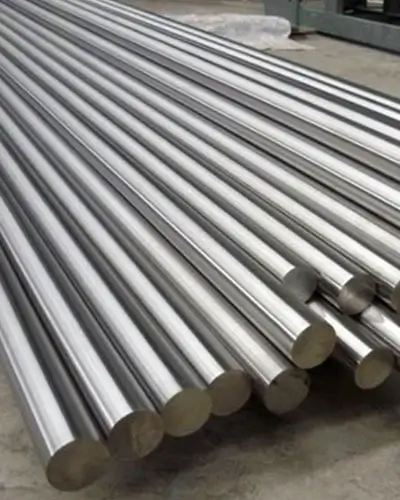
Alloy Steel 4145 Round Bar
➡️ AISI 4145 | UNS G41450 | AISI 4145H
➡️ ASTM, EN, JIS & International Standards
➡️ Supply Conditions
➡️ Multiple Diameters & Supply Lengths
➡️ Global Export & International Delivery
Country of Origin:
Europe, Japan, USA
Material Type:
Alloy Steel
UNS Number:
G41450
Wr. No.:
1.7225 / 1.7228
MTC Available:
EN 10204 3.1
Product Description for Alloy Steel 4145 Round Bar
Alloy Steel 4145 Round Bar is a solid cylindrical bar produced from low-alloy chromium-molybdenum steel grade AISI/SAE 4145 (UNS G41450). Bar is supplied to ASTM A29 / A29M for general requirements and ASTM A322 for hot-wrought alloy steel bars. The grade is best known as the standard material for drill collars and other downhole drilling components, where it is more usually supplied as 4145H modified with additional manganese and molybdenum for improved hardenability.
The composition contains 0.43-0.48% carbon with 0.80-1.10% chromium and 0.15-0.25% molybdenum, placing it directly between 4140 and 4150 in the chromium-molybdenum family. The higher carbon relative to 4140 raises attainable hardness and strength, making it well suited to heavy sections that must retain hardness at depth, but it further reduces weldability and increases quench cracking sensitivity.
After quenching and tempering, tensile strengths of 1000-1200 MPa are typical, and the grade is routinely supplied to the API drill collar hardness requirement of 285-341 HBW with a specified minimum yield strength and impact energy. It also responds well to induction hardening and to nitriding.
Bars are supplied hot-rolled, annealed, normalised, or quenched and tempered, in diameters from about 25 mm to 600 mm and lengths of 3 to 6 m, with heavy forged rounds and hollow bar produced for drilling applications.
Typical applications include drill collars, kellys, stabilisers, subs, mandrels and downhole tools, heavy shafts, gears, axles, forging dies, mill rolls and mining equipment components. Industries served include oil and gas drilling, mining, heavy engineering, tooling and power transmission.
Common Applications of Alloy Steel 4145 Round Bar
➡️ Machined shafts, spindles, valve stems, pump sleeves and pins for food, beverage, dairy and pharmaceutical equipment, where the passive chromium oxide film resists both product acids and caustic clean-in-place chemicals.
➡️ Fasteners, studs, bolts, threaded rod and anchor components produced from bar stock, chosen for corrosion resistance combined with the ductility needed for cold heading and thread rolling.
➡️ Chemical, water treatment and general process plant parts such as agitator shafts, flange blanks, nozzles and support components handling water, steam and mildly corrosive media free of significant chlorides.
➡️ Architectural and structural hardware including handrail stanchions, balustrade fittings, tension rods and bollards, where a bright ground or polished bar finish provides both appearance and low maintenance.
International Equivalent Grade for AS 4145 Round Bar
Standard
Country / Region
Grade
ASTM A29 / A29M
USA
Grade 4145 (UNS G41450)
ASTM A322
USA
Grade 4145 - hot-wrought alloy steel bar
SAE J404
USA
4145
SAE J1268
USA
4145H - hardenability controlled grade
EN 10083-3
Europe / EU
42CrMo4 (1.7225)
EN 10083-3
Europe / EU
50CrMo4 (1.7228)
JIS G4105
Japan
SCM445
KS D 3867
South Korea
SCM445
Technical Specification for Alloy Steel 4145 Round Bar
Specification
Value
Unit
Material
Alloy steel
-
Grade
4145 / 4145H / UNS G41450
-
Product Form
Round bar / rod / forged round / hollow bar
-
Standard
ASTM A29 / A29M and ASTM A322
-
Diameter
25 - 600 (available range)
mm
Length
3 - 6 (standard random or fixed)
m
Manufacturing Process
Hot rolled, forged, or hot rolled and machined
-
Production Route
EAF melting with ladle refining and vacuum degassing, ingot or continuous cast, hot rolling or forging, heat treatment
-
Surface Finish
Hot-rolled black, peeled, rough turned, machined, turned ground and polished
-
Heat Treatment / Delivery Condition
Annealed, normalised, or quenched and tempered as ordered
-
Annealing Temperature
810 - 850 then furnace cool (typical)
deg C
Normalising Temperature
860 - 900 then air cool (typical)
deg C
Hardening Temperature
830 - 860 followed by oil or polymer quench (typical)
deg C
Tempering Temperature
540 - 660 depending on required strength (typical)
deg C
Nitriding Temperature
500 - 530 giving a case hardness of about 600 - 650 HV (typical)
deg C
Tolerance Standard
ASTM A29 / A29M
-
Carbon Equivalent (CEV)
0.80 (typical, IIW formula)
-
Density
7.85 (typical)
g/cm3
Melting Point
1416 - 1495 (approximate)
deg C
Thermal Conductivity
42.6 at 100 deg C (typical)
W/m.K
Coefficient of Thermal Expansion
12.3 at 20 - 100 deg C (typical)
micro-m/m.K
Specific Heat
473 at 50 - 100 deg C (typical)
J/kg.K
Electrical Resistivity
0.220 (typical)
micro-ohm.m
Modulus of Elasticity
205 (typical)
GPa
Magnetic Properties
Ferromagnetic
-
Applicable Testing Standard
ASTM A370, ASTM E8 / E8M, ASTM E23, ASTM E10, ASTM E415, ASTM A388
-
Certification / Inspection Documents
EN 10204 Type 3.1 or 3.2 mill test certificate
-

Technical Specifications
Get the key technical specifications for Alloy Steel 4145 Round Bar
Alloy Steel 4145 Round Bar is ordered to ASTM A29 / A29M and ASTM A322, which define composition, dimensions and quality but do not impose mandatory mechanical minima. In practice, most 4145 for drilling service is bought against a customer or industry specification that states the required hardness range, minimum yield strength and Charpy impact energy for the finished component.
The 4145H designation, covered by SAE J1268, is very common. The H suffix denotes a hardenability-controlled grade, guaranteed to fall within a specified Jominy end-quench band rather than only within a chemistry range. Modified 4145H, with manganese and molybdenum raised above the nominal ranges, is widely used for large diameter drill collars where full through-hardening is required.
Hardening is carried out from 830-860 deg C with an oil or polymer quench, followed by tempering between 540 and 660 deg C. Because the carbon content is higher than 4140, quench cracking risk is greater and quench severity must be controlled carefully, particularly on components with abrupt section changes.
Tempering between about 250 and 400 deg C should be avoided due to tempered martensite embrittlement.
Testing typically includes analysis to ASTM E415, tensile testing to ASTM A370 and E8 / E8M, Charpy testing to ASTM E23, hardness to ASTM E10 and ultrasonic examination to ASTM A388 for heavy forged sections.
Chemical Composition for Alloy Steel 4145 Round Bar
Element
Symbol
Min
Max
Unit
Carbon
C
0.43
0.48
%
Manganese
Mn
0.75
1.00
%
Silicon
Si
0.15
0.35
%
Phosphorus
P
-
0.035
%
Sulfur
S
-
0.040
%
Chromium
Cr
0.80
1.10
%
Molybdenum
Mo
0.15
0.25
%
Iron
Fe
Balance
Balance
%

Chemical Composition
View the chemical composition and applicable material limits for AS 4145 Round Bar
Carbon at 0.43-0.48% is all that separates 4145 from 4140. The additional carbon raises the hardness of the as-quenched martensite, which allows higher tempered strength and better retention of hardness in the interior of very heavy sections. It also raises the carbon equivalent to around 0.80, which further reduces weldability, and increases the risk of quench cracking in components with sharp section changes.
Chromium at 0.80-1.10% is the principal hardenability element. It delays the transformation of austenite to ferrite and pearlite so that martensite forms throughout thick sections with an oil quench, forms stable carbides that resist softening during tempering, and improves wear resistance and nitriding response.
The 0.15-0.25% molybdenum adds further hardenability and secondary hardening during tempering, and it suppresses temper embrittlement by preventing phosphorus from segregating to prior austenite grain boundaries during slow cooling from the tempering temperature.
Manganese at 0.75-1.00% provides additional hardenability, an important consideration in drill collar sizes, and combines with sulphur to form manganese sulphide, preventing hot shortness during forging. In modified 4145H compositions used for large drill collars, both manganese and molybdenum are deliberately raised above these nominal ranges to extend the hardenability band.
Silicon at 0.15-0.35% is the deoxidiser, and phosphorus and sulphur are held to 0.035% and 0.040% and are commonly restricted further where impact requirements apply.
Mechanical Properties for Alloy Steel 4145 Round Bar
Mechanical Property
Value
Unit
Tensile Strength (annealed)
700 (typical)
MPa
Yield Strength (annealed)
450 (typical)
MPa
Hardness (annealed)
197 - 229 (typical)
HBW
Tensile Strength (quenched and tempered)
1000 - 1200 (typical range)
MPa
Yield Strength 0.2% Proof (quenched and tempered)
860 (typical minimum)
MPa
Elongation in 50 mm (quenched and tempered)
13 (typical minimum)
%
Reduction of Area (quenched and tempered)
45 (typical minimum)
%
Hardness (quenched and tempered, drill collar condition)
285 - 341 (specified range)
HBW
Charpy V-Notch Impact Energy at 21 deg C (drill collar condition)
54 average of three specimens (typical minimum)
J
Modulus of Elasticity
205 (typical)
GPa

Mechanical Properties
Check the key mechanical properties and performance requirements of AS 4145 Round Bar
ASTM A29 / A29M and ASTM A322 do not impose mandatory mechanical properties on Alloy Steel 4145 Round Bar, so the values listed are typical for the stated condition. In drilling service the material is normally purchased against a specification that states a hardness range, a minimum yield strength and a Charpy impact requirement, and the industry convention for drill collars is a hardness of 285-341 HBW with a minimum average Charpy V-notch energy of about 54 J at 21 deg C.
The tempering temperature is the controlling variable. Tempering near 540 deg C gives the upper part of the strength range with lower ductility, while tempering near 660 deg C reduces strength and raises elongation, reduction of area and impact energy. Because the required hardness band for drilling components is relatively narrow, tempering temperature must be closely controlled and verified by hardness testing at several positions.
Section size matters. In very large diameters the centre cools more slowly and forms bainite rather than martensite, giving lower core hardness and toughness. That is why large drill collars are usually made from modified 4145H with raised manganese and molybdenum. The wider hardenability band keeps the core inside the required range.
Testing follows ASTM A370, ASTM E8 / E8M, ASTM E23 and ASTM E10, with ultrasonic examination to ASTM A388 on heavy sections.
Dimension / Sizes for Alloy Steel 4145 Round Bar
Dimension / Size
Value
Unit
Diameter (available range)
25 - 600
mm
Standard Length
3 - 6
m
Custom Length
Cut to length on request
-
Diameter Tolerance (hot-rolled)
Per ASTM A29 / A29M
-
Diameter Tolerance (machined or ground)
As agreed at time of order
-
Length Tolerance
Per ASTM A29 / A29M or as agreed
-
Straightness Tolerance
Per ASTM A29 / A29M or as agreed
-
End Condition
Square cut, saw cut, chamfered or as ordered
-
Surface Finish
Hot-rolled black, peeled, rough turned, machined, turned ground and polished
-
Hollow Bar Availability
Available for drill collar and downhole tool manufacture
-
Cut-to-Length Availability
Available
-
Dimensional Standard
ASTM A29 / A29M
-

Dimensions & Sizes
Explore available diameters, lengths, and dimensional requirements for AS 4145 Round Bar
Pricing for Alloy Steel 4145 Round Bar
Round Bar Prices are generally quoted per kilograms or meters tonnes and can fluctuate with the global raw material and market prices. The final price will depend on a variety of factors, including the grade size, diameter, length, surface finish, the quantity and whether the bars are cut to length or in standard lengths.
For smaller quantities, we can also quote per metre or per piece basis once the required dimensions have been confirmed. Container-loads or orders that are larger in size are typically priced per tonne, based upon the specifications required and the supply conditions.
Please provide your desired dimensions, grades, length number, and end for a current quote including the lead time applicable and details for certification.

Pricing
Get current Alloy Steel 4145 Round Bar pricing based on size, quantity, grade, finish, and delivery requirements.
Why Choose Us
Euro Steel Bars is an international distributor, stockist and exporter of stainless round steel bars that cover carbon, stainless alloy, special grades. We stock a variety of sizes and grades. We guarantee every order with mill test certificates as well as full quality-assurance documentation. Our name speaks to our roots: European-sourced materials that is backed by the certificates and rigor that buyers from Asia as well as the Gulf and Africa are looking for.
Each bar we deliver is accompanied by EN 10204 3.1 mill test certificates as well as complete documentation of quality, so what you receive corresponds to what’s written in the documents. We carry a selection of sizes and grades ready for transport, and cut length upon the request of customers, which results in quicker lead times, whether you’re ordering just a one-off spec or a complete project tonnage.
We operate an actual wholesale business that is that is supported with an internationally-operated supply chain therefore we are able to serve fabricators sourcing one grade the same way in the same way as an EPC contractor who is placing a large order. Our clients include manufacturers, fabricators EPC construction companies, engineers oil and gas projects as well as construction companies. we design our inventory as well as documentation to show what buyers need to bring projects forward.
Our customers trust us across Qatar, Oman, Bahrain, Kuwait, Jordan, Malaysia, Singapore, Thailand, Taiwan, Turkey, Italy and South Africa. If you’re looking to source an Gulf energy project, or a construction project within Southeast Asia, you get the same quality of certified material, the exact documentation, and the exact delivery procedure.
Frequently Asked Questions
What is Alloy Steel 4145 Round Bar?
What standard does Alloy Steel 4145 Round Bar comply with?
What is the difference between 4145 and 4145H?
What is the difference between 4145 and 4140?
What are the key mechanical properties of 4145?
What are the equivalent grades of Alloy Steel 4145?
Can Alloy Steel 4145 be welded?
What sizes and forms are available?
Request A Quote
Need a specific grade, size or quantity? Get pricing and availability for your requirement.