
Haynes 214 Round Bar
➡️ Alloy 214 | UNS N07214 | EN 2.4646
➡️ ASTM, EN, JIS & International Standards
➡️ Supply Conditions
➡️ Multiple Diameters & Supply Lengths
➡️ Global Export & International Delivery
Country of Origin:
Europe, Japan, USA
Material Type:
Nickel Alloy
UNS Number:
N07214
Wr. No.:
2.4646
MTC Available:
EN 10204 3.1
Product Description for Haynes 214 Round Bar
Haynes Alloy 214 Round Bar is made from nickel-chromium-aluminium-iron alloy UNS N07214, listed in Europe as 2.4646. There is no ASTM bar specification for this alloy, so bar is supplied to the producer specification or to a purchaser specification agreed with the mill.
Most heat-resistant nickel alloys rely on a chromium oxide scale. Above about 1000°C, chromium oxide starts to evaporate and spall, so oxidation speeds up. Alloy 214 contains enough aluminium to form an aluminium oxide scale instead. Alumina is much denser and more stable, so the alloy loses very little metal even after thousands of hours at high temperature.
Once the alumina layer forms, the alloy also resists carburisation, nitriding and attack by chlorine-bearing gases at high temperature. A small yttrium addition helps the scale stick to the metal during heating and cooling cycles.
The trade-off is strength. Alloy 214 has modest creep strength at its top operating temperatures, so it is used where oxidation, not load, controls life. It can also lose ductility after long exposure at intermediate temperatures, which needs care in design and welding.
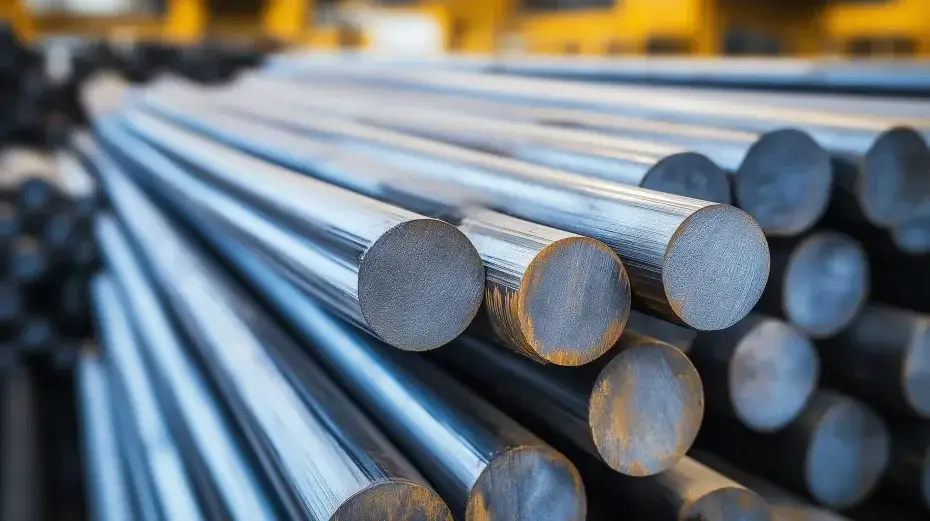
Bar is non-magnetic and supplied solution annealed, turned or ground, cut to length, with EN 10204 3.1 certification. It is made into furnace fixtures, mesh belt pins, honeycomb seals, catalyst support parts, burner parts, thermocouple sheaths and heat-treatment baskets.
The alumina scale also stands up to carburising and chlorine-bearing atmospheres better than most chromia-forming alloys. Common parts include furnace muffles, mesh belts, fixtures and burner hardware. Its strength is modest compared with 230 or X, so it suits lightly loaded parts where scale life is the main goal.
Common Applications of Haynes 214 Round Bar
➡️ Machined shafts, spindles, valve stems, pump sleeves and pins for food, beverage, dairy and pharmaceutical equipment, where the passive chromium oxide film resists both product acids and caustic clean-in-place chemicals.
➡️ Fasteners, studs, bolts, threaded rod and anchor components produced from bar stock, chosen for corrosion resistance combined with the ductility needed for cold heading and thread rolling.
➡️ Chemical, water treatment and general process plant parts such as agitator shafts, flange blanks, nozzles and support components handling water, steam and mildly corrosive media free of significant chlorides.
➡️ Architectural and structural hardware including handrail stanchions, balustrade fittings, tension rods and bollards, where a bright ground or polished bar finish provides both appearance and low maintenance.
International Equivalent Grade for Alloy 214 Round Bar
Standard
Country / Region
Grade
UNS
USA
UNS N07214
ASTM / ASME / AWS
USA
ASTM B572 / AMS 5599 / AWS A5.14 / ASME IX F-43
EN
Europe
EN 2.4646
Technical Specification for Haynes 214 Round Bar
Specification
Value
Unit
Material
Nickel alloy
-
Grade
214 / UNS N07214 / 2.4646
-
Standard
Producer specification (Haynes International)
-
Product Form
Round bar / rod
-
Diameter (supply range)
6–250
mm
Length (random)
1–6
m
Manufacturing Process
Hot rolled, forged, extruded or cold drawn
-
Surface Finish
Descaled, pickled, peeled, turned, ground or bright
-
Heat Treatment / Delivery Condition
Solution annealed
-
Tolerance Standard
Per producer specification or as agreed
-
Density
8.05
g/cm³
Melting Range
1355–1400
°C
Thermal Conductivity at 20°C
12.0
W/m·K
Coefficient of Thermal Expansion 20–100°C
13.3
µm/m·K
Specific Heat at 20°C
452
J/kg·K
Electrical Resistivity at 20°C
1.35
µΩ·m
Modulus of Elasticity at 20°C
218
GPa
Magnetic Properties
Non-magnetic
-
Testing / Inspection
Chemical analysis, tensile, hardness, dimensional, UT and PMI on request
-
Certification
EN 10204 3.1 mill test certificate (3.2 on request)
-

Technical Specifications
Get the key technical specifications for Haynes 214 Round Bar
Haynes 214 bar is supplied to the producer specification of Haynes International because no ASTM or AMS bar document covers UNS N07214. Buyers should request the current specification sheet and agree tolerances, test requirements and certification before ordering.
The delivery condition is solution annealed at about 1065–1095°C, followed by rapid cooling. This keeps the gamma prime phase that aluminium can form in solution, giving the best ductility for machining and forming.
Density is about 8.05 g/cm³, lower than many nickel alloys because of the aluminium content. The physical values in the table are producer data and not specification limits.
Standard testing includes heat chemistry, tension tests and dimensional checks. Buyers may add ultrasonic testing and PMI. Because no public standard exists, the certificate should clearly state the producer specification, heat number, delivery condition and test results.
Hot-finished 214 bar is supplied with a machining allowance, and cold-finished or ground bar can be offered in smaller sizes. Diameter and length tolerances should be agreed in writing because there is no public dimensional table for this grade. Cut lengths, end chamfers and bar marking can be added on request.
Chemical Composition for Haynes 214 Round Bar
Element
Symbol
Min
Max
Unit
Chromium
Cr
15.0
17.0
%
Aluminium
Al
4.0
5.0
%
Iron
Fe
2.0
4.0
%
Yttrium
Y
0.002
0.040
%
Carbon
C
-
0.05
%
Manganese
Mn
-
0.50
%
Silicon
Si
-
0.20
%
Zirconium
Zr
-
0.10
%
Boron
B
-
0.010
%
Nickel
Ni
Balance
-
%

Chemical Composition
View the chemical composition and applicable material limits for Alloy 214 Round Bar
The composition table shows the producer limits for UNS N07214. Aluminium at 4.0–5.0% is the element that makes this alloy special. It is the source of the protective alumina scale that forms on the surface above about 950°C.
Chromium at 15.0–17.0% helps the alumina scale form quickly. At lower temperatures it forms a chromia layer first, and it lowers the aluminium level needed for a continuous alumina film.
Iron at 2.0–4.0% is part of the design and helps hot workability.
Yttrium at 0.002–0.040% is a reactive element. Even in tiny amounts, it improves scale adhesion so the protective layer does not flake off during thermal cycling.
Zirconium up to 0.10% and boron up to 0.010% strengthen grain boundaries. Carbon is limited to 0.05%, manganese to 0.50% and silicon to 0.20%.
Aluminium can also form gamma prime at intermediate temperatures, which is why long holds in that range reduce ductility.
Carbon is capped at 0.05% and manganese at 0.50%. Silicon is held to 0.20% maximum, while zirconium up to 0.10% and boron up to 0.010% help grain-boundary strength. The certificate should list each element against the producer limits.
Mechanical Properties for Haynes 214 Round Bar
Mechanical Property
Value
Unit
Tensile Strength (annealed)
758
MPa
Yield Strength 0.2% (annealed)
438
MPa
Elongation (annealed)
40
%

Mechanical Properties
Check the key mechanical properties and performance requirements of Alloy 214 Round Bar
There is no ASTM minimum for Alloy 214 bar, so the table shows producer reference values for solution annealed material: about 758 MPa tensile strength, 438 MPa yield strength and 40% elongation. Acceptance minimums should come from the producer specification or be agreed on the order.
At room temperature the alloy is strong and ductile. As temperature rises above about 900°C, strength and creep resistance fall faster than in solid-solution alloys such as 230, which is why 214 is used for lightly loaded parts.
Holding the alloy between about 600°C and 900°C can form fine gamma prime particles. These raise strength but lower ductility, and they can lead to cracking in restrained welds or during cold forming after exposure.
Designers should keep stresses low at peak temperature and allow for this ductility loss in parts that cycle through the intermediate range. Actual test results for the heat are reported on the EN 10204 3.1 certificate.
Room-temperature strength of 214 bar is moderate, and much of its value lies in how well it holds its scale during long heating. Its creep and rupture strength are lower than those of 230 or X at the same heat, so load-bearing parts need careful design and producer creep data.
Dimension / Sizes for Haynes 214 Round Bar
Dimension / Size
Value
Unit
Available Diameter Range (supply capability)
6–250
mm
Standard Length (random)
1–6
m
Custom / Cut-to-Length
Available on request
-
Diameter Tolerance
Per producer specification or as agreed
-
Length Tolerance
Per ordered standard or as agreed (commonly +50 / -0 mm for cut lengths)
-
Straightness Tolerance
Per Producer specification (Haynes International) or as agreed
-
End Condition
Saw cut square, chamfered or as ordered
-
Surface Finish
Hot finished, descaled, pickled, peeled, turned, centreless ground or cold drawn bright
-

Dimensions & Sizes
Explore available diameters, lengths, and dimensional requirements for Alloy 214 Round Bar
Pricing for Haynes 214 Round Bar
Round Bar Prices are generally quoted per kilograms or meters tonnes and can fluctuate with the global raw material and market prices. The final price will depend on a variety of factors, including the grade size, diameter, length, surface finish, the quantity and whether the bars are cut to length or in standard lengths.
For smaller quantities, we can also quote per metre or per piece basis once the required dimensions have been confirmed. Container-loads or orders that are larger in size are typically priced per tonne, based upon the specifications required and the supply conditions.
Please provide your desired dimensions, grades, length number, and end for a current quote including the lead time applicable and details for certification.

Pricing
Get current Haynes 214 Round Bar pricing based on size, quantity, grade, finish, and delivery requirements.
Why Choose Us
Euro Steel Bars is an international distributor, stockist and exporter of stainless round steel bars that cover carbon, stainless alloy, special grades. We stock a variety of sizes and grades. We guarantee every order with mill test certificates as well as full quality-assurance documentation. Our name speaks to our roots: European-sourced materials that is backed by the certificates and rigor that buyers from Asia as well as the Gulf and Africa are looking for.
Each bar we deliver is accompanied by EN 10204 3.1 mill test certificates as well as complete documentation of quality, so what you receive corresponds to what’s written in the documents. We carry a selection of sizes and grades ready for transport, and cut length upon the request of customers, which results in quicker lead times, whether you’re ordering just a one-off spec or a complete project tonnage.
We operate an actual wholesale business that is that is supported with an internationally-operated supply chain therefore we are able to serve fabricators sourcing one grade the same way in the same way as an EPC contractor who is placing a large order. Our clients include manufacturers, fabricators EPC construction companies, engineers oil and gas projects as well as construction companies. we design our inventory as well as documentation to show what buyers need to bring projects forward.
Our customers trust us across Qatar, Oman, Bahrain, Kuwait, Jordan, Malaysia, Singapore, Thailand, Taiwan, Turkey, Italy and South Africa. If you’re looking to source an Gulf energy project, or a construction project within Southeast Asia, you get the same quality of certified material, the exact documentation, and the exact delivery procedure.
Frequently Asked Questions
What is Haynes Alloy 214 Round Bar?
Should I choose Haynes 214 or Haynes 230?
Why is Haynes 214 so resistant to oxidation?
How is Haynes 214 welded?
What are the limits of Haynes 214?
Can Haynes 214 bar be cut to length?
Request A Quote
Need a specific grade, size or quantity? Get pricing and availability for your requirement.