
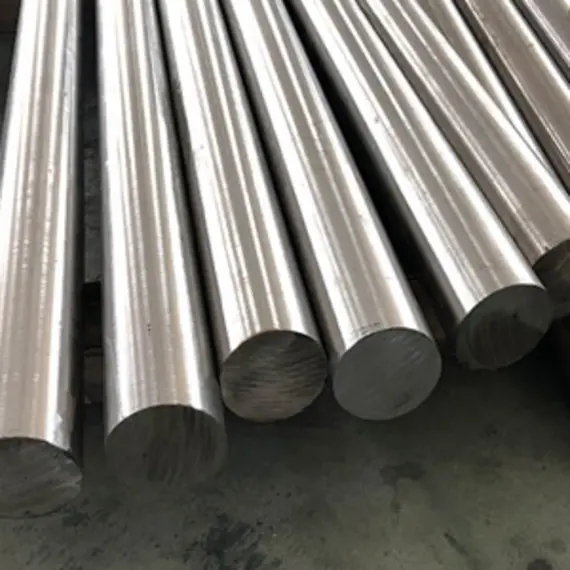
Stainless Steel 321 Round Bar
➡️ SS 321 | UNS S32100 | EN 1.4541
➡️ ASTM, EN, JIS & International Standards
➡️ Supply Conditions
➡️ Multiple Diameters & Supply Lengths
➡️ Global Export & International Delivery
Country of Origin:
Europe, Japan, USA
Material Type:
Stainless Steel
UNS Number:
S32100
Wr. No.:
1.4541
MTC Available:
EN 10204 3.1
Product Description for Stainless Steel 321 Round Bar
Type 321 (UNS S32100) is a titanium-stabilised austenitic stainless steel, normally ordered to ASTM A276 / A276M and ASTM A479 / A479M with dimensions to ASTM A484 / A484M. In Europe it is specified as grade 1.4541 to EN 10088-3.
It is essentially Type 304 with a controlled titanium addition of at least five times the combined carbon and nitrogen content. Titanium takes the carbon first, forming stable titanium carbide and preventing chromium carbide from precipitating at grain boundaries during welding or long exposure between roughly 450 C and 850 C. That gives resistance to intergranular corrosion in the as-welded condition and makes the grade a standard answer for equipment that cycles through the sensitisation range.
Because carbon is not pushed down to low-carbon levels, 321 keeps useful creep and stress-rupture strength, and it is widely used in continuous service to roughly 870 C in oxidising atmospheres.
Delivery is solution annealed at about 1000-1100 C followed by a fast quench, hot-finished or cold-finished by drawing, peeling, turning or grinding, in diameters from 6 mm to 300 mm, random or cut lengths. The structure is fully austenitic, so annealed bar is non-magnetic and cannot be hardened thermally.
Titanium oxidises readily across the welding arc, so stabilised or over-alloyed filler metals are used for welded construction rather than matching wire. A stabilising anneal at roughly 850-900 C is sometimes applied after solution annealing where conditions are demanding, and ASTM A262 Practice E testing is commonly specified.
The usual work is expansion joints, exhaust manifolds, aircraft engine components, refinery and boiler parts, thermal-cycling equipment and welded chemical plant.
Common Applications of Stainless Steel 321 Round Bar
➡️ Machined shafts, spindles, valve stems, pump sleeves and pins for food, beverage, dairy and pharmaceutical equipment, where the passive chromium oxide film resists both product acids and caustic clean-in-place chemicals.
➡️ Fasteners, studs, bolts, threaded rod and anchor components produced from bar stock, chosen for corrosion resistance combined with the ductility needed for cold heading and thread rolling.
➡️ Chemical, water treatment and general process plant parts such as agitator shafts, flange blanks, nozzles and support components handling water, steam and mildly corrosive media free of significant chlorides.
➡️ Architectural and structural hardware including handrail stanchions, balustrade fittings, tension rods and bollards, where a bright ground or polished bar finish provides both appearance and low maintenance.
International Equivalent Grade for SS 321 Round Bar
Standard
Country / Region
Grade
ASTM A276 / A276M
USA
Type 321 (UNS S32100)
ASTM A479 / A479M
USA
UNS S32100
ASME SA-479
USA
UNS S32100
EN 10088-3
Europe / EU
1.4541 (X6CrNiTi18-10)
BS EN 10088-3
United Kingdom
1.4541
BS 970
United Kingdom
321S31
JIS G4303
Japan
SUS 321
GB/T 1220
China
06Cr18Ni11Ti (S32168)
KS D 3706
South Korea
STS 321
ISO 15510
International
X6CrNiTi18-10
Technical Specification for Stainless Steel 321 Round Bar
Specification
Value
Unit
Material
Stainless steel
-
Grade
321 / UNS S32100 / 1.4541
-
Product Form
Round bar / rod
-
Standard
ASTM A276 / A276M, ASTM A479 / A479M, EN 10088-3
-
Diameter
6 - 300 (typical supply range)
mm
Length
3 - 6 (random), or cut to length
m
Manufacturing Process
Hot rolled or forged, solution annealed
-
Production Route
EAF + AOD refining, continuous cast or ingot
-
Surface Finish
Hot-rolled and pickled, cold-drawn, peeled, turned, centreless ground, polished
-
Heat Treatment / Delivery Condition
Solution annealed 1000-1100 C, water quenched, EN condition +AT
-
Tolerance Standard
ASTM A484 / A484M, or EN 10060 / EN 10278 in European practice
-
Density
7.90 (typical)
g/cm3
Melting Range
1400 - 1425 (typical)
C
Thermal Conductivity at 100 C
16.1 (typical)
W/m.K
Coefficient of Thermal Expansion (20-100 C)
16.6 (typical)
um/m.C
Specific Heat (0-100 C)
500 (typical)
J/kg.K
Electrical Resistivity at 20 C
0.72 (typical)
uOhm.m
Modulus of Elasticity at 20 C
193 (typical)
GPa
Magnetic Properties
Non-magnetic in the solution-annealed condition
-
Maximum Service Temperature
870 (typical, continuous, oxidising atmosphere)
C
Testing / Inspection Standard
ASTM A370 for mechanical testing, ASTM A262 Practice E for intergranular corrosion
-
Certification / Inspection Documents
EN 10204 3.1 or 3.2 mill test certificate
-

Technical Specifications
Get the key technical specifications for Stainless Steel 321 Round Bar
Material is ordered to ASTM A276 / A276M or ASTM A479 / A479M under UNS S32100, or to EN 10088-3 as 1.4541 in the +AT solution-annealed condition, with ASME SA-479 for pressure-retaining components. Size tolerance, straightness and finish are governed by ASTM A484 / A484M, or EN 10060 and EN 10278 in European practice.
Titanium content is the requirement that governs everything, set at a minimum of five times the combined carbon and nitrogen with a 0.70% ceiling, so there is always enough titanium to combine with all the carbon present. Confirm it from the heat analysis reported on the certificate.
Solution annealing runs 1000-1100 C followed by a fast quench. Where service is particularly demanding, a stabilising anneal at roughly 850-900 C may follow, tying up carbon as titanium carbide before the component starts work.
Continuous oxidising service to roughly 870 C is normal. There is no hardening treatment for the grade, and more strength has to come from cold working, at the cost of ductility and with a slight magnetic response possible.
One known limitation is knife-line attack, a narrow band of intergranular corrosion that can appear right beside welds in strongly oxidising media. A post-weld stabilising anneal deals with it where the risk exists. ASTM A262 Practice E testing is commonly specified.
Chemical Composition for Stainless Steel 321 Round Bar
Element
Symbol
Min
Max
Unit
Carbon
C
-
0.08
%
Manganese
Mn
-
2.00
%
Silicon
Si
-
0.75
%
Phosphorus
P
-
0.045
%
Sulfur
S
-
0.030
%
Chromium
Cr
17.00
19.00
%
Nickel
Ni
9.00
12.00
%
Titanium
Ti
5 x (C+N)
0.70
%
Nitrogen
N
-
0.10
%
Iron
Fe
Balance
-
%

Chemical Composition
View the chemical composition and applicable material limits for SS 321 Round Bar
Titanium is the addition that matters. Set at a minimum of five times the combined carbon and nitrogen content and capped at 0.70%, it has a far greater appetite for carbon than chromium does. Weld the steel, or hold it between roughly 450 C and 850 C, and titanium forms titanium carbide in preference to chromium carbide. Chromium stays in solid solution at the grain boundaries, where it carries on supporting the passive film, and intergranular corrosion is avoided without dropping carbon to low-carbon levels.
Chromium at 17.00-19.00% forms that passive film and supplies the general corrosion and oxidation resistance, supporting continuous service to roughly 870 C in oxidising atmospheres.
Nickel at 9.00-12.00% holds the austenitic structure across the full temperature range, gives high ductility and toughness, and helps in reducing environments.
Carbon is allowed up to 0.08%, which is exactly why 321 keeps materially better creep and stress-rupture strength than the low-carbon grade 304L. Nitrogen up to 0.10% adds modest solid-solution strengthening.
Manganese and silicon deoxidise and add a little strength. Phosphorus and sulphur are residuals restricted to protect hot workability, weldability and corrosion resistance. Titanium is reactive enough to be partly lost across the welding arc, so stabilised or over-alloyed fillers are used.
Mechanical Properties for Stainless Steel 321 Round Bar
Mechanical Property
Value
Unit
Tensile Strength
515
MPa (minimum)
Yield Strength 0.2% Proof
205
MPa (minimum)
Elongation in 50 mm
40
% (minimum, ASTM A276 Condition A)
Elongation in 50 mm, shapes 12.5 mm section and under
30
% (minimum, ASTM A276 footnote)
Reduction of Area
40
% (minimum, ASTM A276)
Hardness
217
HB (maximum)
Hardness
95
HRB (maximum)
Tensile Strength, EN 10088-3 condition +AT
500 - 700
MPa (specified range)
Modulus of Elasticity
193
GPa (typical)

Mechanical Properties
Check the key mechanical properties and performance requirements of SS 321 Round Bar
Everything here describes solution-annealed bar. The figures are minima, with two exceptions: hardness caps, and the EN tensile figure is a range. ASTM and EN requirements differ and are kept apart accordingly: EN 10088-3 for 1.4541 in the +AT condition calls for 200 MPa minimum 0.2% proof strength with tensile between roughly 500 and 700 MPa, while ASTM A276 requires 515 MPa minimum tensile and 205 MPa minimum proof strength. Testing follows ASTM A370 in the delivered condition.
At room temperature the behaviour closely mirrors Type 304: moderate strength, high ductility, excellent toughness. What 321 offers is stability rather than extra strength. Since carbon is not restricted, creep and stress-rupture strength at temperature run well ahead of 304L, which is why the grade goes into hot service and thermal cycling.
A fully austenitic structure gives no ductile-to-brittle transition, so impact toughness holds down to cryogenic temperatures, though ASTM A276 imposes no mandatory Charpy requirement.
There is no hardening treatment for the grade. Cold drawing raises tensile and proof strength while lowering elongation and may induce slight magnetism. Results vary with bar diameter, finish and any residual cold work.
Dimension / Sizes for Stainless Steel 321 Round Bar
Dimension / Size
Value
Unit
Diameter
6 - 300
mm
Standard Length
3 - 6 (random / mill lengths)
m
Custom Length
Cut to length available on request
-
Diameter Tolerance
Per ASTM A484 / A484M, varies with size and finish class
-
Length Tolerance
Per ASTM A484 / A484M or as agreed at order
-
Straightness Tolerance
Per ASTM A484 / A484M or as agreed at order
-
End Condition
Square cut, chamfered, or as ordered
-
Surface Finish
Hot-rolled and pickled, cold-drawn, peeled, turned, centreless ground, polished
-
Available Size Range
6 - 300, larger diameters by forging on enquiry
mm
Cut-to-Length Availability
Available
-
Dimensional Standard
ASTM A484 / A484M, or EN 10060 / EN 10278
-

Dimensions & Sizes
Explore available diameters, lengths, and dimensional requirements for SS 321 Round Bar
Pricing for Stainless Steel 321 Round Bar
Round Bar Prices are generally quoted per kilograms or meters tonnes and can fluctuate with the global raw material and market prices. The final price will depend on a variety of factors, including the grade size, diameter, length, surface finish, the quantity and whether the bars are cut to length or in standard lengths.
For smaller quantities, we can also quote per metre or per piece basis once the required dimensions have been confirmed. Container-loads or orders that are larger in size are typically priced per tonne, based upon the specifications required and the supply conditions.
Please provide your desired dimensions, grades, length number, and end for a current quote including the lead time applicable and details for certification.

Pricing
Get current Stainless Steel 321 Round Bar pricing based on size, quantity, grade, finish, and delivery requirements.
Why Choose Us
Euro Steel Bars is an international distributor, stockist and exporter of stainless round steel bars that cover carbon, stainless alloy, special grades. We stock a variety of sizes and grades. We guarantee every order with mill test certificates as well as full quality-assurance documentation. Our name speaks to our roots: European-sourced materials that is backed by the certificates and rigor that buyers from Asia as well as the Gulf and Africa are looking for.
Each bar we deliver is accompanied by EN 10204 3.1 mill test certificates as well as complete documentation of quality, so what you receive corresponds to what’s written in the documents. We carry a selection of sizes and grades ready for transport, and cut length upon the request of customers, which results in quicker lead times, whether you’re ordering just a one-off spec or a complete project tonnage.
We operate an actual wholesale business that is that is supported with an internationally-operated supply chain therefore we are able to serve fabricators sourcing one grade the same way in the same way as an EPC contractor who is placing a large order. Our clients include manufacturers, fabricators EPC construction companies, engineers oil and gas projects as well as construction companies. we design our inventory as well as documentation to show what buyers need to bring projects forward.
Our customers trust us across Qatar, Oman, Bahrain, Kuwait, Jordan, Malaysia, Singapore, Thailand, Taiwan, Turkey, Italy and South Africa. If you’re looking to source an Gulf energy project, or a construction project within Southeast Asia, you get the same quality of certified material, the exact documentation, and the exact delivery procedure.
Frequently Asked Questions
What is Stainless Steel 321 Round Bar?
What is the difference between 321 and 304L?
What standard does Stainless Steel 321 Round Bar comply with?
What are the equivalent grades of Stainless Steel 321 Round Bar?
What are the key mechanical properties of Stainless Steel 321 Round Bar?
What is knife-line attack and does it affect 321?
Where is Stainless Steel 321 Round Bar commonly used?
What sizes and lengths are available?
Request A Quote
Need a specific grade, size or quantity? Get pricing and availability for your requirement.