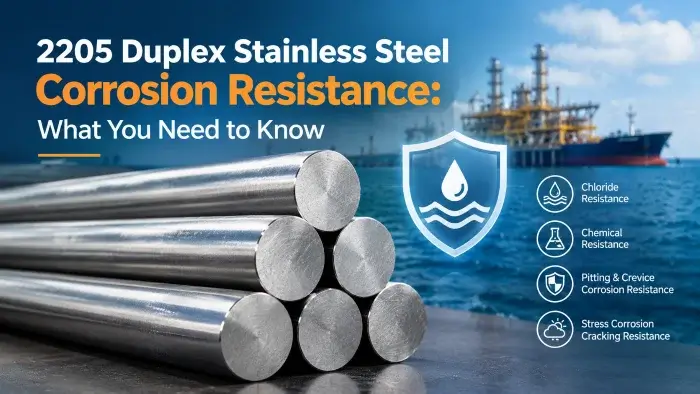
2205 duplex stainless steel (UNS S32205 / S31803) resists corrosion in chloride, acidic, and sour environments where standard austenitic grades like 304 and 316L fail. Its microstructure sits at roughly 50% ferrite and 50% austenite. The alloy carries 22% chromium, 3% molybdenum, and 0.14% to 0.20% nitrogen. That combination gives 2205 a Pitting Resistance Equivalent Number (PREN) between 34 and 38. Engineers specify it for offshore oil and gas, seawater systems, chemical processing, and desalination projects across the Middle East, Southeast Asia, and Europe.
2205 is not corrosion-proof in every condition. It has defined temperature limits, chloride thresholds, and crevice geometries where it will fail. Engineers and procurement teams need to know those limits before writing a specification or placing a purchase order.
Table of Contents
What gives 2205 its corrosion resistance
Three alloying elements do most of the work inside the dual-phase microstructure:
- Chromium (Cr) at 21.0% to 23.0% forms the passive chromium oxide (Cr2O3) film that resists general and pitting attack.
- Molybdenum (Mo) at 2.5% to 3.5% stabilises the passive film in chloride environments and resists crevice and pitting corrosion.
- Nitrogen (N) at 0.14% to 0.20% enhances pitting resistance in the austenite phase and increases strength without reducing toughness.
The ferrite phase provides high mechanical strength and resistance to chloride stress corrosion cracking. The austenite phase contributes ductility and toughness. Together they produce a material that outperforms 316L in most aggressive environments while costing less than super duplex grades.
PREN: the quantitative measure
The Pitting Resistance Equivalent Number is the standard metric engineers use to compare pitting and crevice corrosion resistance across stainless steel grades in chloride environments.
PREN formula: PREN = %Cr + 3.3 x %Mo + 16 x %N
For 2205, the calculated PREN falls between 34 and 38, depending on the exact heat chemistry.
- PREN below 25 (304, 316L) suits mild environments but carries a high pitting risk in warm seawater or process chlorides.
- PREN 30 to 40 (2205 duplex) suits offshore, chemical, and moderate sour service. It is the practical middle ground between cost and performance.
- PREN above 40 (2507 super duplex, 6% Mo austenitics) is reserved for aggressive subsea, hot seawater, and high-pressure sour gas applications.
When you review a mill test certificate from a supplier, verify the PREN calculation against the certified chemistry. A PREN below 34 may indicate a non-conforming heat or a substitution with the older S31803 chemistry rather than the tighter S32205 specification.
Pitting and crevice corrosion resistance
Pitting and crevice corrosion are the most common localised corrosion failures in chloride environments. 2205 resists both better than standard austenitic grades, but it has defined limits.
Critical pitting temperature (CPT)
The CPT is the temperature above which stable pitting initiates under standardised laboratory conditions. For 2205 tested per ASTM G48 Method A in 6% ferric chloride (FeCl3):
- 2205 duplex CPT is typically 30°C to 35°C.
- 316L CPT is typically 10°C to 15°C.
- 2507 super duplex CPT is typically 50°C to 60°C.
2205 handles warm seawater and moderate process chlorides at ambient to mildly elevated temperatures. It will pit if exposed to hot, stagnant, highly concentrated chloride solutions.
Critical crevice corrosion temperature (CCT)
Crevice corrosion initiates at lower temperatures than pitting because the geometry creates a locally aggressive microenvironment. Gasket interfaces, under-deposit zones, and threaded connections are common failure points. For 2205 tested per ASTM G48 Method F, the CCT is typically 20°C to 25°C in 6% FeCl3.
In seawater cooling systems, heat exchangers, and desalination plants, designers must account for crevice geometries. If operating temperatures in crevice zones exceed 25°C in full-strength seawater, super duplex 2507 or a nickel alloy may be the safer choice.
Chloride stress corrosion cracking (SCC) resistance
Chloride stress corrosion cracking is the primary reason engineers specify duplex stainless steels over 304 and 316L. In austenitic grades, the face-centred cubic crystal structure provides easy crack-propagation paths in the presence of chlorides, tensile stress, and temperatures above roughly 60°C.
2205 resists chloride SCC for three reasons. The body-centred cubic ferrite phase interrupts crack propagation. The high yield strength of around 450MPa minimum reduces the effective stress intensity at crack tips. The balanced microstructure prevents the continuous austenite networks that allow SCC in 300-series grades.
SCC resistance limits
2205 is not immune to SCC under extreme conditions. SCC risk increases significantly above 80°C in high-chloride solutions. Caution is required above 10,000ppm Cl- at elevated temperatures. Improper cold working or welding without post-weld heat treatment can reintroduce localised SCC susceptibility through residual stress.
For subsea pipelines, offshore risers, and chemical processing equipment operating below 80°C in seawater or moderate chloride brines, 2205 provides reliable long-term SCC resistance.
Sour service and H2S resistance
Sour environments contain hydrogen sulfide (H2S), which can cause sulfide stress cracking and hydrogen-induced cracking. This makes sour service resistance a hard requirement for oil and gas projects in the Gulf region, Middle East, and North Sea.
2205 duplex stainless steel is qualified under NACE MR0175 / ISO 15156 for sour service, subject to specific hardness and environmental limits. The maximum hardness is 28 HRC or below. It applies in environments with H2S partial pressures relevant to oil and gas production. Fabricators frequently machine it into downhole tubulars, wellhead components, valve trim, and subsea flowlines.
When procuring 2205 duplex stainless steel round bar or forgings for sour service, confirm the material is supplied with NACE MR0175 / ISO 15156 compliance stated on the mill test certificate, along with verified hardness test results.
The limits of 2205: when to upgrade
Specifying 2205 outside its design envelope leads to premature failure.
Temperature limitations
The maximum continuous service temperature is 250°C. Above 300°C, 2205 is susceptible to 475°C embrittlement and the precipitation of sigma and chi intermetallic phases. These degrade both toughness and corrosion resistance. Austenitic grades like 310S or nickel alloys like Inconel 625 and Hastelloy C-276 are more appropriate for high-temperature corrosive service.
When to specify super duplex 2507 instead
Upgrade to 2507 (UNS S32750, PREN above 40) when operating temperatures in seawater exceed 30°C with crevice geometries present. It is also necessary when chloride concentrations exceed 20,000ppm at temperatures above 50°C, when the application involves hot acidic chloride solutions, or when project specifications mandate a PREN above 40.
When to specify nickel alloys instead
Switch to Inconel 625, Hastelloy C-276, or titanium grades when the environment involves hot sulfuric, hydrochloric, or phosphoric acid, or when extreme reducing acid conditions are present where even super duplex cannot maintain passivity.
2205 vs. 316L vs. super duplex 2507
| Parameter | 316L (S31603) | 2205 duplex (S32205) | 2507 super duplex (S32750) |
|---|---|---|---|
| PREN | 24 to 26 | 34 to 38 | Above 40 |
| Min. yield strength | 170MPa | 450MPa | 550MPa |
| CPT (6% FeCl3) | 10°C to 15°C | 30°C to 35°C | 50°C to 60°C |
| Chloride SCC resistance | Poor above 60°C | Good below 80°C | Good below 100°C |
| Sour service (NACE) | Limited | Qualified | Qualified |
| Relative cost | Low | Medium | High |
| Best for | Mild chemical, food, architectural | Offshore, desalination, oil and gas | Deepwater subsea, hot seawater |
| Primary weakness | Pitting, crevice, SCC in chlorides | Crevice corrosion in hot stagnant seawater | Higher cost, tighter welding controls |
2205 delivers roughly double the yield strength of 316L. This allows thinner wall thicknesses and lower installed weight while providing better corrosion resistance at a fraction of the cost of super duplex or nickel alloys.
Where 2205 is used
The corrosion resistance profile of 2205 makes it a common specification across several industrial sectors.
Oil and gas projects in the Gulf, Middle East, and North Sea use it for subsea flowlines, risers, and pressure vessels for sour gas processing. Fabricators machine wellhead components and Christmas tree parts from duplex stainless steel round bars.
Marine and offshore sectors in Southeast Asia and Europe specify it for seawater cooling water piping, firewater pump shafts, and ballast water treatment systems.
Chemical processing and desalination plants use it for reverse osmosis high-pressure piping, evaporator tubes, and brine heaters.
Infrastructure projects use it for bridges, tunnels in coastal atmospheres, and structural reinforcement bars in chloride-exposed concrete.
Procurement and quality assurance
Specifying the correct grade is only half the job. The documentation, certification, and traceability provided by the stockist matter equally for project compliance.
Standards and specifications
When ordering 2205 duplex stainless steel, confirm compliance with ASTM A276 / A479 for bars, ASTM A790 for pipe, ASTM A182 for fittings, and ASME SA-240 / SA-276 for pressure vessels. European and major EPC contractors often require NORSOK M-650 qualification for special materials. Oil and gas projects require NACE MR0175 / ISO 15156 sour service qualification.
Required certifications and testing
Every heat of 2205 supplied to a project should come with an EN 10204 Type 3.1 or Type 3.2 inspection certificate containing full chemical and mechanical data. Buyers should also require Positive Material Identification (PMI) confirming Cr, Mo, Ni, N, and PREN. Charpy V-Notch impact test results are necessary for offshore and low-temperature service. ASTM A923 Method C corrosion testing confirms the absence of detrimental intermetallic phases from improper heat treatment. Hardness testing must show 28 HRC or below for NACE compliance.
Improper heat treatment, incorrect chemistry, or the presence of sigma phase can reduce the PREN of 2205 below specification and compromise its corrosion resistance in service. A reputable stockist maintains full traceability and ensures every bar or pipe meets the specified standard before dispatch.
Sourcing 2205 from Euro Steel Bars
Euro Steel Bars (ESB) is an international supplier, stockist, and exporter of 2205 duplex stainless steel. We serve B2B industrial buyers, EPC contractors, oil and gas operators, and marine engineering firms across the Gulf, Middle East, Southeast Asia, Europe, Turkey, Taiwan, and South Africa.
When you source 2205 from ESB, you get a full range of sizes in UNS S32205 and S31803 round bars, hollow bars, and related products. We provide complete documentation packages including MTC, PMI reports, NACE compliance certificates, and third-party inspection reports. Our logistics team handles FOB, CIF, and DDP shipping to your project site.
Whether you need material for valve trim machining in a Gulf petrochemical project or structural bars for a European marine installation, ESB handles the grade, the certification, and the delivery timeline. Contact our technical sales team to request a quote, check stock availability, or discuss your project specifications.
Frequently asked questions
What is the PREN of 2205 duplex stainless steel?
The PREN of 2205 duplex stainless steel (UNS S32205) typically ranges from 34 to 38. The formula is PREN = %Cr + 3.3 x %Mo + 16 x %N. This places it well above 316L, which sits around 25, and makes it suitable for moderate chloride and sour service environments.
Is 2205 resistant to chloride stress corrosion cracking?
Yes. 2205 resists chloride SCC at temperatures below roughly 80°C because of its balanced ferrite-austenite microstructure. This is one of the main reasons engineers select 2205 over 304 or 316L for offshore and chemical processing applications. Above 80°C in high-chloride solutions, SCC risk increases and material selection should be reviewed.
Can 2205 be used in seawater applications?
2205 works in seawater at ambient temperatures, particularly in flowing conditions. In crevice geometries like flanges and gasketed joints at seawater temperatures above 25°C, crevice corrosion can initiate. For hot or stagnant seawater in crevice-prone designs, super duplex 2507 is the safer option.
What is the maximum operating temperature for 2205?
The maximum recommended continuous service temperature is 250°C. Above that, the material is at risk of 475°C embrittlement and sigma-phase precipitation, which degrade mechanical properties and corrosion resistance.
What certifications should I require when purchasing 2205 round bars?
Require an EN 10204 Type 3.1 mill test certificate with full chemistry, including nitrogen content for PREN verification, mechanical properties, and heat number traceability. For oil and gas projects, also require NACE MR0175 / ISO 15156 compliance, hardness data of 28 HRC or below, and ASTM A923 Method C corrosion test results.
What is the difference between UNS S31803 and UNS S32205?
Both refer to 2205 duplex stainless steel. S31803 is the earlier, broader composition range. S32205 is the refined, tighter chemistry with higher minimum nitrogen (0.14% to 0.20%) and molybdenum (3.0% to 3.5%) to guarantee a PREN of 34 or above. Most mills and stockists supply the tighter S32205 specification. Always confirm the UNS number on the MTC.