Does copper nickel corrode in saltwater?
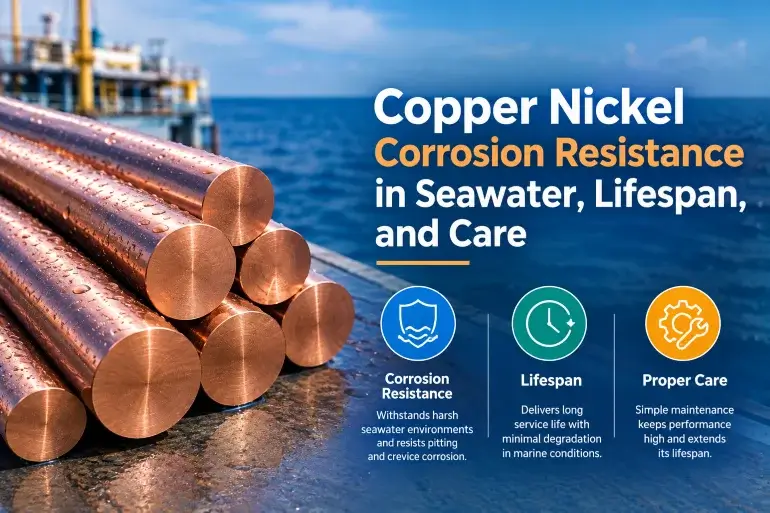
Copper nickel does not suffer from rapid general corrosion in clean, flowing seawater. Marine and offshore engineers specify it for desalination and cooling systems because it holds up well in these environments.
But the resistance is not absolute. Copper nickel relies on a self-repairing surface film. If flow velocities or water chemistry fall outside specific design parameters, the film breaks down and localized corrosion starts.
Procurement managers and fabricators sourcing material for pump shafts, valve stems, and fasteners need to understand how this alloy behaves to ensure a 25 to 40 year service life.
Table of Contents
How copper nickel resists seawater
Copper nickel alloys resist seawater corrosion by forming a thin surface oxide film.
When exposed to clean, oxygenated seawater, the alloy reacts to form an inner layer of cuprous oxide. Over the first few weeks, this film matures. It incorporates nickel, iron, and manganese ions from the seawater and the alloy matrix. This creates a multi-layer barrier.
The mature film drops the general corrosion rate to negligible levels. The surface layer also provides resistance to macro-biofouling. A slow release of trace copper ions at the surface stops barnacles and mussels from attaching. This reduces maintenance in seawater cooling systems.
Choosing between 90/10 and 70/30 grades
When evaluating materials for marine systems and sourcing copper nickel round bars, buyers usually look at two standard grades. These are typically supplied to ASTM B151, ASME SB151, EN 12163, or EN 12164. Both grades contain 1 to 2 percent iron and manganese. Iron is critical because it enhances the protective film and prevents erosion-corrosion.
90/10 copper nickel (UNS C70600 / CW352H)
This grade contains roughly 90 percent copper and 10 percent nickel. It works well for general seawater piping, heat exchangers, condensers, and standard marine hardware. It is cost-effective and handles biofouling well. For general marine applications with moderate flow velocities, specifying a copper nickel 90/10 round bar is standard practice.
70/30 copper nickel (UNS C71500 / CW354H)
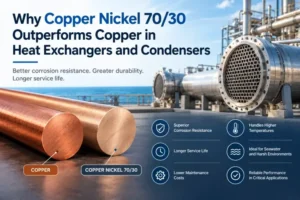
This grade contains roughly 70 percent copper and 30 percent nickel. Engineers use it for severe offshore environments, high-temperature heat exchangers, and areas with higher fluid velocities. The extra nickel and iron provide better mechanical strength and resist impingement attack. For high-stress offshore components, a copper nickel 70/30 round bar is the right choice.
Conditions that cause copper nickel to corrode
Copper nickel can fail if engineers ignore specific environmental threats.
Impingement attack
High-velocity seawater, turbulence, or entrained air bubbles can physically strip the protective oxide film away. If the flow rate is too high, the film cannot repair itself fast enough. This leads to localized horseshoe-shaped pits. For continuous service in clean seawater, maximum design flow velocities are generally 3.0 meters per second for 90/10 and 3.5 to 4.0 meters per second for 70/30.
Sulfide pollution
Copper nickel is vulnerable to sulfides found in stagnant harbor waters, estuaries, or polluted industrial coastal zones. If the alloy is exposed to sulfide-polluted deaerated water first, it forms a non-protective cuprous sulfide film. When this film later meets oxygenated water, it breaks down and causes severe pitting.
Stagnation during commissioning
Leaving raw seawater stagnant inside newly installed systems for extended periods prevents the protective film from maturing and leads to pitting. Commissioning protocols should require treated fresh water for hydrostatic testing, followed by complete draining and drying.
Galvanic coupling
Copper nickel is relatively noble in the galvanic series. If you couple it with more noble materials like graphite, titanium, or passivated super duplex stainless steels, the copper nickel becomes the anode and corrodes faster. You must use insulating flanges when transitioning to higher alloys.
Expected lifespan and corrosion rates
In clean, flowing, oxygenated seawater, the general corrosion rate of mature copper nickel is usually between 0.0025 mm and 0.025 mm per year.
A solid copper nickel round bar machined into a marine shaft will lose less than 0.5 mm of material over a 25 year lifespan. The corrosion rate decreases over time as the protective film matures and thickens. Marine and offshore infrastructure routinely achieves a 25 to 40 year design life with this material.
Care, storage, and fabrication
Fabricators buying copper nickel round bars need to preserve the corrosion resistance in the machine shop.
Store the bars away from carbon steel grinding, cutting, or welding areas. Iron dust settling on the surface can embed and rust, starting localized pitting once the part reaches seawater. Sourcing from a specialized stockist helps. When you procure copper nickel round bars from a dedicated supplier, the material stays in segregated racking to prevent cross-contamination.
Copper nickel tends to work-harden and can be gummy. Use sharp high-speed steel or carbide tooling with clean cutting fluids. Avoid excessive heat generation during machining.
Never use marking paints, lubricants, or testing equipment containing mercury or ammonia compounds. These cause liquid metal embrittlement or stress corrosion cracking in copper alloys.
Sourcing and procurement considerations
Verifying chemical composition via the EN 10204 3.1 mill test certificate is just as important as verifying dimensions. Procurement teams need to check three things:
- Iron content must be in the specified range, usually 1.0 to 2.0 percent. Iron anchors the protective film.
- Nickel and cobalt must meet the minimum threshold to ensure the correct electrochemical potential.
- Strict limits on carbon, lead, sulfur, and phosphorus are necessary to maintain hot-working properties and prevent intergranular attack.
Whether you specify a high-strength copper nickel 70/30 round bar for offshore pumps or standard 90/10 for shipboard piping, full mill test certificate traceability is required for project compliance.
Why source from Euro Steel Bars
Marine and offshore projects run on tight schedules and require strict material integrity. Euro Steel Bars combines a physical wholesale operation with an international supply chain to support engineering, procurement, and construction contractors.
We provide certified material traceability. Every copper nickel 90/10 round bar and 70/30 bar we supply includes an EN 10204 3.1 mill test certificate. We verify chemical and mechanical properties before dispatch to ensure the materials meet ASTM, ASME, or EN standards.
We prepare material for fabrication. Transporting full-length random bars adds freight costs and requires extra cutting on your shop floor. We provide cut-to-length and cut-to-size services to deliver the exact dimensions your machines need, reducing material waste and machining time.
We use export-ready packaging. Copper nickel is susceptible to iron contamination. We pack round bars in heavy-duty segregated wooden crates or steel-palletized bundles with proper dunnage. This prevents physical damage and cross-contamination during ocean freight to shipyards in the Middle East, Southeast Asia, and Europe.
We maintain strategic stock levels of marine alloys. If your project requires non-standard diameters or specific lengths, our mill network allows us to source and deliver project-specific requirements without delaying your schedule.
Frequently asked questions
Does copper nickel 70/30 rust or corrode over time?
Copper alloys do not rust. Rust refers specifically to iron oxide. Copper nickel 70/30 does not suffer from general corrosion in clean seawater because of its stable passivation layer. It can suffer from localized pitting or crevice corrosion over time if exposed to sulfides, highly polluted water, or flow velocities that exceed its impingement attack limits.
What prevents copper nickel from corroding?
A thin, adherent, self-healing surface film primarily composed of cuprous oxide prevents corrosion. This film incorporates nickel and iron ions from the alloy and the surrounding seawater. The resulting multi-layer barrier slows down the electrochemical corrosion process.
Is copper nickel 90/10 better for saltwater than freshwater?
Yes. Copper nickel 90/10 is alloyed specifically for saltwater environments. It needs the chloride ions and dissolved minerals in seawater to form its protective marine oxide film. In freshwater, this film does not form as effectively.
What is the lifespan of copper nickel pipes?
While we supply round bars for machined components, the metallurgical lifespan of copper nickel pipes is identical. In clean, flowing seawater, copper nickel pipes typically last 25 to 40 years or more. The general corrosion rate drops below 0.0025 mm per year once the initial protective surface film matures.
How do I prevent corrosion in copper nickel 90/10 pipes?
Maintain design flow velocities below 3.0 meters per second to prevent impingement attack. Avoid exposing the bare metal to sulfide-polluted harbor waters during the initial weeks of commissioning while the oxide film forms. Use chlorinated fresh water for initial hydrostatic testing, and drain the system completely if it will sit stagnant for long periods.
Will copper nickel 70/30 turn green like regular copper?
Copper nickel alloys have a lower copper release rate than pure copper. They form a stable dark-grey to black mature oxide film in seawater. They rarely develop the bright green patina seen on pure copper roofs or statues in marine environments.
How do you prevent green patina on copper nickel?
In submerged marine applications, the alloy naturally resists green patina. If you use copper nickel for architectural purposes in atmospheric conditions, you can prevent surface oxidation by washing it regularly with fresh water or applying a clear UV-stable lacquer to seal the surface from oxygen and moisture.
How do I clean and maintain copper nickel 70/30?
Industrial and marine components require minimal maintenance. If you need to clean them for inspection, use mild non-abrasive detergents, fresh water, and soft cloths. Avoid harsh acids, wire brushing, or chloride-based cleaners. These can strip the protective oxide layer and force the alloy to re-passivate.
How to polish copper nickel to look like new?
You can restore a bright finish to a machined copper nickel component using standard non-embedded copper or brass metal polishes and a soft buffing wheel. Polishing mechanically removes the protective oxide film. The metal will look bright but will naturally darken and re-passivate once returned to service.
Can copper nickel corrode in polluted or stagnant seawater?
Yes. In stagnant or sulfide-polluted harbor waters, copper nickel can form a non-protective cuprous sulfide film instead of its usual cuprous oxide film. When this sulfide film is later exposed to aerated oxygen-rich seawater, it breaks down rapidly. This leads to severe pitting and accelerated localized corrosion. Proper commissioning and continuous flow mitigate this risk.