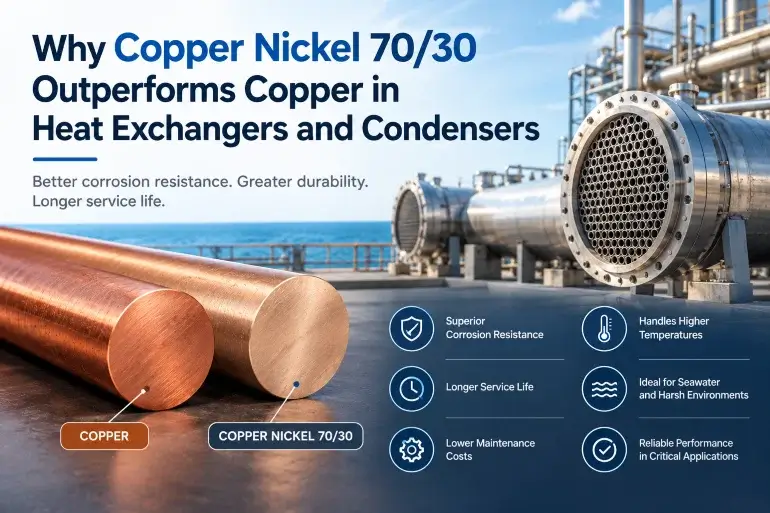
Pure copper has excellent thermal conductivity, but it fails quickly in aggressive cooling environments like seawater, brackish water, and industrial process streams. It lacks the mechanical strength and localized corrosion resistance needed to survive high-velocity flows and marine biology.
Copper Nickel 70/30 (UNS C71500) solves this problem. It combines the thermal properties of copper with the durability of heavy-duty alloys. Process engineers and procurement teams specifying cooling systems need to understand this difference to reduce maintenance downtime and ensure structural integrity. This applies to the heat exchanger tubes themselves and the structural components machined from Copper Nickel Round Bars.
Table of Contents
How Pure Copper Fails in Heat Exchangers
Pure copper relies on a fragile cuprous oxide film for corrosion resistance. In high-velocity water, or water with suspended sand and silt, this film strips away faster than it can reform. The result is impingement attack, forming deep pits that penetrate tube walls.
Biofouling is another major issue. Mussels, barnacles, and slime attach easily to copper in seawater. This growth insulates the tubes, drops the heat transfer coefficient, and restricts fluid flow.
Power plant condensers also face ammonia stress corrosion cracking. Steam often contains trace ammonia or amines for pH control. Pure copper and standard brasses crack suddenly when exposed to these chemicals.
Finally, copper is soft. Tubes require thicker walls to handle operating pressures, which reduces thermal efficiency and adds weight.
The Metallurgical Advantages of CuNi 70/30 (UNS C71500)
CuNi 70/30 contains about 30 percent nickel, plus deliberate additions of iron (0.4 to 1.0 percent) and manganese. These elements change how the metal behaves in demanding environments.
Erosion-Corrosion Resistance
Nickel and iron modify the protective oxide layer on the surface. CuNi 70/30 forms a thin, highly adherent oxide film that resists shear stress from fluid flow. Pure copper systems must stay below 1.5 to 2.0 meters per second to prevent impingement attack. CuNi 70/30 handles flow rates over 3.0 meters per second, and up to 4.5 meters per second in straight runs.
Biofouling Resistance
The alloy releases copper ions at a controlled, microscopic rate. This prevents marine larvae and algae from settling without harming the broader environment. The condenser stays clean, preserving thermal efficiency and reducing the need for chlorination.
Ammonia SCC Immunity
The high nickel content stops stress corrosion cracking from ammonia and amines. This makes CuNi 70/30 the standard choice for surface condensers and lube oil coolers in power generation and marine engines.
Mechanical Strength
CuNi 70/30 has much higher tensile and yield strength than pure copper. Engineers can specify thinner tube walls while keeping the same burst-pressure ratings. This strength also makes it ideal for structural components and machined parts that require precision-ground Copper Nickel 70/30 Round Bar.
The Thermal Conductivity Trade-Off
Pure copper has a thermal conductivity of roughly 390 W/m·K. CuNi 70/30 operates at around 29 W/m·K. On paper, copper looks much better.
In practice, overall heat transfer depends on the whole system. The higher strength of CuNi 70/30 allows for thinner tube walls, which reduces the thermal resistance of the metal.
Fouling is the most critical variable. Pure copper tubes foul rapidly in untreated seawater. The biological growth acts as an insulator and destroys the theoretical advantage of copper’s high base conductivity. CuNi 70/30 stays clean.
Cupronickel also compares well to other corrosion-resistant metals. Its thermal conductivity is nearly double that of standard austenitic stainless steel (about 15 W/m·K) and significantly higher than titanium (about 17 W/m·K).
Technical Specifications and Procurement Data
Procurement managers must verify the correct grade and standard. Slight deviations in nickel, iron, or manganese can compromise the protective oxide film.
Key Standards and Designations
- UNS: C71500
- ASTM B111 (Tubes and Condensers)
- ASTM B122 (Plates, Sheets, and Strip)
- ASTM B151 (Rod and Bar)
- EN 12451 (Tubes), EN 12449 (Seamless round tubes), EN 12164 (Rod and bar)
Chemical Composition Limits (ASTM B111/B151)
- Copper (Cu): Remainder (typically 68 to 70 percent)
- Nickel + Cobalt (Ni+Co): 29.0 to 33.0 percent
- Iron (Fe): 0.40 to 1.00 percent (Modifies the oxide film for erosion resistance)
- Manganese (Mn): 1.00 percent maximum
- Zinc (Zn): 1.00 percent maximum
Fabrication and Sourcing Considerations
CuNi 70/30 is highly weldable using GTAW (TIG) or GMAW (MIG) with matching filler metals like AWS A5.14 ERCuNi. The alloy is sensitive to contamination from low-melting-point metals and carbon. Work areas must stay separate from carbon steel fabrication to prevent embedded iron particles, which cause localized galvanic pitting.
Traceability is required when procuring CuNi 70/30 for tubes, plates, or raw stock for machining flanges and pump shafts. All material needs EN 10204 Type 3.1 Mill Test Certificates to verify chemical analysis and mechanical properties.
CuNi 70/30 handles high-velocity and polluted water. Standard seawater intake systems and lower-pressure cooling loops often use Copper Nickel 90/10 Round Bar (UNS C70600) as a cost-effective alternative.
Why Procurement Teams Source from Euro Steel Bars (ESB)
Sourcing non-ferrous alloys for critical infrastructure requires a supplier who understands international industrial projects. Euro Steel Bars supports EPC contractors, marine fabricators, and plant operators by combining physical stock with a disciplined supply chain.
We provide EN 10204 Type 3.1 Mill Test Certificates with every batch of CuNi 70/30 and 90/10, verifying chemical composition and heat numbers. To reduce material waste in your machine shop, we offer custom cut-to-length services for round bars.
Copper nickel is sensitive to galvanic contamination and moisture during transit. Our export packaging prevents saltwater exposure and physical damage during shipping to industrial hubs across the Middle East, Asia, and Europe. Whether you need standard stock sizes or project-specific procurement with supplementary Ultrasonic Testing, our technical sales team understands your application requirements.
Frequently Asked Questions
What is better for cooling systems: copper or cupronickel?
Cupronickel is much better for cooling systems using seawater, brackish water, or contaminated industrial water. Pure copper has higher base thermal conductivity, but it fails quickly from erosion-corrosion, impingement attack, and biofouling. Cupronickel provides the durability and long-term thermal efficiency that pure copper lacks.
Which copper nickel grade is best for condenser and heat exchanger use?
CuNi 70/30 (UNS C71500) is the best grade for high-velocity, polluted, or abrasive seawater, and for systems needing high mechanical strength. CuNi 90/10 (UNS C70600) is highly effective and more cost-efficient for standard, clean seawater applications with moderate flow velocities.
How does copper nickel thermal conductivity compare with stainless steel and titanium?
Copper nickel (about 29 W/m·K) has lower thermal conductivity than pure copper (about 390 W/m·K). However, it is nearly double that of standard austenitic stainless steel (about 15 W/m·K) and significantly higher than titanium (about 17 W/m·K).
Does copper nickel resist biofouling in cooling water systems?
Yes. Copper nickel alloys resist biofouling naturally. The alloy releases copper ions at a controlled rate that stops marine organisms like mussels and barnacles from settling, without harming the broader environment. This keeps the internal surface clean and preserves the heat transfer coefficient.
What is the recommended water velocity for copper nickel in condensers?
The maximum recommended design seawater velocity for CuNi 90/10 is typically 2.0 to 2.5 meters per second. For CuNi 70/30, the recommended velocity is 2.5 to 3.0 meters per second. It can handle up to 4.5 meters per second in straight, unobstructed pipe runs without erosion-corrosion.
Is copper nickel used for tube sheets and water boxes?
Yes. Copper nickel is heavily used for tube sheets, water boxes, and end covers in shell-and-tube heat exchangers. Using cupronickel for these components ensures galvanic compatibility with the tubes and provides excellent resistance to seawater impingement attack at the tube inlets.
Is copper nickel suitable for desalination plant heat exchangers?
Yes. CuNi 70/30 and 90/10 are standard materials for desalination plants. They are used extensively in Multi-Stage Flash (MSF) and Multiple Effect Distillation (MED) plants for heat recovery sections, brine heaters, and reject coolers because they resist hot, highly saline brine.
What is the maximum operating temperature for copper nickel in heat exchangers?
The maximum continuous operating temperature for copper nickel alloys in standard seawater and corrosive cooling services is typically around 200°C (392°F). It can withstand higher temperatures in non-corrosive environments, but design limits must match the specific ASME or EN code allowances for the operating pressure.
Is copper nickel better than aluminium brass for condensers?
Generally, yes. Aluminium brass (UNS C68700) resists clean seawater well, but copper nickel (especially 70/30) performs better in polluted seawater, high-velocity conditions, and environments with ammonia or sulfides. Cupronickel also resists stress corrosion cracking and biofouling better than aluminium brass.
Why do ships and power plants use copper nickel in cooling systems?
Ships and power plants use copper nickel for critical cooling loops because it guarantees long-term reliability and reduces operational costs. Its resistance to biofouling, high-velocity erosion-corrosion, and ammonia stress corrosion cracking prevents unplanned shutdowns and extends the lifecycle of condensers and lube oil coolers.