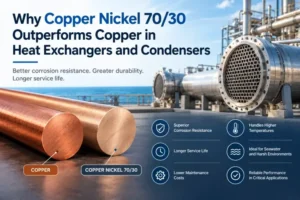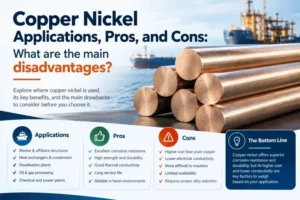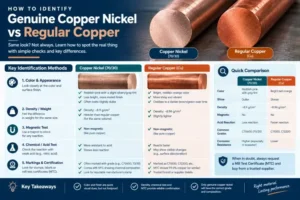
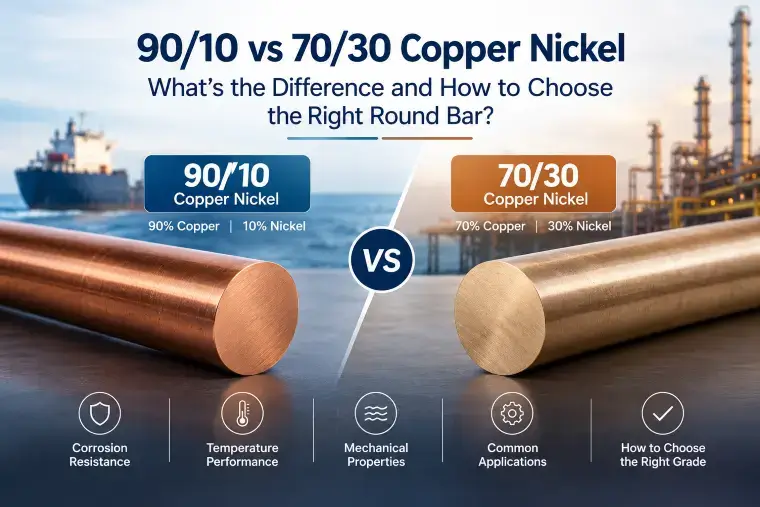
Anyone specifying copper-nickel round bar eventually lands on the same fork in the road: 90/10 (UNS C70600) or 70/30 (UNS C71500). Both are copper-nickel alloys, also known as cupronickel or CuNi, and both resist seawater corrosion far better than most metals. Both show up constantly in marine and offshore bills of material. The confusion is rarely about what they are. It’s about which one actually fits a given job, and whether paying more for 70/30 buys anything the application needs.
In short: 70/30 has roughly three times the nickel of 90/10, which gives it higher strength, better tolerance for high-velocity or turbulent flow, and a more reliably non-magnetic structure. 90/10 costs less, is easier to source in volume, and conducts heat almost twice as well. For static or moderate-flow seawater exposure, either alloy performs well enough that cost and availability usually decide the outcome.
This guide covers the real differences: composition, mechanical and physical properties, corrosion and erosion behavior, cost, and the practical factors that should drive the choice.
What 90/10 and 70/30 copper nickel actually are
Copper and nickel are completely miscible: they dissolve into each other in any proportion, so these alloys form a single-phase face-centered cubic structure rather than the multi-phase microstructures you get in most alloy systems. That single-phase structure is why both grades are ductile, weldable, and easy to form even though they can’t be strengthened by heat treatment (no age-hardening response; the only way to raise strength is cold work).
Both alloys carry small, deliberate additions of iron and manganese. The iron is not incidental. It promotes formation of a more stable, iron-enriched protective film on the metal surface, which is a big part of why these alloys hold up under moving seawater rather than just static immersion.
| * | 90/10 Cu-Ni | 70/30 Cu-Ni |
|---|---|---|
| UNS number | C70600 | C71500 |
| EN designation | CW352H (CuNi10Fe1Mn) | CW354H |
| British Standard | CN102 | CN107 |
| Governing bar/rod spec | ASTM B151/B151M | ASTM B151/B151M |
Chemical composition of C70600 vs C71500
Per ASTM B151/B151M, the specification that covers copper-nickel rod and bar (as opposed to B466/B467, which cover pipe and tube), the composition limits are:
| Element | C70600 (90/10) | C71500 (70/30) |
|---|---|---|
| Copper | Remainder | Remainder |
| Nickel | 9.0–11.0% | 29.0–33.0% |
| Iron | 1.0–1.8% | 0.40–1.0% |
| Manganese | 1.0% max | 1.0% max |
| Lead | 0.05% max | 0.05% max |
| Zinc | 1.0% max | 1.0% max |
| Sulfur | 0.02% max | 0.02% max |
| Phosphorus | 0.02% max | 0.02% max |
Notice that iron runs the opposite direction from nickel: 90/10 actually carries more iron than 70/30 (up to 1.8% vs. a 1.0% cap). This isn’t an accident. The higher iron addition in 90/10 partly compensates for its lower nickel content by reinforcing the protective film, which is part of why 90/10 still performs respectably against erosion despite having a third of the nickel.
Mechanical properties of 90/10 and 70/30 round bar (annealed)
| Property | 90/10 (C70600) | 70/30 (C71500) |
|---|---|---|
| 0.2% proof (yield) strength | ~100 N/mm² (typical range 100–350 depending on temper) | ~120 N/mm² (typical range 130–450 depending on temper) |
| Tensile strength | ~300 N/mm² (range 290–420) | ~350 N/mm² (range 350–520) |
| Elongation | ~30% | ~35% |
| Hardness | ~90 HV | ~100 HV |
Neither alloy responds to heat treatment. If a job needs higher strength than the annealed figures above, the only route is cold work, which raises strength at the cost of ductility in both grades roughly proportionally. 70/30 starts from a higher baseline in both strength and hardness, which matters for components under mechanical load, not just corrosive exposure, such as valve stems, pump shafts, and high-pressure fittings.
Physical properties: density, melting range, and thermal conductivity
| Property | 90/10 | 70/30 |
|---|---|---|
| Density | 8.90 g/cm³ | 8.95 g/cm³ |
| Melting range | 1100–1145°C | 1170–1240°C |
| Thermal conductivity | ~50 W/m·K | ~29 W/m·K |
| Electrical resistivity | ~19 µΩ·cm | ~34 µΩ·cm |
| Modulus of elasticity | ~135 GPa | ~152 GPa |
| Magnetic behavior | Effectively non-magnetic in normal mill condition | Non-magnetic |
Two points worth flagging because they change design decisions:
- Thermal conductivity runs the opposite direction from strength. 90/10 conducts heat almost twice as well as 70/30. For heat exchanger and condenser applications, that’s a genuine argument for 90/10 even before corrosion or cost enters the picture, since it can mean a smaller heat transfer surface for the same duty.
- Magnetic signature. Both alloys are non-magnetic in practical terms, but 70/30 is the more reliably and consistently non-magnetic of the two. This is why 70/30 has historically been the default for minesweeper hulls and other low-magnetic-signature naval work. 90/10 can be processed (fast-cooled after a final solution treatment) to achieve a similarly low signature, but that’s an added processing step, not the as-supplied condition.
Corrosion and erosion resistance in seawater
Both alloys form a protective surface film through interaction with seawater, resist biofouling (marine growth) better than most metals used in seawater service, and post general corrosion rates in the same very low range, roughly 0.025 to 0.0025 mm/year in most seawater service. For static or low-flow exposure, the practical corrosion performance of 90/10 and 70/30 is close enough that corrosion resistance alone rarely settles the decision. Where they genuinely separate is under flow and turbulence.
The protective film is mechanically weaker than the metal underneath it, so at high enough flow velocity or in turbulent zones (weld beads, sharp bends, downstream of valves) the film gets stripped faster than it can rebuild, and erosion-corrosion sets in. 70/30 tolerates higher velocities before this happens.
Published maximum design velocities vary noticeably by source, geometry, and which standard is being applied (BS MA 18, DIN 85004-2, and UK Def Stan 02-781 don’t all use identical figures), so treat the numbers below as design guidance to be checked against the governing spec, not universal limits:
| Service | 90/10 max velocity | 70/30 max velocity |
|---|---|---|
| Open piping, long-radius bends | ~3.5 m/s | ~4.0 m/s |
| Once-through condensers/heat exchangers | ~2.4 m/s | ~3.0 m/s |
| Two-pass condensers/heat exchangers | ~2.0 m/s | ~2.6 m/s |
Note the pattern: heat exchanger and condenser tube limits are consistently lower than open piping limits for both alloys, because tube-side turbulence and entrance effects are more severe than straight pipe runs. Short-duration excursions to 10–15 m/s are generally tolerated (documented in firefighting-system service, for instance) without meaningful damage, which is different from a sustained design velocity.
Sand-loaded seawater should be treated more conservatively than clean seawater for both alloys; reduce design velocity by roughly 1–1.5 m/s where entrained sand is expected, or consider the higher-iron 66-30-2-2 alloy (C71640) for genuinely heavy sand loading, since that grade tolerates significantly higher velocities than either 90/10 or 70/30.
Both alloys should avoid intermittent exposure to sulfide-polluted water, which produces a non-protective film and accelerates attack in either grade. This isn’t a 90/10-vs-70/30 distinction so much as a caution for both.
Cost and fabrication differences
70/30 costs more than 90/10, and the gap is driven almost entirely by nickel content. Nickel trades at a substantial premium over copper and its price is considerably more volatile, so the cost differential between the two alloys moves with the nickel market rather than staying fixed. As a rule of thumb, expect 70/30 round bar to carry a meaningful, sometimes significant, premium over equivalent 90/10 stock, which is exactly why 90/10 remains the higher-volume, default choice across marine and offshore piping systems, with 70/30 reserved for where its extra margin is actually needed.
Both alloys machine similarly: workable but not fast. They work-harden under cutting, so sharp tooling, positive rake angles, adequate cutting speed, and rigid setups all matter more than they would with free-cutting brass. Neither alloy should be expected to machine anywhere near as easily as a leaded free-cutting alloy.
For welding, filler metal choice matters more than which base metal you’re joining. AWS A5.7 ERCuNi filler wire, nominally 70/30 composition, is the standard filler for welding both 90/10-to-90/10 and 70/30-to-70/30 joints, and for joining the two grades to each other. Using a consistent 70/30 filler across both base metals is standard shop practice, not an error.
How to choose between 90/10 and 70/30 copper nickel
Run through these in order. The first one that clearly applies usually settles the decision.
Does a specification or class society rule already mandate one grade?
Naval specs, NORSOK, and many offshore operator standards specify the alloy directly for a given service. If the job has a governing spec, that overrides a cost-based decision.
Is the service velocity or turbulence high?
If actual or expected flow velocity approaches or exceeds the 90/10 design limits for the relevant geometry (see table above), or if the component sits downstream of a pump, valve, or sharp bend where local turbulence is unavoidable, specify 70/30.
Is water quality aggressive?
Polluted water, higher operating temperature, sand loading, or a long design life with limited maintenance access all argue for the extra corrosion margin of 70/30.
Does the component carry meaningful mechanical load?
Valve stems, pump and propeller shafts, high-pressure flange bolting-adjacent hardware, and other structurally loaded parts benefit from 70/30’s higher as-annealed strength, independent of the corrosion question.
Is low magnetic signature required?
70/30 is the more consistent choice as supplied. 90/10 can meet a low-signature requirement but only with an added heat treatment step, so specify that explicitly if it’s needed.
Is heat transfer efficiency the priority?
For condenser and heat exchanger duty where thermal conductivity drives sizing, 90/10’s roughly 70% higher thermal conductivity is a real advantage, and its velocity limits at typical tube-side flow rates are usually adequate.
If none of the above forces a decision, default to 90/10
It’s the established workhorse for general marine and industrial seawater service: adequately corrosion resistant, easier to source in volume, and meaningfully cheaper. Reserve 70/30 for where its extra strength, velocity tolerance, or corrosion margin is actually load-bearing on the decision, not just “the better one on paper.”
Quick reference: 90/10 vs 70/30 at a glance
| Factor | Favors 90/10 | Favors 70/30 |
|---|---|---|
| Cost | ✓ | |
| General availability | ✓ | |
| Thermal conductivity | ✓ | |
| High-velocity/turbulent flow | ✓ | |
| Aggressive/polluted water, sand loading | ✓ | |
| Higher mechanical strength requirement | ✓ | |
| Consistent low magnetic signature | ✓ | |
| Static or moderate-flow seawater exposure | ✓ | ✓ (either works) |
Frequently asked questions
Which copper nickel alloy is best for seawater?
Both perform well in seawater; neither is universally “best.” 90/10 is the standard choice for general and moderate-flow seawater service. 70/30 is the better choice where flow velocity is high, turbulence is unavoidable, the water is polluted or sand-laden, or the component carries significant mechanical load. For static or moderate-flow exposure, 90/10 usually performs close enough to 70/30 that its lower cost makes it the practical pick.
Which is stronger, copper nickel 90/10 or 70/30?
70/30 is stronger. In the annealed condition it runs roughly 350 N/mm² tensile and 120 N/mm² yield versus roughly 300 N/mm² tensile and 100 N/mm² yield for 90/10. Neither alloy responds to heat treatment, so higher strength in either grade comes only from cold work.
Is 70/30 better than 90/10 for high-velocity water?
Yes. 70/30 tolerates higher flow velocities before erosion-corrosion sets in, roughly 4.0 m/s versus 3.5 m/s in open piping with long-radius bends, and correspondingly higher limits in heat exchanger and condenser service. Actual limits depend on geometry and the governing design standard, so check the applicable spec rather than treating these as fixed numbers.
Which is cheaper, copper nickel 90/10 or 70/30?
90/10 is cheaper. The gap is driven almost entirely by nickel content, since 70/30 carries roughly three times the nickel of 90/10 and nickel trades at a substantial, fairly volatile premium over copper.
Is 70/30 worth the extra cost over 90/10?
Only when its specific advantages are actually load-bearing on the decision: high or turbulent flow, aggressive or sand-laden water, higher mechanical strength requirements, or a consistent low magnetic signature. Outside those conditions, 90/10 delivers comparable seawater performance at a lower price, which is why it remains the higher-volume default.
What are the UNS numbers for copper nickel 90/10 and 70/30?
90/10 copper nickel is UNS C70600. 70/30 copper nickel is UNS C71500. Both are covered under ASTM B151/B151M for rod and bar.
What is the composition difference between 90/10 and 70/30 copper nickel?
The main difference is nickel content: 9.0–11.0% in C70600 versus 29.0–33.0% in C71500. Iron runs the other way, at 1.0–1.8% in 90/10 versus 0.40–1.0% in 70/30, since the higher iron addition in 90/10 partly compensates for its lower nickel by reinforcing the protective surface film.
Can 90/10 and 70/30 copper nickel be used interchangeably?
Not as a general rule. For static or moderate-flow seawater exposure, either alloy typically performs adequately and the choice comes down to cost. Where velocity, turbulence, aggressive water chemistry, mechanical load, or magnetic signature are factors, the two are not interchangeable, and substituting 90/10 for a 70/30 requirement (or the reverse, on cost grounds) risks either premature erosion-corrosion or unnecessary expense.
Which grade is easier to weld and machine, 90/10 or 70/30?
Machining is broadly similar for both: they work-harden at comparable rates and both need sharp tooling, positive rake angles, and rigid setups rather than high-speed free-machining practice, though 70/30’s higher strength means somewhat higher cutting forces. Weldability is also similar, and both are typically welded with the same ERCuNi (70/30-composition) filler metal, including when joining the two grades to each other.
When should I choose 70/30 over 90/10 copper nickel?
Choose 70/30 when a specification or class society rule requires it, when service velocity or turbulence approaches 90/10’s design limits, when the water is polluted, hot, or sand-laden, when the component carries meaningful mechanical load (valve stems, shafts, high-pressure hardware), or when a consistently low magnetic signature is required. If none of these apply, 90/10 is the more economical default.