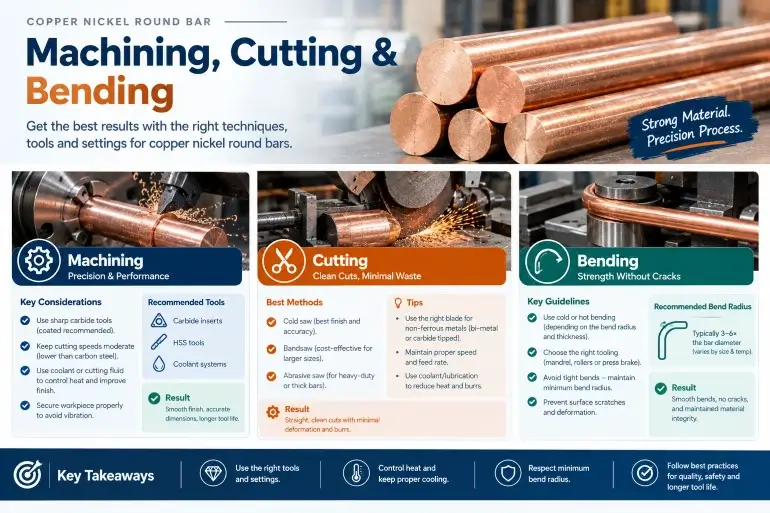
Marine, offshore, and desalination projects use copper nickel alloys for seawater corrosion resistance. The two most common grades are 90/10 (UNS C70600) and 70/30 (UNS C71500). Machine shops and fabricators often find these non-ferrous alloys difficult to process. Copper nickel is ductile, tough, and work-hardens quickly. This guide covers the practical steps for machining, cutting, and bending copper nickel round bars without damaging the material or destroying tooling.
Table of Contents
Work hardening and chip control
Copper nickel work-hardens rapidly. If a cutting tool rubs the material instead of shearing it, the surface layer hardens. Subsequent passes become difficult and the cutting edge degrades.
The alloy also produces long, stringy chips. Poor chip control causes bird-nesting around the spindle, scratches the finished bar surface, and breaks tools.
Machining copper nickel
Machining a Copper Nickel 90/10 Round Bar requires rigid tool holding, specific geometries, and heavy coolant flow. 90/10 is the standard grade for marine fittings and pump shafts, so most shop setups target this specific alloy.
Tooling and geometry
- Carbide inserts hold a sharp edge under high heat and work best for production runs. High-speed steel (HSS) works for low-volume jobs but must stay razor-sharp.
- Use positive rake angles. This reduces cutting forces and shears the material cleanly, which prevents work hardening.
- Maintain sufficient clearance angles so the tool flank does not rub the workpiece.
- Select carbide inserts with engineered chip breakers. Sharp, polished rake faces help snap stringy chips into manageable shapes.
Speeds and feeds
The primary rule for machining work-hardening alloys is to never let the tool dwell.
- Keep a constant, positive feed rate. The feed must cut beneath the work-hardened layer left by the previous pass. Light feeds cause the tool to rub and wear out faster.
- Use moderate surface speeds (SFM). Copper nickel machines faster than hardened steel but slower than free-machining brass.
- Take heavier, consistent depths of cut instead of multiple light skimming passes.
Coolant and lubrication
Copper nickel has low thermal conductivity. Heat stays in the cutting zone and the chip rather than dissipating into the workpiece.
- Apply high-volume, high-pressure flood coolant.
- Use heavy-duty soluble oils or emulsifiable fluids with extreme pressure (EP) additives. This reduces friction, prevents built-up edge (BUE), and flushes chips away.
Cutting and sawing copper nickel bars
The initial cut-to-length breakdown of Copper Nickel Round Bars happens before the material reaches a CNC lathe. Doing this incorrectly alters the metallurgy.
- Band sawing is the most efficient method. Use a bi-metal blade with a positive rake tooth geometry meant for tough non-ferrous alloys. Run the blade slower than you would for mild steel and keep a steady feed rate to stop the teeth from stripping.
- Avoid abrasive chop saws and friction saws. The localized heat alters the copper nickel metallurgy and leaves heavy burrs that require secondary grinding.
- Many fabrication teams order cut-to-length services directly from the stockist. Pre-cut blanks with dimensional inspection reports let CNC machines start turning immediately.
Bending and forming considerations
Copper nickel has high elongation and bends easily. Fabricators still need to account for springback and structural stress.
- Both grades bend cold on standard press brakes or mandrel benders. A Copper Nickel 70/30 Round Bar has a higher yield strength and different springback than the softer 90/10 variant. Calculate for springback and over-bend the part slightly to hit the final angle.
- Heavy sections or tight radii require hot bending. Heat the material uniformly to between 850°C and 950°C (1560°F to 1740°F).
- Severe cold working requires intermediate annealing. This relieves internal stress, restores ductility, and prevents micro-cracking in marine environments.
- Use internal mandrels or sand-packing when bending tubes to prevent ovality and wall collapse.
Sourcing and procurement considerations
Machinability depends heavily on raw material consistency.
- Iron and manganese additions dictate the mechanical properties and impingement attack resistance. Require EN 10204 3.1 Mill Test Certificates (MTC) to verify heat chemistry and mechanical properties before the material enters the shop.
- Suppliers must follow international dimensional tolerances like ASTM B151 or ASME SB151. Oversized bars force unnecessary roughing passes.
- Marine and offshore projects require strict material traceability. The stockist must track the batch from the originating melt to the final cut piece.
Sourcing from Euro Steel Bars
Procurement teams need reliable supply chains alongside good metallurgy. Euro Steel Bars (ESB) supplies copper nickel round bars with a focus on shop-floor readiness and export logistics.
- We provide full heat traceability and EN 10204 3.1 Mill Test Certificates with every order. Quality assurance teams get the exact chemical and mechanical data needed for project sign-offs.
- Our in-house cutting facilities produce pre-cut blanks to exact length specifications. This reduces scrap rates and freight costs for international buyers.
- We stock bars that meet ASTM, ASME, and DIN dimensional tolerances. Consistent sizing means machine operators spend less time adjusting offsets.
- Our wholesale operation packages round bars in secure, seaworthy bundling. Whether shipping to Qatar, Singapore, or South Africa, the material arrives free from transit damage and moisture ingress.
Frequently asked questions
How to cut copper nickel round bar cleanly?
Use a bi-metal band saw with a positive rake tooth geometry and a steady feed rate. Avoid abrasive chop saws, which generate heat, alter the metallurgy, and leave heavy burrs.
What tools do I need to cut copper nickel 90/10 round bar?
A bi-metal band saw blade designed for tough non-ferrous alloys works for initial cut-to-length. CNC machining requires carbide inserts with sharp, polished rake faces and engineered chip breakers.
Can I bend or shape copper nickel 70/30 round bar by hand?
Manual tube benders work for small diameters and thin walls. Larger solid round bars need mechanical assistance like a press brake because of the alloy’s high yield strength.
How bendable is copper nickel 90/10 round bar?
It is highly bendable with elongation often exceeding 30%. Fabricators must account for elastic springback and intentionally over-bend the material.
How do you bend copper nickel without breaking it?
Keep the bend radius appropriate for the bar diameter. For severe cold bending or heavy solid sections, heat the material uniformly to 850°C to 950°C to relieve internal stresses.
Can you bend copper nickel without annealing?
Yes, for moderate cold bending. Severe cold working or tight-radius bending requires intermediate annealing to restore ductility and prevent stress corrosion cracking.
What are common mistakes people make with copper nickel 70/30?
Using light machining feeds causes severe work hardening. Using abrasive friction saws ruins the cut edge. Failing to calculate for springback ruins the bend angle.
Does copper nickel work harden during machining?
Yes. If the cutting tool rubs or dwells instead of shearing the material, the surface layer hardens immediately.
What cutting speeds and feeds work for copper nickel?
Use moderate surface speeds and a constant, deep feed rate. The feed must cut entirely beneath the work-hardened layer left by the previous pass.
What coolant or lubricant should I use when machining copper nickel?
Apply high-volume, high-pressure flood coolant. Heavy-duty soluble oils with extreme pressure (EP) additives reduce friction and flush stringy chips.