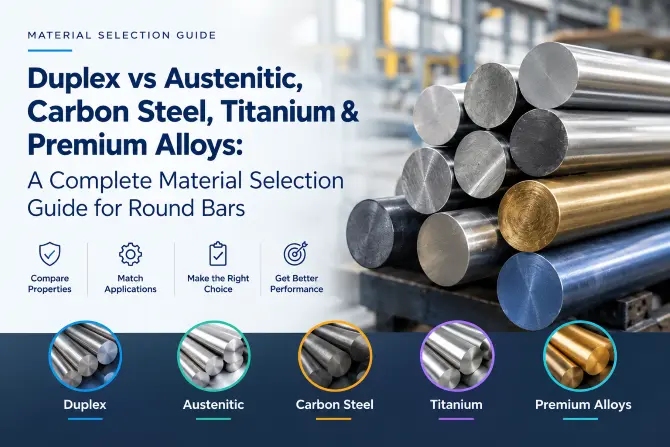
If you are specifying round bars for a project in oil and gas, chemical processing, marine engineering, or power generation, you have likely landed on a familiar crossroads: which alloy family actually fits this application?
The question is not academic. Choosing between duplex stainless steel, austenitic grades like 316L, carbon steel, titanium, or a premium alloy like 904L or Nitronic 60 determines your component service life, maintenance budget, fabrication timeline, and whether the part survives the environment it is placed in.
This guide breaks down the real differences, including metallurgical, mechanical, economic, and practical factors, so you can specify with confidence and source the right round bar without second-guessing the decision six months into service.
Table of Contents
Duplex vs Austenitic Stainless Steel
Austenitic stainless steels (the 300 series: 304, 316, 316L, 317L, 321, 347) have a face-centred cubic (FCC) crystal structure stabilised by nickel and manganese. They are non-magnetic, highly formable, and tough at cryogenic temperatures.
Duplex stainless steels (UNS S31803/S32205, S32101, S32750, S32760) contain a roughly 50/50 mixture of ferrite (BCC) and austenite (FCC) phases. This dual-phase structure gives duplex its defining characteristics: roughly double the yield strength of standard austenitic grades and significantly improved resistance to chloride stress corrosion cracking (Cl-SCC).
Mechanical Properties Comparison
| Property | 316L Austenitic | 2205 Duplex | 2507 Super Duplex |
|---|---|---|---|
| Yield Strength (0.2% offset) | ~200-220MPa | ~450-550MPa | ~550-620MPa |
| Tensile Strength | ~500-620MPa | ~620-800MPa | ~750-900MPa |
| Elongation | ~40% | ~25% | ~15-25% |
| Hardness (typical) | ~95HRB | ~25-31HRC | ~28-32HRC |
The practical implication is clear. A duplex 2205 round bar can carry the same structural load as a 316L bar at roughly half the cross-sectional area. For shafts, fasteners, valve stems, and pump components, sourcing the right duplex stainless steel round bars can mean weight savings, smaller housings, and lower material volume, effectively offsetting the higher per-kilogram price.
Corrosion Resistance and PREN Values
The Pitting Resistance Equivalent Number (PREN = %Cr + 3.3x%Mo + 16x%N) is the standard screening metric:
- 316L: PREN ~24-26
- Duplex 2205 (S32205): PREN ~34-38
- Super Duplex 2507: PREN >40
- 904L (super austenitic): PREN ~34-38
In chloride-containing environments like seawater, brine, and produced water, 2205 duplex resists pitting and crevice corrosion markedly better than 316L. More critically, duplex grades resist Cl-SCC at temperatures where austenitic grades become vulnerable, typically above 60°C in concentrated chloride solutions. This is the single most common reason engineers switch from 316 to duplex in desalination and offshore applications.
Fabrication and Welding Considerations
Austenitic grades are more forgiving in fabrication. They can be cold-formed aggressively and welded with standard procedures using matching filler metals.
Duplex requires stricter procedure control:
- Heat input control during welding is critical. Too little heat leaves excessive ferrite, while too much promotes sigma phase precipitation above 300°C.
- Interpass temperature should generally stay below 150°C.
- Post-weld heat treatment is not recommended for duplex.
- Machining requires lower speeds, higher feed rates, and rigid setups due to the higher strength and work-hardening tendency of the ferrite phase.
Cost Reality and Lean Duplex Alternatives
Duplex 2205 typically costs 20-40% more per kilogram than 316L, but because you can use a smaller diameter for the same load, the installed cost is often comparable. Lean duplex 2101 round bar (UNS S32101), with reduced nickel and molybdenum, narrows the gap further and competes directly with 316L on price while offering superior strength and SCC resistance.
When to Choose Austenitic Instead
Austenitic remains the right call when the application requires extensive cold forming, service temperatures drop below -50°C, the environment involves reducing acids where high-nickel austenitics outperform duplex, or magnetic permeability must be near zero.
Duplex Stainless Steel vs Carbon Steel
Carbon steel (AISI 1020, 1045, 4140, EN8, S355) dominates structural engineering because of its low cost and wide availability. However, it lacks inherent corrosion resistance.
The Decision Framework
| Factor | Carbon Steel | Duplex 2205 |
|---|---|---|
| Material cost (round bar) | Baseline (1x) | 4-7x carbon steel |
| Corrosion resistance | None without coating | Intrinsic; no coating needed |
| Yield strength | 250-355MPa | 450-550MPa |
| Maintenance over 20 years | High (coating renewal) | Minimal |
| Availability in large dia. (>300mm) | Excellent | Limited; check stockist |
When Carbon Steel Is the Right Choice
Carbon steel is correct when the component is painted, galvanised, or cathodically protected, when large-diameter shafts (>350mm) are needed, or when budget is the overriding constraint and corrosion risk is managed externally.
When Duplex Replaces Carbon Steel
Duplex replaces carbon steel in offshore platforms, subsea hardware, and chemical plant internals where coating maintenance is impractical. A practical example is a pump shaft in a seawater intake system. A 1045 carbon steel shaft with epoxy coating might last 5 to 7 years before coating breakdown leads to pitting. A duplex 2205 round bar, at roughly four times the initial bar cost, routinely exceeds 20 years with no intervention. The total cost of ownership flips decisively in favour of duplex by year 10.
Duplex 2101 vs Mild Steel: Why Upgrade?
Lean duplex 2101 contains approximately 21.5% Cr, 5% Mn, 1.5% Ni, and 0.22% N. Its PREN is ~25-27, comparable to 316L, but its yield strength is ~450MPa, more than double that of mild steel (S235/S275).
The upgrade case is strongest where mild steel would otherwise require hot-dip galvanising. In architectural structures and water treatment frames, 2101 eliminates the coating maintenance cycle entirely. The round bar cost premium over mild steel is roughly 2.5 to 3.5 times, but you remove surface preparation and recoating from the project budget.
Duplex vs Aluminium: Weight vs Durability
Aluminium (6061, 6082, 7075) is chosen strictly for weight. In applications where mass is the governing constraint, aluminium density of 2.7g/cm3 versus duplex density of 7.8g/cm3 is decisive.
However, in corrosion-dominated environments with chlorides, aluminium suffers pitting and galvanic corrosion. If the component is stationary, exposed to seawater, and weight is not the primary driver, duplex is the more durable and lower-maintenance choice.
Duplex Stainless Steel vs Titanium
The Performance Comparison
| Property | Duplex 2205 | Titanium Gr. 2 / Gr. 5 |
|---|---|---|
| Density | 7.8g/cm3 | 4.5g/cm3 |
| Yield Strength | 450-550MPa | 275MPa (Gr. 2) / 830MPa (Gr. 5) |
| Corrosion resistance (chlorides) | Excellent up to ~50°C | Exceptional across all temperatures |
| Cost (round bar, per kg) | 1x (reference) | 5-10x duplex |
| Weldability | Requires procedure control | Requires high-purity shielding |
When Titanium Is Justified
Titanium is justified when chloride concentrations exceed 20,000ppm at temperatures above 80°C, when the environment includes hot reducing acids where even super duplex struggles, or when weight is critical alongside absolute corrosion resistance.
When Duplex Is the Smarter Buy
For most offshore, chemical, and marine applications within the proven duplex envelope, 2205 delivers excellent corrosion performance at a manageable cost. Titanium round bar is harder to machine, difficult to weld without strict back-purging, and has limited availability in large diameters, often extending lead times to 12-20 weeks.
Duplex 2101 vs Titanium: A Practical View
For structural supports, handrails, and general marine hardware, 2101 delivers 80-90% of titanium corrosion performance at roughly 15% of the cost. Unless the environment includes hot concentrated chlorides or a strict weight constraint, 2101 is the economically rational choice.
2205 Duplex vs 904L Stainless Steel
Composition and PREN
| Element | 2205 (S32205) | 904L (N08904) |
|---|---|---|
| Cr | 22-23% | 19-23% |
| Ni | 4.5-6.5% | 23-28% |
| Mo | 3.0-3.5% | 4.0-5.0% |
| Cu | — | 1.0-2.0% |
| PREN | ~34-38 | ~34-38 |
Where 2205 Wins
2205 wins in chloride pitting, crevice corrosion, and chloride stress corrosion cracking. Its higher nitrogen and balanced microstructure give it a practical edge in critical pitting temperature tests. It also offers double the yield strength of 904L, allowing smaller bar diameters.
Where 904L Wins
904L wins in sulphuric acid service. The copper addition gives 904L superior resistance in reducing sulphuric acid environments. Duplex performs poorly in reducing acids because the ferrite phase is attacked preferentially.
Disadvantages of 904L
904L is expensive due to high nickel content, making its price highly sensitive to market fluctuations. It has lower yield strength, requiring larger cross-sections. It remains susceptible to Cl-SCC above 60°C, and availability in large-diameter round bars is limited.
2205 Duplex vs Nitronic 60
Nitronic 60 (UNS S21800) is an austenitic stainless steel engineered specifically to resist galling, metal-to-metal wear, and seizing in threaded applications. Its PREN is ~24-26, comparable to 304.
In a corrosive environment, 2205 will outlast Nitronic 60 by a wide margin. In a dry or mildly corrosive environment with high mechanical wear, Nitronic 60 will outlast 2205 because duplex is susceptible to galling in sliding contact.
Practical Specification Guidance for Round Bar Buyers
When you have selected the alloy family, confirm the following before issuing an RFQ:
- Standard and grade designation: Specify UNS S32205 to ASTM A276 or EN 1.4462 to EN 10088-3.
- Diameter tolerance: Cold-drawn bars (h9, h11) vs hot-rolled/peeled bars.
- Length: Random lengths (3m to 6m) vs cut-to-length.
- Heat treatment condition: Solution-annealed and quenched is standard.
- Certification: EN 10204 3.1 MTC as a minimum. Confirm NACE MR0175 compliance for sour service.
- Testing: Ultrasonic testing (SEP 1921 Class E/e) and PMI verification.
Frequently Asked Questions
What’s the difference between duplex and austenitic stainless steel?
Duplex stainless steel contains roughly equal parts ferrite and austenite phases, giving it about twice the yield strength of austenitic grades like 316L and far greater resistance to chloride stress corrosion cracking. Austenitic grades offer better formability, cryogenic toughness, and ease of welding. Duplex is preferred in chloride-rich, high-strength applications, while austenitic suits deep-forming, low-temperature, and reducing-acid environments.
Duplex stainless steel vs carbon steel: when to use each?
Use carbon steel when the environment is controlled through coatings or cathodic protection, when large diameters are needed, or when budget is the primary constraint. Use duplex when the component faces chlorides, seawater, or sour service and coating maintenance is impractical. Over a 15 to 25 year lifecycle, duplex often costs less in total ownership despite a significantly higher initial bar price.
How does duplex compare to carbon steel?
Duplex offers intrinsic corrosion resistance with no coating requirement, roughly double the yield strength of structural carbon steel, and a service life measured in decades rather than years in aggressive environments. Carbon steel wins on upfront cost, availability in very large diameters, and simplicity of welding. The choice depends on whether corrosion is managed externally or must be handled by the material itself.
Duplex stainless steel vs carbon steel: which should I use?
If the component is exposed to moisture, chlorides, process chemicals, or marine atmospheres without reliable coating maintenance, duplex is the technically correct choice. If the part is indoors, painted, galvanised, or in a non-corrosive structural role, carbon steel delivers the required performance at a fraction of the cost. Define the environment first, then the material selection follows naturally.
Duplex 2101 vs mild steel: why upgrade your material choice?
2101 lean duplex provides approximately 450MPa yield strength, which is over twice that of mild steel, alongside inherent corrosion resistance without paint or galvanising. In water treatment and coastal structures, it eliminates recurring coating maintenance costs. The bar costs roughly three times more than mild steel, but the total lifecycle cost is often lower once surface preparation and recoating are accounted for.
Why would I choose duplex over aluminium?
In stationary, chloride-exposed applications like marine hardware and chemical plant internals, duplex resists pitting and crevice corrosion far better than aluminium, which is vulnerable to galvanic attack. The main advantage of aluminium is its low weight. If the component is not weight-critical and must survive decades in a corrosive environment, duplex stainless steel is the more durable and lower-maintenance option.
How does duplex stainless steel compare to titanium?
Titanium outperforms duplex in extreme chloride environments, hot reducing acids, and weight-sensitive applications. However, titanium round bar costs up to ten times more, is harder to machine, and has limited availability in large diameters. For most offshore, chemical, and marine applications within the proven duplex envelope, 2205 delivers excellent corrosion performance at a much more manageable cost for industrial buyers.
Duplex 2101 vs titanium: which material should I choose?
For structural supports, handrails, shafts, and general marine hardware in coastal service, 2101 delivers excellent corrosion resistance and strength at roughly 15% of the cost of titanium. Choose titanium only when the environment includes hot concentrated chlorides, reducing acids, or a strict weight constraint. For most industrial and marine round bar applications, 2101 is the economically rational specification.
2205 vs 904L stainless: which offers better corrosion resistance?
In chloride environments, 2205 is superior due to higher nitrogen content, balanced duplex microstructure, and resistance to chloride stress corrosion cracking. In sulphuric and phosphoric acid service, 904L provides a clear advantage thanks to its copper and high nickel content. Their pitting resistance equivalent numbers overlap, so the deciding factor is the specific corrodent, concentration, and operating temperature.
Duplex vs 904L: which stainless steel is better?
Neither alloy is universally better. 2205 duplex excels in chloride resistance and mechanical strength, making it ideal for oil and gas, marine, and desalination applications. 904L excels in reducing-acid environments common in chemical and fertiliser processing. Match the alloy to the dominant corrodent. Specifying 904L for a seawater application, or 2205 for hot sulphuric acid service, would be a costly error.
What are the disadvantages of 904L stainless steel?
904L is expensive due to high nickel and molybdenum content, making its price highly sensitive to market fluctuations. It has lower yield strength than duplex, requiring larger cross-sections for structural integrity. It also remains susceptible to chloride stress corrosion cracking above 60°C. Availability in large-diameter round bars is limited, with longer lead times, and it is unsuitable for reducing acids above 70°C.
2205 duplex stainless vs Nitronic 60: which lasts longer?
In corrosive environments, 2205 lasts significantly longer due to its superior pitting resistance equivalent number. In high-wear, galling-prone, or metal-to-metal contact applications with low corrosion exposure, Nitronic 60 outlasts 2205 because it was specifically engineered to resist seizing and adhesive wear. The longer-lasting material depends entirely on whether chemical corrosion or mechanical wear is the dominant failure mechanism in your application.
Sourcing the Right Round Bar
Material selection is only half the decision. The other half is finding a supplier who stocks the correct grade in the diameter you need, provides compliant mill test certificates, and can deliver to your project site without a 16-week mill lead time derailing your schedule.
At Euro Steel Bars, we stock and supply duplex, austenitic, carbon steel, alloy steel, nickel alloy, and titanium round bars across international standards including ASTM, EN, JIS, and BS. Bars are available in hot-rolled, cold-drawn, peeled, turned, and ground finishes, with EN 10204 3.1 and 3.2 certification, NACE compliance, and third-party inspection as required.
If you are working through a material selection decision and need to confirm availability, tolerances, or certification requirements for a specific grade and diameter, contact our technical sales team with your specification. We will confirm stock position, pricing, and lead time within one business day.
This guide is intended for general material selection reference. For critical applications involving pressure equipment, sour service, or safety-classified components, always validate the final material choice against the applicable design code (ASME, EN 13480, DNV-OS, NORSOK) and, where necessary, with a qualified corrosion or materials engineer.