Engineers specify Copper Nickel 90/10 round bar (UNS C70600, W.Nr 2.0872, CW352H) for shafts, valve stems, fasteners, and pump components in marine and offshore environments. Procurement teams often see high quotes for this alloy compared to austenitic stainless steels like 316L. The cost comes from specific metallurgical, manufacturing, and supply chain factors.
Table of Contents
The primary cost driver: nickel premiums and LME fluctuations
Copper nickel costs more than standard steel because of its raw materials. The 90/10 grade contains 90% copper and 10% nickel, plus small amounts of iron (1.0 to 2.0%) and manganese (up to 1.0%) to prevent erosion-corrosion.
- Base metals: Copper and nickel trade on the London Metal Exchange (LME). The daily LME prices set the baseline cost for the alloy.
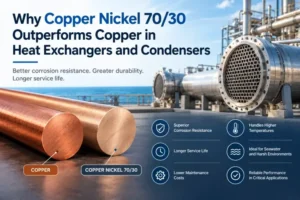
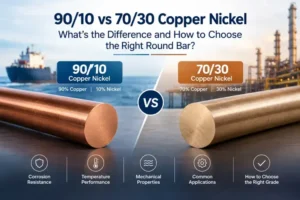
- Nickel costs: Nickel is much more expensive per metric ton than copper, iron, or chromium. The Copper Nickel 70/30 round bar (UNS C71500) costs even more because it contains 30% nickel.
- Alloying: Mixing iron and manganese into a copper-nickel melt requires strict controls to prevent segregation. This adds time and overhead to the melting process.
Manufacturing and processing costs
Mills must follow strict processes to produce CuNi 90/10 round bar to ASTM B151 or ASME SB151 standards.
Melting and casting: Copper alloys conduct heat quickly and solidify in specific ways. Furnaces must use controlled atmospheres to stop oxidation and gas porosity. Continuous casting needs specialized graphite molds and exact cooling rates to prevent internal shrinkage.
Hot working: CuNi 90/10 has a narrow hot-working temperature range. Billets crack if they get too hot and require too much force if they get too cold. This slow extrusion process lowers mill throughput and raises the cost per kilogram.
Finishing options: The surface finish changes the price.
- Hot-rolled (HR) is the most economical option. The mill descales the bar but leaves standard tolerances and a rough surface. Buyers use this for non-critical parts or when they plan to machine the entire surface.
- Peeled or turned bars go through a machine that removes the outer oxidized layer. This provides a smooth finish and tighter diameter tolerances, typically h9 or h11. The extra machining time and material yield loss increase the price.
- Cold drawn or ground bars are for precision shafting. The process requires high energy and specialized dies to achieve tight tolerances, making it the most expensive finish.
Certification, testing, and traceability
Marine and offshore buyers need documentation to prove the material meets specifications. The paperwork adds to the final price.
- EN 10204 3.1 Mill Test Certificates (MTC): The mill must run chemical analysis, tensile tests, and hardness tests, then document the results. The lab and administrative work for this traceability is built into the material cost.
- Third-party inspections: Shipyards and EPC contractors often require inspectors from Lloyd’s Register, DNV, ABS, or TUV to witness the testing. Coordinating these visits adds logistical costs and mill holding fees.
- NACE compliance: Sour gas environments require NACE MR0175 or ISO 15156 compliance. The mill must control the process tightly and run extra tests to ensure the heat meets specific hardness and microstructural limits.
Size, yield, and freight considerations
Standard sizes and custom diameters: Mills get the best yield when they run standard diameters (20mm, 30mm, 50mm, 100mm) in long batches. If a buyer orders a non-standard size or a very large diameter over 200mm that requires open-die forging instead of extrusion, the mill charges a premium for the custom setup and lower yield.
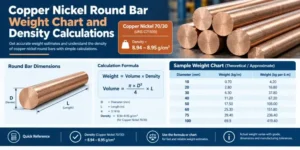
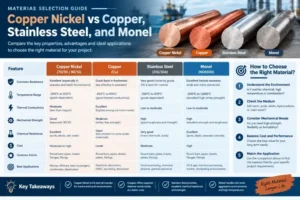
Weight and freight: Copper Nickel 90/10 has a density of about 8.9 g/cm³. Stainless steel 316 is around 8.0 g/cm³, and carbon steel is 7.85 g/cm³. A CuNi bar weighs more per meter than a steel bar of the same size. This increases the theoretical weight (and the total material cost) and raises international freight charges, especially for urgent air shipments.
How buyers optimize CuNi procurement costs
Buyers can manage copper nickel costs without giving up quality or compliance.
- Specify standard sizes: Do not ask for cold-drawn h7 tolerances if a hot-rolled or peeled h11 bar works for the application. Design parts around standard metric or imperial sizes that stockists keep on the shelf to avoid custom mill premiums.
- Order cut-to-length: Buying random mill lengths (3 to 5 meters) means paying to ship unused drops. Suppliers with cut-to-size services let you order exact dimensions for your Copper Nickel 90/10 round bar. This reduces material waste and freight weight.
- Consolidate orders: Mills set Minimum Order Quantities (MOQs) for copper-nickel melts, often 500kg to 1,000kg per diameter. Stockists pool demand and hold physical inventory, allowing buyers to order smaller quantities from master bars with full original MTC traceability.
- Clarify certifications early: Do not ask for full marine certification if a standard 3.1 MTC is enough. If the end client requires DNV or ABS witness testing, state this in the initial RFQ to avoid paying for retroactive testing.
Sourcing from Euro Steel Bars (ESB)
Where you source the material affects project timelines and budgets. Euro Steel Bars (ESB) stocks and exports copper nickel round bars for B2B industrial buyers.
- Stock and cutting: We keep physical stock of marine alloys. CuNi is heavy and expensive, so buying full mill lengths creates costly drop-waste and high freight charges. Our cut-to-size services let you order exact dimensions, which improves yield and lowers shipping weight.
- Traceability: Material without paperwork is scrap metal in the marine sector. We supply our bars with original EN 10204 3.1 Mill Test Certificates. We provide chemical and mechanical traceability back to the primary melt for ASTM, ASME, and EN standards.
- Export logistics: Local sourcing often means high markups and long lead times. We combine international mill pricing with export logistics. We ship to project sites in Qatar, Oman, Bahrain, Kuwait, Jordan, Malaysia, Singapore, Thailand, Taiwan, Turkey, Italy, and South Africa. We handle the crating and documentation for heavy metal cargo.
- Flexible quantities: Primary mills ignore small orders for specialty grades. We let fabricators buy the exact amount of CuNi 70/30 or 90/10 round bar they need without buying a full mill bundle.
Certified. Prepared. Delivered.
Request a quote or contact our technical sales team via WhatsApp or phone to check stock, pricing, and delivery schedules.
Frequently asked questions
Why is copper nickel more expensive than copper?
Alloying copper with nickel and adding iron or manganese requires tightly controlled melting processes. This achieves the mechanical and anti-corrosion properties needed for marine applications, which costs more than producing pure copper.
What factors affect the price of copper nickel round bar?
The price depends on London Metal Exchange (LME) base metal prices, nickel content, bar diameter, the manufacturing process (hot-rolled, peeled, or cold drawn), certification requirements like EN 10204 3.1 MTCs, and order volume.
How does the nickel price affect copper nickel round bar cost?
Nickel is an expensive base metal. Copper Nickel 90/10 contains 10% nickel, and 70/30 contains 30%. Daily changes in the LME nickel price directly change the manufacturing cost of the alloy.
Is copper nickel 70/30 more expensive than 90/10?
Yes. Copper Nickel 70/30 (UNS C71500) contains 30% nickel. This makes its raw material cost higher than the 90/10 grade (UNS C70600), which has 10% nickel.
Is copper nickel priced per kg, per foot or per piece?
International B2B trade prices copper nickel round bar per kilogram or metric ton based on theoretical weight. Local distributors sometimes convert this to a per-foot or per-piece price for smaller orders.
Does bar diameter affect the price per kg?
Yes. Mills get the best yield from standard diameters. Non-standard sizes, very small diameters, or large diameters that need forging instead of extrusion require custom setups. This lowers yield and raises the price per kg.
Do bulk orders lower the price of copper nickel round bar?
Yes. Mills have Minimum Order Quantities (MOQs) for specific melts. Bulk orders meet these MOQs, which removes small-batch surcharges and lowers the cost per kilogram.
Do custom cutting and mill test certificates add to the price?
Standard EN 10204 3.1 Mill Test Certificates are usually in the base mill price. Custom cut-to-size services add labor and machining costs. Third-party witnessed testing from DNV, ABS, or Lloyd’s adds external inspection fees.
Why do copper nickel prices change from month to month?
Prices change based on daily LME trading values for copper and nickel, mining outputs, supply chain disruptions, and the energy costs to melt and process the alloys.
Is copper nickel cheaper than stainless steel over the long term?
It is often cheaper over the long term in seawater and high-chloride environments. The initial cost is higher than 316L stainless steel, but CuNi resists biofouling, pitting, and stress corrosion cracking. This reduces maintenance and replacement costs over the life of the asset.