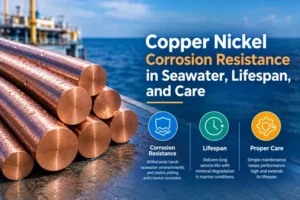
Marine engineering and desalination plants require materials that resist seawater corrosion. Copper nickel alloys, specifically 90/10 (UNS C70600) and 70/30 (UNS C71500), handle these environments well. Using pure copper instead of copper nickel in a seawater cooling system causes rapid erosion and early failure.
Procurement teams and QA inspectors receiving shipments of Copper Nickel Round Bars must verify the material before fabrication. Identification relies on visual checks, chemical testing, and document review.
Table of Contents
Copper nickel vs regular copper comparison
Before testing the material, buyers can review the physical and chemical differences between pure copper and copper nickel alloys.
| Property | Pure Copper (C11000) | Cu-Ni 90/10 (C70600) | Cu-Ni 70/30 (C71500) |
|---|---|---|---|
| Color | Bright reddish brown | Pale reddish gold | Silvery grey |
| Nickel content | Trace | 9.0 to 11.0% | 29.0 to 33.0% |
| Iron content | Trace | 1.0 to 1.8% | 0.4 to 1.0% |
| Tensile strength | ~210 MPa | ~310 to 380 MPa | ~345 to 415 MPa |
| Magnetic | No | No | No |
| Primary standard | ASTM B187 | ASTM B151 | ASTM B151 |
If the material looks bright red and tests below 250 MPa tensile strength, it is not copper nickel.
Visual and physical identification
The most immediate difference between pure copper and copper nickel alloys is the appearance and machining behavior.
Color and surface appearance
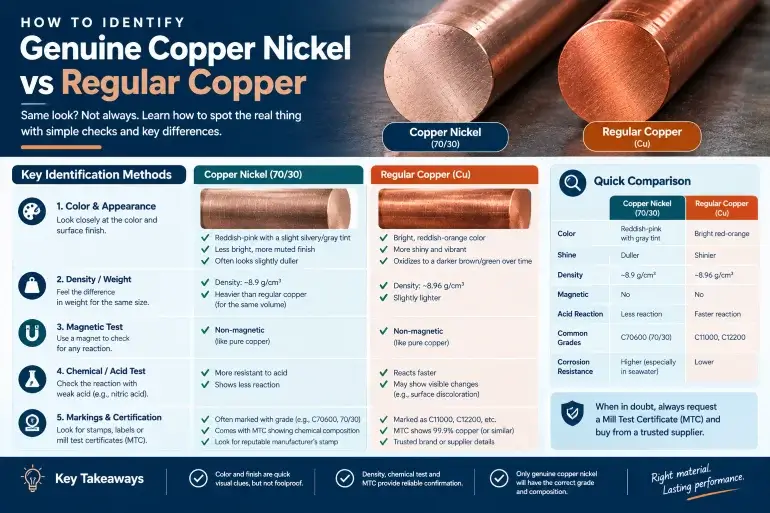
Pure copper has a bright reddish brown tone. Nickel is a silvery white metal. When alloyed with copper at 10 to 30 percent, it removes the red color.
- Copper Nickel 90/10 Round Bar (UNS C70600) has a pale reddish gold or brassy appearance. It does not look like pure copper.
- Copper Nickel 70/30 Round Bar (UNS C71500) contains more nickel. The color shifts to silvery grey and looks similar to dull stainless steel in certain lighting.
Machining chips
Machining pure copper produces bright, shiny, red orange chips. The metal is soft and gummy. Copper nickel produces paler, tougher chips because the nickel and iron increase tensile strength.
Magnet testing
A magnet will not stick to pure copper or copper nickel. The alloys contain small amounts of iron for corrosion resistance, but the copper nickel matrix remains non magnetic. Magnet testing cannot differentiate these materials from austenitic stainless steel.
Analytical testing methods
Visual checks catch obvious substitutes, but professional verification requires instrumental analysis.
Positive material identification via XRF
X ray fluorescence (XRF) is the standard for on site alloy verification. A handheld XRF analyzer provides an elemental breakdown of the bar surface in seconds.
| Element | 90/10 (C70600) | 70/30 (C71500) | Pure Copper (C11000) |
|---|---|---|---|
| Copper (Cu) | 86.2 to 90.0% | 65.0 to 70.0% | 99.9% or higher |
| Nickel (Ni) | 9.0 to 11.0% | 29.0 to 33.0% | Less than 0.1% |
| Iron (Fe) | 1.0 to 1.8% | 0.4 to 1.0% | Less than 0.01% |
| Manganese (Mn) | 1.0% or less | 1.0% or less | Less than 0.01% |
If the XRF does not detect significant nickel and iron, the material is not copper nickel. PMI testing should happen on every heat for critical marine applications before fabrication.
Optical emission spectrometry
Laboratories use OES to verify light elements like carbon and phosphorus. This involves grinding a small spot on the bar end and creating a spark. OES provides a highly accurate chemical composition to cross reference against ASTM B151 limits.
Density check
Copper nickel 70/30 has a density of about 8.94 g/cm3. The 90/10 alloy is around 8.90 g/cm3. Pure copper is 8.96 g/cm3. These values are very close, so density alone is not a reliable test. It can only support other evidence if someone suspects a gross substitution like brass.
Mill test certificates and documentary proof
Physical testing is only part of the verification process. Genuine copper nickel round bars must come with an EN 10204 3.1 Mill Test Certificate (MTC) from the manufacturer.
Heat number traceability
Every bar should have a heat number stamped or stenciled on the end face. This number must match the heat number on the MTC. If the bar is unmarked, the chain of custody is broken and the metal should be quarantined.
Chemical composition
The certificate lists the exact makeup of the batch. Look for the intentional alloying elements. Nickel must fall within 9.0 to 11.0 percent for C70600, or 29.0 to 33.0 percent for C71500. Iron is essential for seawater flow velocity resistance. A certificate for regular copper shows nickel as a trace impurity below 0.1 percent.
Applicable manufacturing standards
The MTC must state the material meets the correct specification. For copper nickel round bars, the governing standards include ASTM B151, ASME SB151, EN 12163, and DIN 17664.
Mechanical properties
Copper nickel is stronger than pure copper. The MTC should report tensile strength between 310 and 415 MPa for annealed 90/10 and 70/30 alloys. Pure copper in a soft temper shows tensile strength around 210 MPa. Low strength values on the certificate indicate the document belongs to a different alloy.
Spotting mislabeled material
Material substitution in the supply chain happens. Red flags include a bright red color on a bar labeled C71500, missing heat stamps, generic certificates without specific heat data, and prices that fall far below market rates for nickel bearing alloys.
For critical seawater or desalination projects, perform incoming PMI on every heat before releasing material to production.
Sourcing copper nickel from Euro Steel Bars
Testing materials on site is necessary, but controlling the supply chain prevents substitution risks. Euro Steel Bars supplies, stocks, and exports specialty alloys for international projects. We combine physical wholesale operations with global logistics to handle both standard stock requirements and project specific procurement.
We provide guaranteed traceability. Every Copper Nickel Round Bar we export includes original EN 10204 3.1 Mill Test Certificates. This gives buyers complete heat traceability from the melt to the fabrication floor.
Standard mill lengths often create material waste. We offer in house bandsaw cutting services to deliver 90/10 or 70/30 bars cut to exact project dimensions.
We maintain physical stock of high demand specifications to service urgent maintenance and fast tracked project schedules. Our export team manages logistics to ship materials to shipyards in Singapore, offshore platforms in Qatar, or desalination facilities in Oman.
Frequently asked questions
What color is copper nickel compared with copper and stainless steel?
Pure copper is bright reddish brown. Copper nickel 90/10 appears pale reddish gold. Copper nickel 70/30 looks silvery grey because the high nickel content removes the red tone. Stainless steel is a brighter, more reflective silver. Chemical testing is required to tell 70/30 copper nickel and stainless steel apart in poor lighting.
Can a magnet test tell me if a bar is copper nickel?
No. Neither copper nor copper nickel is magnetic. A magnet will not stick to C70600 or C71500. The small iron additions in copper nickel do not make the alloy magnetic.
How can I verify the composition of copper nickel bar?
Use a handheld XRF analyzer for rapid on site verification. Confirm that nickel reads 9 to 11 percent for 90/10, or 29 to 33 percent for 70/30. Cross reference the results against the heat specific Mill Test Certificate.
What is PMI testing?
Positive material identification uses analytical instruments like XRF guns to verify the elemental composition of a metal alloy on site. For copper nickel, PMI confirms the presence of nickel, iron, and manganese.
What is a mill test certificate and why does it matter?
An MTC is a document from the manufacturer certifying the chemical composition and mechanical properties of a specific production heat. It provides documentary proof that the material meets the engineering specification. Without a valid MTC, there is no verifiable record that the bar is genuine copper nickel.
What does an EN 10204 3.1 certificate show?
This certificate is issued by an independent inspection representative. It shows the heat number, full chemical analysis, mechanical test results, the product standard, and a statement of conformity.
Which UNS numbers should I look for?
Look for UNS C70600 for copper nickel 90/10 and UNS C71500 for copper nickel 70/30. These designations should appear on the MTC and the bar end stamp. If the documentation references C11000 or C12200, the material is pure copper.
What markings should genuine copper nickel round bar have?
Mill produced bars are marked with the alloy designation, heat number, manufacturer logo, size, and applicable standard. Markings might be stamped, stenciled, or color coded. Unmarked bars should be treated with caution.
How do I spot mislabeled copper nickel?
Look for a bright red color, absence of nickel on the XRF, missing heat stamps, or tensile strength below 280 MPa. Any discrepancy between paperwork and physical testing requires immediate quarantine.
Which standards cover copper nickel round bar?
The primary standards are ASTM B151 for rod and bar, ASME SB151 for pressure equipment, EN 12163 for general purpose rod, and DIN 17664. Always confirm which standard your project requires before ordering.