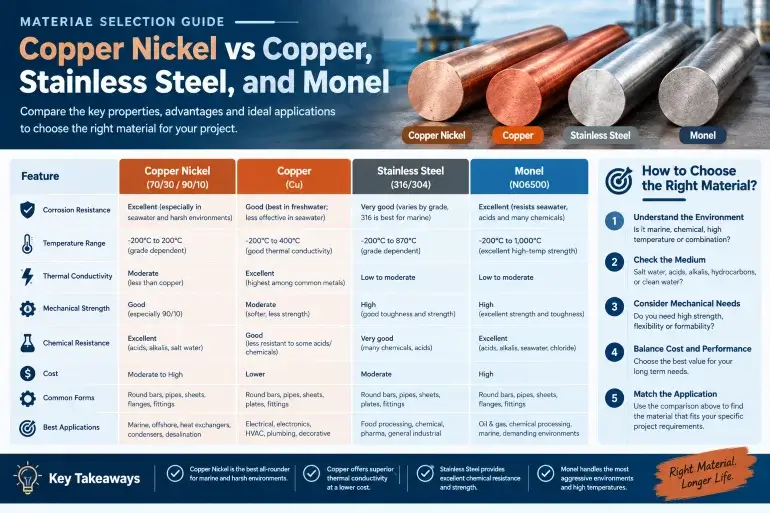
Engineers and procurement teams working in seawater cooling, offshore oil and gas, and desalination face a specific problem. They must balance mechanical strength, localized corrosion resistance, biofouling, and cost. Copper nickel (CuNi) is a common choice for these environments. But buyers often need to justify it against pure copper, stainless steel, and Monel.
This guide compares the mechanical and chemical properties of these metals to help you specify the right round bar for your project.
Table of Contents
Is cupronickel stronger than pure copper?
Yes. Pure copper (like C11000) is used for electrical and thermal conductivity. It is mechanically soft. Annealed pure copper has a tensile strength of about 210 MPa and a yield strength around 33 MPa.
Copper nickel alloys (90/10 and 70/30) solve the mechanical limits of pure copper. Adding nickel, iron, and manganese to the copper base increases tensile and yield strength through solid-solution strengthening. The alloy keeps the corrosion resistance of copper but can actually handle structural loads.
Comparative mechanical data (annealed condition)
| Material | Tensile strength (MPa) | Yield strength 0.2% offset (MPa) | Primary limitation |
|---|---|---|---|
| Pure copper (C11000) | 210 | 33 | Too soft for structural use, poor erosion-corrosion resistance. |
| 90/10 CuNi (C70600) | 310 to 380 | 110 to 125 | Lower strength compared to high-alloy steels. |
| 70/30 CuNi (C71500) | 380 to 450 | 125 to 350 | Higher cost, more difficult to machine than 90/10. |
You cannot use pure copper for structural marine hardware, valve stems, pump shafts, or high-pressure fittings. Cupronickel provides the mechanical rigidity and fatigue resistance required for moving or load-bearing components in marine applications.
Copper nickel vs stainless steel (316/316L)
This comparison usually comes down to mechanical strength versus specific corrosion resistance.
Mechanical strength
316L stainless steel is stronger. A standard 316L round bar has a tensile strength of roughly 485 MPa and a yield strength of 170 MPa. It also has higher surface hardness. If your application requires high structural loads or high-pressure containment, stainless steel is the baseline.
Pitting and crevice corrosion
Copper nickel wins in stagnant or slow-moving chloride environments. 316L relies on a passive chromium oxide layer. In seawater, especially in low-flow areas or under deposits, this layer breaks down. This causes pitting and crevice corrosion, which leads to sudden failure of shafts or fasteners.
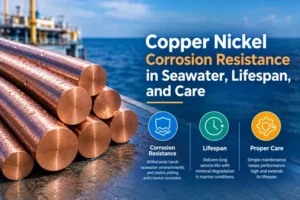
Copper nickel forms a thin, protective cuprous oxide film. This film resists pitting and crevice corrosion even in polluted or stagnant seawater.
Biofouling resistance
Stainless steel does not stop marine biological growth. Barnacles attach to the surface, causing under-deposit corrosion and blocking flow. Copper nickel releases copper ions at a microscopic rate. This prevents marine growth naturally, keeping seawater intake pipes and condenser tubes clear without chemical treatments. For standard marine cooling systems, specifying a copper nickel 90/10 round bar (C70600) provides reliable biofouling resistance at a lower cost than 316L.
Copper nickel vs Monel (alloy 400)
Monel is a nickel-copper alloy (about 67% Ni, 30% Cu). Comparing the two is mostly about budget and extreme operating conditions.
Strength and temperature tolerance
Monel 400 has a tensile strength of roughly 550 MPa. It also keeps its mechanical properties at much higher temperatures than copper nickel. If your pump shafts or valves will see aggressive acids (like sulfuric or hydrochloric) or high heat, Monel is the correct technical choice.
Cost and machining
Monel relies on high-purity nickel. It often costs three to four times more than 90/10 CuNi. It is also difficult to machine, which adds to manufacturing time and tool wear.
Application boundaries
Procurement teams usually specify Monel only when copper nickel cannot handle the chemical or thermal load. For standard seawater cooling, firewater systems, and offshore splash zones, Monel is over-engineered. If a system has higher-velocity seawater and needs more strength than 90/10 offers, but Monel is out of budget, upgrading to a copper nickel 70/30 round bar (C71500) is the standard engineering fix.
Material selection matrix
| Property | Pure copper (C11000) | 90/10 CuNi (C70600) | 316L stainless steel | Monel 400 (N04400) |
|---|---|---|---|---|
| Primary use | Electrical, thermal | Seawater piping, marine hardware | General structural, architectural | High-temp, aggressive acids, high-stress shafts |
| Tensile strength | 210 MPa | 310 MPa | 485 MPa | 550 MPa |
| Pitting resistance (seawater) | Poor | Excellent | Poor to moderate | Excellent |
| Biofouling resistance | Excellent | Excellent | None | None |
| Relative cost | Low | Moderate | Low to moderate | Very high |
| Machinability | Difficult (gummy) | Good | Moderate | Poor (work-hardens) |
Procurement considerations for copper nickel round bars
Sourcing non-ferrous alloys for marine and industrial projects requires attention to standards and documentation.
Standards and specifications
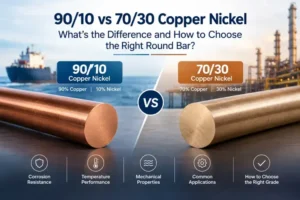
When you issue an RFQ for copper nickel round bars, reference the correct manufacturing standards. ASTM B151 and ASME SB151 cover copper nickel rod and bar. EN 12163 and EN 12164 are the European equivalents. Always specify if you need C70600 (90/10) for standard desalination and marine use, or C71500 (70/30) for higher-velocity seawater and impingement attack resistance.
Certification and traceability
Material failure in offshore environments is not an option. Require EN 10204 3.1 mill test certificates (MTC) with every shipment. The MTC must show the exact chemical breakdown. Iron and manganese ratios are necessary in CuNi because they form the protective oxide film. The certificate must also include tensile and hardness test results.
Stock and preparation
Copper nickel is a specialized alloy. Local distributors rarely keep large inventories. International stockists maintain strategic stock of CuNi round bars to support urgent maintenance (like replacing a sheared valve stem on an offshore rig) and project production runs. Using a supplier that offers cut-to-length services reduces material waste and gets the bar stock ready for CNC machining immediately upon delivery.
Why procurement teams source from Euro Steel Bars
Sourcing specialized alloys requires a supply chain partner who understands marine and industrial compliance. Euro Steel Bars operates as a physical wholesale stockist and an international exporter. We focus on three operational areas for every shipment.
We provide EN 10204 3.1 MTCs that verify the precise chemical makeup and mechanical properties. This prevents inspection delays with marine class surveyors.
Raw bar stock takes time to prep before machining. We cut materials to your exact size and length requirements. This lowers your scrap rates and saves handling time on the shop floor.
We export to project sites and fabrication shops across the Middle East, Europe, and Southeast Asia. We handle the packing and cross-border documentation so the material arrives ready for production.
Frequently asked questions
Is copper nickel better than stainless steel for pipes?
Yes, in seawater and chloride environments. Stainless steel (316L) is stronger but prone to pitting, crevice corrosion, and biofouling in stagnant water. Copper nickel resists these failure modes and stops marine growth, making it more reliable for long-term marine piping.
What is the difference between cupronickel and Monel?
The base metal and the cost. Cupronickel is a copper-based alloy (70-90% Cu) with nickel added. Monel is a nickel-based alloy (about 65% Ni) with copper added. Monel is stronger, handles higher temperatures, and resists acids better. It is also much more expensive and harder to machine.
How strong is copper nickel 90/10 compared to other materials?
Copper nickel 90/10 (C70600) has a typical tensile strength of 310 to 380 MPa and a yield strength of 110 to 125 MPa. It is stronger than pure copper or brass but weaker than 316L stainless steel and Monel 400. It has enough strength for most marine fittings, flanges, and low-to-medium pressure piping.
How much more expensive is copper nickel than copper?
Copper nickel usually costs 20% to 40% more than pure copper, depending on nickel market prices. The extra cost pays for the massive increase in mechanical strength and the resistance to erosion-corrosion and biofouling in marine applications.
Is copper nickel more corrosion resistant than pure copper?
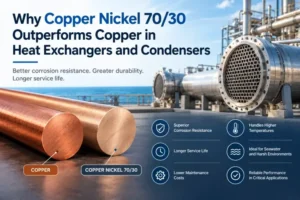
Yes. Pure copper suffers from impingement attack (erosion-corrosion) in high-velocity water and is vulnerable to sulfide pollution in seawater. Adding nickel, iron, and manganese creates a much more stable protective oxide film that resists flow-accelerated corrosion.
Does copper nickel conduct heat and electricity as well as copper?
No. Alloying copper with nickel drops electrical and thermal conductivity significantly. Copper nickel is used in heat exchangers because its corrosion resistance prevents fouling. Fouling would otherwise insulate the tube and ruin efficiency. It is not used for electrical busbars or high-efficiency thermal transfer.
Is copper nickel better than brass for marine use?
Yes, mostly because it avoids dezincification. Naval brass is strong but can leach zinc in certain seawater conditions, leaving the material porous and weak. Copper nickel is immune to dezincification and handles high-velocity seawater erosion better than standard brasses.
Is copper nickel cheaper than Monel?
Yes. Copper nickel often costs 30% to 50% of the price of Monel 400. Unless the application involves high concentrations of sulfuric or hydrochloric acid, or temperatures that exceed CuNi limits, cupronickel is the more economical choice.
How does copper nickel compare with titanium in seawater?
Titanium is technically superior and immune to almost all seawater corrosion. It is also much stronger. However, titanium is too expensive for most general marine applications. Copper nickel is the standard cost-effective alternative for seawater cooling systems.
Is copper nickel harder to work with than copper?
Yes. Pure copper is very soft and ductile. It bends easily but is gummy and difficult to machine. Copper nickel is harder and tougher. It chips better during machining than pure copper, but it requires more robust tooling and slower bending speeds than soft copper tubing.