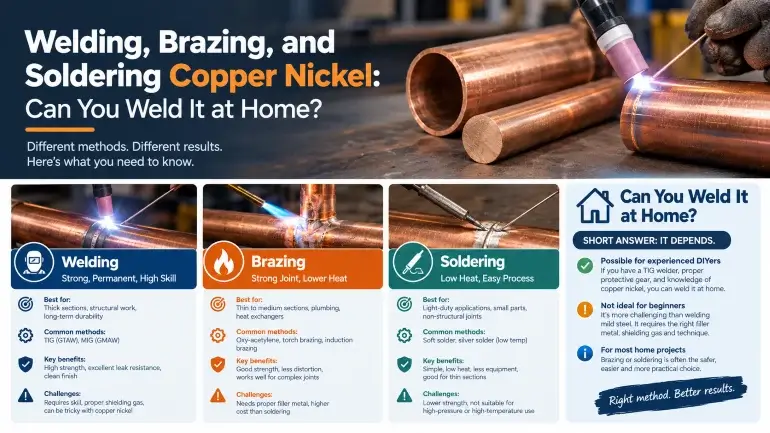
You can weld Copper Nickel (CuNi) at home if you have a DC TIG welder, pure argon shielding gas, deoxidized filler wire, and good puddle control. But CuNi behaves very differently from carbon or stainless steel. It pulls heat away quickly, the weld pool is highly fluid, and the metal is highly prone to porosity.
A hobbyist might ask this to fix a boat’s saltwater intake. Industrial fabricators and procurement managers ask it to understand field-repair limits for offshore platforms or desalination plants. The integrity of a CuNi joint depends on the joining method, the filler metal, and the quality of the base Copper Nickel Round Bars you start with.
This guide covers the technical realities of welding, brazing, and soldering the two most common grades: 90/10 (UNS C70600) and 70/30 (UNS C71500).
Table of Contents
Welding Copper Nickel (GTAW and GMAW)
Welding CuNi requires managing heat dissipation and preventing copper oxide formation. Oxides lead to severe weld porosity.
The Home Shop vs. Industrial Reality
Hobbyists usually stick to TIG (GTAW) on thin pipes. Industrial shops use TIG for root passes but often switch to MIG (GMAW) for thick walls and heavy flanges.
Required Consumables and Shielding
You cannot use standard stainless or mild steel fillers. That causes galvanic corrosion and joint failure in marine environments. You need an ERCuNi filler metal (AWS A5.7 classification). This wire contains deoxidizers like titanium, manganese, and silicon to match the base metal.
ERCuNi works for both grades. But if you are welding a high-strength Copper Nickel 70/30 Round Bar for a critical application, you might need a matching 70/30 filler to maximize erosion-corrosion resistance.
For shielding gas, use pure argon for TIG. For thick sections, a 75% helium and 25% argon mix adds heat and helps the weld tie in at the toes.
Preventing Porosity
Molten copper absorbs oxygen and hydrogen rapidly. Moisture or oil on the base metal creates steam bubbles in the pool, leaving a porous weld.
- Brush the joint with a stainless steel wire brush used only for CuNi. Cross-contamination from carbon steel ruins the weld.
- Wipe the joint with acetone or another non-chlorinated solvent to remove drawing lubricants and oils right before striking the arc.
- Preheat heavy sections over 15mm thick to 100°C or 150°C. This slows the cooling rate so gases can escape before the puddle freezes.
Brazing Copper Nickel
Brazing happens below the base metal’s melting point, usually between 600°C and 800°C. It avoids heat distortion and works well when TIG equipment is not practical.
When to Braze
Brazing is ideal for low-pressure marine plumbing like saltwater sanitation lines. It is also highly effective for dissimilar metal joints, such as connecting CuNi to brass or bronze valves in offshore manifolds.
Filler Metals and Flux
Use silver brazing alloys (AWS A5.8 BVAg series). Avoid copper-phosphorus (BCuP) fillers. Phosphorus reacts with the nickel in CuNi to form brittle phosphides, which crack under vibration.
Unlike TIG welding, brazing requires a chemical flux to dissolve oxides. Use a high-temperature fluoride-based flux. You must wash off all residual flux after brazing, or it will cause severe pitting in seawater.
Soldering Copper Nickel
Soldering uses fillers that melt below 450°C.
Mechanically, you can solder CuNi if you use aggressive fluxes and silver-bearing soft solders. But it is almost never acceptable for industrial or marine use.
Why Soldering Fails in B2B Environments
Solder lacks the tensile and shear strength to handle marine engine vibration or pressure spikes in desalination piping. Standard plumbing solders are also anodic to CuNi. In seawater, the solder corrodes rapidly and the joint leaks. Finally, solder weakens as operating temperatures rise.
If you cannot weld or braze a part, use mechanical joining like flanges, compression fittings, or threaded connections.
Common Fabrication Defects
Watch for these common defects whether you are in a home garage or a shipyard.
- Hot cracking: This happens if the joint is highly restrained or if the base metal contains impurities like lead, sulfur, or bismuth. Using an uncertified Copper Nickel 90/10 Round Bar with improper trace elements increases the risk of centerline cracking.
- Undercutting: The CuNi weld pool is very fluid. If your travel speed is too fast or amperage too high, you will melt away the edges of the joint.
- Zinc volatilization: Never use brass fillers. The arc heat vaporizes the zinc, creating toxic white fumes and leaving a porous joint.
Sourcing and Procurement Considerations
A good weld starts with good base metal. Procurement teams and EPC contractors need strict material traceability. Minor deviations in iron or manganese content change how the alloy handles high-velocity seawater. You need EN 10204 3.1 Mill Test Certificates to verify the chemistry of the specific heat you receive.
Why Global Fabricators Source from Euro Steel Bars (ESB)
We supply, stock, and export specialty alloy round bars. We operate as a physical wholesale stockist and an international export partner for professional buyers.
- Stock and lead times: Mills often quote 12 to 16 weeks for specialty alloys. We keep physical inventory of CuNi round bars to support urgent replacements and keep shop floors running.
- Cut-to-length services: We cut bars to your exact project specifications. This reduces material waste, lowers freight costs, and saves your machinists prep time.
- Traceability: Every shipment includes EN 10204 3.1 certificates. We verify the iron and manganese ratios that dictate erosion-corrosion resistance before the material ships.
- Export logistics: We handle the packaging, export documentation, and freight for shipyards in Singapore, desalination plants in Qatar, and offshore projects globally. The material arrives ready to machine or weld.
Frequently Asked Questions
What Filler Rod Should I Use for Copper Nickel 90/10 Welding?
Use an ERCuNi filler metal (AWS A5.7). It contains deoxidizers like titanium, manganese, and silicon, plus iron additions. These prevent porosity and match the base metal’s strength.
How Do I Prepare Copper Nickel 90/10 Before Welding?
Clean the joint with a stainless steel wire brush dedicated only to CuNi to remove oxides. Then wipe it with acetone to remove oils and drawing lubricants right before welding.
What Temperature Should Copper Nickel 90/10 Be Welded At?
Thin sections do not need preheat. Keep interpass temperatures below 150°C (300°F). For heavy sections over 15mm thick, preheat to 100°C or 150°C to slow cooling and let gases escape the weld pool.
Can a Beginner Welder Work With Copper Nickel 90/10?
It is difficult. CuNi pulls heat fast and the puddle is very fluid. It requires good TIG skills. Mistakes in surface prep or arc length will cause severe porosity.
How Do I Weld Copper Nickel 90/10 to Carbon Steel?
Do not weld them directly. It creates brittle phases and galvanic corrosion. Butter the carbon steel joint with a nickel-based filler like ERNi-1, machine it flat, and then weld the CuNi to that nickel layer using ERCuNi.
Can Copper Nickel 90/10 Be Annealed After Welding?
No post-weld heat treatment is required. CuNi is a solid-solution alloy and does not harden from welding heat. Mills only anneal it to relieve stresses from cold drawing.
Can You Solder Copper Nickel Easily?
Mechanically yes, if you use strong fluxes and silver-bearing soft solders. But CuNi forms oxides quickly when heated, making it hard for the solder to wet the surface.
Can I Solder Copper Nickel 90/10 Instead of Welding?
Only for low-pressure domestic plumbing. Solder lacks the strength for marine or industrial use and creates galvanic corrosion in seawater.
How to Braze Copper Nickel Properly?
Use a silver-based brazing alloy and avoid copper-phosphorus fillers. Apply a high-temperature fluoride flux, ensure a tight capillary fit, and wash off all residual flux afterward to prevent pitting.
How Do I Connect or Attach Copper Nickel 70/30 Round Bar?
For high-pressure or structural use, machine the ends for threaded connections, flanges, or mechanical couplings. If you must weld it, use TIG or MIG with ERCuNi wire, pure argon, and strict interpass temperature limits.