
When you swap carbon steel for copper nickel in a marine or desalination project, the weight changes immediately. Copper nickel is denser. A copper nickel round bar weighs about 13.5% to 14% more than a carbon steel bar of the exact same size.
Structural steel has a specific gravity of 7.85 g/cm³. Copper nickel alloys sit between 8.90 g/cm³ and 8.94 g/cm³. If you are estimating material costs, calculating container payloads, or checking crane capacities, you need to account for this density difference.
Table of Contents
The core difference: copper nickel density vs. carbon steel
To calculate the weight, you first need to know which grade you are buying. The two standard industrial grades under ASTM B151 are:
- Copper Nickel 90/10 Round Bar (UNS C70600). This contains 90% copper and 10% nickel, plus small amounts of iron and manganese. The nominal density is 8.90 g/cm³ (0.322 lb/in³). It is the standard choice for seawater cooling and condenser tubes because it resists biofouling.
- Copper Nickel 70/30 Round Bar (UNS C71500). This contains 70% copper and 30% nickel. The density is slightly higher at 8.94 g/cm³ (0.323 lb/in³). Engineers specify this for high-velocity seawater and aggressive chemical environments.
The 0.4% density difference between the two grades rarely matters for shipping, but it matters for strict weight-sensitive marine engineering.
How does copper nickel compare to pure copper and stainless steel?
When evaluating material substitutions, buyers need to compare weights across different alloy families.
Pure copper (C101/C110) has a density of 8.94 g/cm³. Copper nickel 90/10 is actually slightly lighter than pure copper, while 70/30 weighs almost the same.
Austenitic stainless steel (304/316) sits around 7.93 to 8.00 g/cm³. Copper nickel is about 11% to 12% heavier than standard stainless.
Carbon steel is 7.85 g/cm³. Copper nickel is roughly 14% heavier.
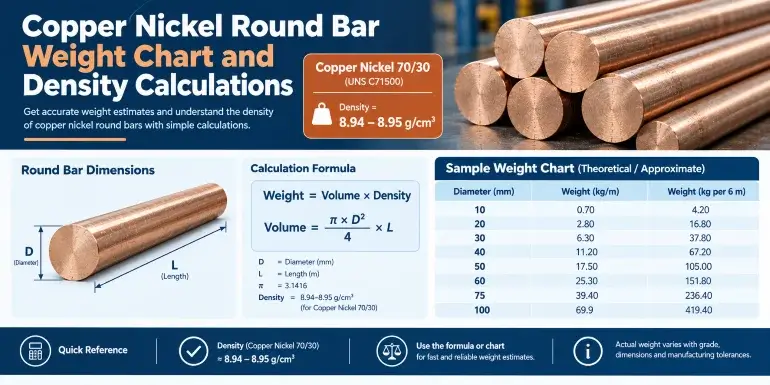
Copper nickel round bar weight chart (90/10 grade)
This table shows the theoretical weight for standard metric and imperial diameters of Copper Nickel Round Bars. We included both metric and imperial measurements to support international project estimators.
| Diameter (mm) | Diameter (inches) | Weight per meter (kg/m) | Weight per foot (lbs/ft) |
|---|---|---|---|
| 10 | 0.39 | 0.70 | 0.47 |
| 12 | 0.47 | 1.01 | 0.68 |
| 16 | 0.63 | 1.79 | 1.20 |
| 20 | 0.79 | 2.80 | 1.88 |
| 25.4 | 1.00 | 4.51 | 3.03 |
| 30 | 1.18 | 6.29 | 4.23 |
| 32 | 1.26 | 7.16 | 4.81 |
| 40 | 1.57 | 11.18 | 7.51 |
| 50 | 1.97 | 17.48 | 11.75 |
| 60 | 2.36 | 25.16 | 16.91 |
| 75 | 2.95 | 39.32 | 26.42 |
| 80 | 3.15 | 44.74 | 30.06 |
| 100 | 3.94 | 69.90 | 46.97 |
| 120 | 4.72 | 100.66 | 67.64 |
| 150 | 5.91 | 157.28 | 105.69 |
| 200 | 7.87 | 279.60 | 187.88 |
(Note: For 70/30 grade, add approximately 0.45% to the weights listed above to account for the higher density of 8.94 g/cm³).
How to calculate the weight of any copper nickel round bar
If you are ordering non-standard diameters or forged billets, you can calculate the theoretical weight yourself.
The formula for round bar weight
The standard formula multiplies the volume of the cylinder by the material density:
Weight = (π × Diameter² / 4) × Length × Density
The multiplier formula for metric measurements
Estimators usually use a simplified multiplier based on the specific gravity. Make sure your diameter is in millimeters and your length is in meters.
- For 90/10: Weight (kg/m) = Diameter (mm)² × 0.00699
- For 70/30: Weight (kg/m) = Diameter (mm)² × 0.00702
Converting weight per meter to weight per foot
If you have a metric chart but need imperial numbers for fabrication, multiply the kg/m value by 0.672. For example, a 50mm bar weighs 17.48 kg/m. Multiply 17.48 by 0.672 to get 11.75 lbs/ft.
Procurement and sourcing considerations
Theoretical weight is just the starting point. When you source these bars internationally, you have to account for manufacturing realities.
Diameter tolerance and actual weight
The charts above assume the bar is exactly at its nominal diameter. Actual delivered weight varies based on the manufacturing process and allowed tolerances under ASTM B151 or EN 12451.
Hot rolled black bars have wider diameter tolerances. A bar rolled to the upper limit of its tolerance will weigh noticeably more per meter than the theoretical calculation. Cold drawn, peeled, or turned bars have much tighter tolerances. If your project requires strict weight adherence, specify peeled bars.
Always clarify with your supplier if the material is sold on theoretical weight or actual weighed weight. Buying by actual weight prevents you from paying for oversized tolerances.
Freight and container payloads
Because copper nickel is 14% heavier than steel, you hit container weight limits much faster. A standard 20ft shipping container maxes out at roughly 28 metric tons. When you ship heavy diameters like 100mm or 150mm bars, the container reaches its weight limit before it runs out of floor space. You have to calculate the exact number of bundles per container to optimize freight costs and ensure the load is lashed safely for ocean transit.
Cut-to-length and machining allowances
When you order round bars for CNC machining, you have to account for the material that gets removed. If your supplier provides cut-to-length services, remember that the saw blade kerf, end-cropping to remove mill defects, and chamfering will slightly reduce the final delivered weight compared to the raw mill length.
Certification and traceability
Copper nickel is a high-value alloy used in critical offshore applications. Weight calculations need to be backed by verifiable documentation. When you verify the chemical composition of your Copper Nickel 70/30 Round Bar, require EN 10204 3.1 Mill Test Certificates to confirm the heat number chemistry and mechanical properties.
If weight is a critical engineering factor, ask the mill to explicitly verify the specific gravity on the MTC. For larger diameters, ultrasonic testing is standard practice to check for internal voids that would affect both structural integrity and actual weight.
Why industrial buyers source copper nickel from Euro Steel Bars
Managing alloy density, mill tolerances, and international freight requires a supplier who understands metallurgy and logistics. At Euro Steel Bars, we operate a physical wholesale stockholding facility alongside an international export supply chain. Here is how we handle the practical side of sourcing Copper Nickel Round Bars.
Precision cutting to reduce scrap
Copper nickel is expensive. Buying standard 3-meter or 6-meter random lengths usually leaves you with heavy, expensive offcuts. We saw-cut bars to your exact dimensional requirements. Supplying pre-cut blanks eliminates scrap weight, lowers your upfront material cost, and saves machining time.
Traceability and MTCs
Material pedigree is mandatory for marine and desalination projects. We supply every batch with full Mill Test Certificates detailing the chemical analysis, mechanical properties, and specific gravity. We maintain complete heat-number traceability from the mill to your site to satisfy third-party inspectors.
Export packaging and payload optimization
Standard bundling does not work for heavy, high-value alloy bars in international transit. We pack orders in heavy-duty export wooden crates with secure lashing. Our logistics team calculates container payloads to ensure your FCL or LCL shipments are optimized for weight limits, which prevents transit damage and avoids port surcharges.
Flexible supply for project and emergency stock
Whether you need a single replacement shaft for a ship repair or a full container load for a new desalination plant, we can fulfill the order. We keep strategic stock on hand for urgent requirements and leverage our mill network for large-scale project sourcing.
Sourcing copper nickel round bars
Accurate weight estimation is necessary for project budgeting and logistics, whether you need 90/10 for shipbuilding or 70/30 for high-pressure desalination.
Euro Steel Bars maintains a supply chain for copper nickel round bars that meets the dimensional and certification requirements of international marine and industrial projects. If you need to verify weights for a bill of materials, arrange custom cutting, or plan export logistics, contact our technical sales team to request a quote or check stock availability.
Frequently asked questions
How do I calculate the weight of a copper nickel round bar?
Square the diameter in millimeters and multiply by the density multiplier. Use 0.00699 for 90/10 and 0.00702 for 70/30. The result is the weight in kilograms per meter.
What is the formula for round bar weight?
The universal formula is Weight = (π × Diameter² / 4) × Length × Density. For quick metric calculations, use the simplified multiplier formula: Diameter (mm)² × Density Multiplier = kg/m.
What is the density of copper nickel in g/cm³ and lb/in³?
Copper nickel 90/10 has a density of 8.90 g/cm³ (0.322 lb/in³). Copper nickel 70/30 has a density of 8.94 g/cm³ (0.323 lb/in³).
How much does a 1-inch copper nickel round bar weigh per foot?
A 1-inch (25.4 mm) diameter 90/10 round bar weighs 3.03 lbs per foot (4.51 kg/m).
How much does a 50 mm copper nickel round bar weigh per metre?
A 50 mm diameter 90/10 round bar weighs 17.48 kg per metre. The 70/30 grade weighs roughly 17.55 kg/m.
How much does a 6-metre length of copper nickel round bar weigh?
Multiply the weight per metre by 6. A standard 50 mm 90/10 bar weighs 17.48 kg/m, so a 6-metre length weighs 104.88 kg.
Is 70/30 copper nickel heavier than 90/10?
Yes, but only slightly. The higher nickel content gives 70/30 a density of 8.94 g/cm³, making it about 0.45% heavier than 90/10 (8.90 g/cm³). Logistics teams usually ignore this difference, but engineers factor it into precise calculations.
How do I convert weight per metre to weight per foot?
Multiply the metric weight per metre (kg/m) by 0.672 to get the imperial weight per foot (lbs/ft). To go the other way, multiply lbs/ft by 1.488 to get kg/m.
Does diameter tolerance change the actual weight of the bar?
Yes. Theoretical charts assume the bar is exactly at its nominal diameter. Hot-rolled bars have wider tolerances, so a bar at the upper limit will weigh more than the chart suggests. Cold-drawn or peeled bars have tight tolerances and match theoretical weights closely.
How does copper nickel bar weight compare with copper and stainless steel?
Copper nickel (8.90 to 8.94 g/cm³) weighs almost the same as pure copper (8.94 g/cm³). It is significantly heavier than austenitic stainless steel (7.98 g/cm³) and carbon steel (7.85 g/cm³), adding 12% to 14% more weight for the same dimensions.