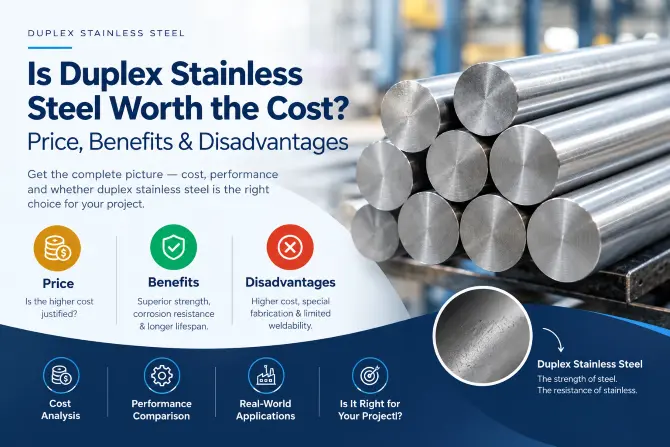
You have been handed a specification calling for UNS S31803 or S32205 round bar. Or perhaps you are evaluating whether to upgrade from 316L to duplex for a new project. Either way, the first question hitting your desk is straightforward: is the price premium justified, or is someone over-specifying?
This is the right question. Duplex stainless steel is not a universal upgrade. It solves specific problems exceptionally well, but it also carries real limitations in fabrication, availability, and cost behaviour that do not show up on a datasheet. If you are procuring, engineering, or fabricating with duplex round bar, you need the full picture before committing budget and lead time.
This guide covers what duplex actually costs relative to alternatives, why the price moves the way it does, where the genuine disadvantages sit, and when the investment makes sense versus when a cheaper grade will do the job.
Table of Contents
Understanding What You Are Actually Paying For
Duplex stainless steel gets its name from its two-phase microstructure, which consists of roughly equal parts austenite and ferrite. This is not a marketing label. The dual-phase structure is what delivers approximately double the yield strength of standard austenitic grades like 304 or 316L, along with significantly improved resistance to chloride stress corrosion cracking (SCC).
The most common grades you will encounter in round bar form include:
- Lean Duplex (e.g., S32304): Lower Mo, no Ni added intentionally. Used in structural applications, bridges, and rebar.
- Standard Duplex (S31803/S32205): 22%Cr, 5%Ni, 3%Mo. Standard for oil and gas, chemical, and marine sectors.
- Super Duplex (S32750/S32760): 25%Cr, 7%Ni, 3.5%Mo + N. Used in subsea, FGD, and aggressive chemical environments.
- Hyper Duplex (S33207/S32906): Greater than 29%Cr, very high PREN. For extreme chloride and deep subsea applications.
For a complete inventory of available grades and specifications, explore our full range of duplex stainless steel round bars.
The alloying package is what drives cost. Standard duplex (2205) contains roughly 22% chromium, 5% nickel, and 3% molybdenum, plus nitrogen. Super duplex pushes to 25%Cr, 7%Ni, and 3.5-4%Mo, with copper and tungsten additions in some specifications. Every percentage point of molybdenum and nickel adds cost at the melt, and these elements are where the price volatility lives.
Duplex Stainless Steel Price Guide: What to Expect
The Pricing Structure
Duplex round bar is not priced like commodity carbon steel. You will not find a single spot price that applies globally. Instead, the price you receive from a stockist or mill depends on several layered factors:
1. Alloy surcharge (the dominant variable)
Most mills and stockists price duplex bar as a base price plus an alloy surcharge. The surcharge recalculates monthly (sometimes weekly) based on the London Metal Exchange (LME) or producer-published indices for nickel, molybdenum, chromium, and sometimes manganese and nitrogen. For 2205, nickel and molybdenum together typically account for 60-75% of the surcharge. For super duplex, the share of molybdenum increases further.
This means the price you were quoted three months ago may not hold today. If you are budgeting a project six months out, build in a 10-20% contingency on the alloy surcharge component unless you lock pricing with your supplier.
2. Size and form
Round bar pricing varies by diameter. Smaller diameters (below 25mm) often carry a premium per kilogram because of higher processing costs relative to material volume. Very large diameters (above 200mm) may also carry a premium due to limited mill rolling capacity and longer production cycles. The sweet spot for pricing efficiency is generally in the 30-150mm range, where most mills run regular production schedules.
3. Specification and testing
A bar supplied to ASTM A276 with a standard mill test certificate (MTC/EN 10204 3.1) is the baseline. If your project requires NACE MR0175/ISO 15156 compliance (common in oil and gas), PED 2014/68/EU certification, 3.2 third-party inspection, or specific impact testing at sub-zero temperatures, each requirement adds cost. NACE-compliant 2205 bar, for example, requires tighter control of ferrite content, hardness limits (typically less than or equal to 28HRC), and specific heat treatment records.
4. Quantity and availability
Full truckload or container-load quantities from a stockist will price significantly better per kilogram than a single 6m length cut to order. If the size you need is in stock at a regional distribution centre, you avoid the mill surcharge for a production run. If it must be mill-rolled, you are paying for a dedicated heat, and minimum order quantities apply (often 5-10 tonnes per size).
5. Origin and certification pathway
Bars sourced from major European, Japanese, or Korean mills typically price higher than Indian or Chinese-origin material, partly due to brand premium and partly due to differing testing and traceability standards. For projects in the Gulf or Europe where end-user approval lists restrict origins, this matters.
Approximate Price Positioning (Relative, Not Absolute)
Giving a fixed EUR/kg or USD/kg figure in a published article would be misleading because alloy surcharges shift monthly. What is stable is the relative positioning:
- 2205 duplex round bar typically costs 1.5-2.2x the price of 316L round bar of the same size and specification.
- Super duplex (S32750/S32760) sits at roughly 2.5-3.5x the price of 316L, and 1.5-1.8x the price of 2205.
- Lean duplex (S32304) can be close to or slightly below 316L pricing because it eliminates or reduces nickel, though availability in round bar form is more limited.
- Compared to carbon steel or low-alloy bar, duplex is 4-7x more expensive per kilogram, but the strength-to-weight advantage means you may use less material.
The critical calculation is not cost per kilogram. It is cost per unit of delivered performance, including corrosion life, pressure rating, wall thickness reduction, maintenance interval, and replacement cycle.
What Drives Price Volatility
If you are tracking duplex pricing over a project timeline, watch these indicators:
- Nickel (LME): The single largest swing factor. A 20% move in nickel can shift the duplex surcharge by 8-12%.
- Molybdenum (Mo oxide/ferro-molybdenum): Less publicly traded than nickel, but molybdenum price spikes disproportionately affect super duplex.
- Energy costs: Electric arc furnace (EAF) melting, which most stainless producers use, is energy-intensive. European energy price fluctuations feed into base prices.
- Freight and logistics: For buyers in the Gulf, Southeast Asia, or South Africa importing from European or Asian mills, container rates and surcharges add a meaningful layer.
The Real Disadvantages of Duplex Stainless Steel
This is the section most supplier websites skip or soften. We will not. If you are going to spend 1.5-3x more per kilogram, you need to know where duplex creates problems.
1. Narrow Heat Treatment and Fabrication Window
Duplex stainless steel must be solution-annealed at 1020-1100°C followed by rapid quenching. If cooling is too slow, or if the material is held in the 600-1000°C range during welding or hot forming, intermetallic phases (sigma, chi) and chromium nitrides precipitate. These destroy toughness and corrosion resistance.
In practice, this means:
- Welding requires strict heat input control (typically 0.5-2.5kJ/mm for 2205). Too little heat and you get excessive ferrite; too much and you get sigma phase.
- Post-weld heat treatment is generally not possible in the way you might stress-relieve carbon steel. You cannot simply normalise duplex.
- Hot forming must be done in a tight temperature band (typically 1100-950°C for 2205), and the workpiece must be quenched afterward. This is significantly more demanding than hot-forming 316L.
For a fabricator used to working with 304 or 316L, duplex introduces process discipline that increases labour time and requires trained welders with specific procedure qualifications.
2. Limited Availability in Some Sizes and Forms
While 2205 round bar in common diameters (20-150mm) is reasonably well stocked globally, super duplex and hyper duplex round bars are not. If you need S32750 bar in 180mm diameter, you may face a 12-20 week mill lead time because production runs are infrequent. Lean duplex round bar, such as Duplex Stainless Steel 2101 Round Bar or 2404, is even harder to source outside of specific structural applications.
This availability gap creates project risk. If a bar fails inspection or you discover a quantity shortfall mid-project, replacement is not as simple as calling a local stockist for 316L.
3. Machining Difficulties
Duplex is tougher and work-hardens more readily than 316L. The high ferrite content makes chip formation less predictable, and the strength of the material means higher cutting forces and faster tool wear. In practice:
- Cutting speeds need to be reduced by roughly 20-30% compared to 316L.
- Tooling costs increase, particularly for deep-hole drilling of round bar.
- Thread cutting and tapping require rigid setups and appropriate coolants.
For buyers purchasing round bar for CNC machining into valve bodies, pump shafts, or fasteners, this translates to higher machining time and cost per finished part.
4. Toughness Limitations at Low Temperatures
Duplex stainless steel has a ductile-to-brittle transition temperature because of its ferrite phase. Standard 2205 is generally rated for service down to approximately -50°C, and super duplex to around -46 to -60°C depending on specification. This is adequate for most oil and gas and chemical applications, but it is not suitable for cryogenic service (LNG at -162°C, liquid nitrogen, etc.), where austenitic grades like 304L, 316L, or 9% nickel steel are required.
5. Not Universally Approved or Familiar
In some regions and industries, duplex is still less familiar to inspectors, welding engineers, and maintenance teams. This can slow down approval processes, require additional welding procedure qualifications (WPQR), and create resistance during handover. If your end client’s approved vendor list or welding specification has not been updated to include duplex, the administrative overhead can offset the material savings.
6. Cost Sensitivity to Small Quantities
Because duplex bar is more expensive per kilogram and often stocked in narrower size ranges, small-quantity purchases are disproportionately expensive. If you need three lengths of 60mm 2205 bar for a repair job, you may pay a significant premium over the per-kg stockist price, or face a minimum order. This makes duplex less economical for maintenance spares and one-off fabrications compared to the 316L that is sitting in every steel trader’s warehouse.
When Duplex IS Worth the Cost
Despite those disadvantages, duplex is the correct and often the only economical choice in specific scenarios:
- Chloride-rich environments where 316L will fail. Offshore platforms, desalination plants, seawater cooling systems, and chemical processing with chlorides above 200ppm. 316L will suffer pitting and SCC; 2205 or super duplex will not, within their PREN limits. The cost of a 316L failure (shutdown, replacement, safety risk) dwarfs the initial material premium.
- Where weight and wall thickness matter. Because duplex yield strength is roughly 450-550MPa versus 200-250MPa for 316L, you can design with thinner walls. In pressure vessels, heat exchanger tubes, or structural members, this can reduce material volume by 30-50%, partially or fully offsetting the per-kg price difference.
- Oil and gas upstream and subsea. NACE MR0175 environments with H2S and CO2. Duplex and super duplex are specified here not as a luxury but as a requirement. There is no cheaper alternative that meets the corrosion and mechanical demands simultaneously.
- Bridging the gap between 316L and nickel alloys. When 316L is not enough but Inconel 625 or Hastelloy C-276 would be overkill (and 5-10x the cost), super duplex sits in the right performance-to-cost band.
When Duplex Is NOT the Right Choice
- General atmospheric or freshwater service: 304 or 316L is cheaper, easier to fabricate, and perfectly adequate.
- Cryogenic applications: Use austenitic grades.
- Highly acidic (sulphuric, hydrochloric) environments below pH2: Duplex does not perform well. You need high-nickel alloys or titanium.
- Applications requiring extensive hot forming or complex welding geometries: The fabrication constraints of duplex may make 316L or a nickel alloy more practical despite higher material cost.
- Small-quantity, non-critical spare parts: The sourcing difficulty and cost premium do not justify it.
Practical Buying Considerations for Duplex Round Bar
If you have determined duplex is the right grade, here is what to get right at the procurement stage:
- Confirm the exact specification. “Duplex” is not sufficient. You need the UNS number (S31803 vs. S32205 matters, as S32205 is the refined version with tighter composition), the delivery standard (ASTM A276, EN 10088-3, ASME SA-276), and any project-specific requirements (NACE, PED, impact testing temperature).
- Clarify the testing and documentation package. Do you need EN 10204 3.1 (manufacturer’s declaration) or 3.2 (independent inspection)? Does the MTC need to include ferrite content, hardness, and impact test results? For oil and gas, confirm whether the NACE compliance is per MR0175/ISO 15156 and which edition.
- Ask about stock versus mill rolling. If your size is in stock at a supplier’s warehouse, you save 8-16 weeks. If it must be produced, confirm the mill’s minimum order quantity, production lead time, and whether the heat will be dedicated or shared.
- Lock pricing carefully. Given alloy surcharge volatility, ask your supplier whether the quoted price is fixed or subject to surcharge adjustment at delivery. For projects with long lead times, some suppliers will offer surcharge-capped pricing for a fee.
- Plan for machining and fabrication. If the bar is going to a machine shop or fabricator, make sure they have experience with duplex. Provide them with the MTC so they know the exact composition and hardness. Confirm welding consumables (typically ER2209 for 2205, ER2594 for super duplex) are available.
Cheaper Alternatives: And When They Work
- 316L: Works in low-chloride environments, general chemical service, and food-grade applications. Fails where there is chloride SCC risk or high-strength requirements.
- Lean duplex (S32304): Works in structural applications and moderate chloride exposure where Ni cost is a concern. Fails in aggressive chemical or oil and gas sour service.
- Coated or painted carbon steel: Works for atmospheric, non-critical, budget-driven projects. Fails in any wet chloride or chemical exposure.
- FRP/GRP: Works in highly corrosive, low-pressure, non-structural applications. Fails under high pressure, high temperature, or heavy mechanical load.
- Titanium Grade 2: Works in extreme chloride, seawater, and weight-critical designs. Fails in reducing acids and carries a massive cost at large sections.
The honest answer is that for the specific applications where duplex is specified (offshore oil and gas, desalination, chemical processing with chlorides), there is usually no cheaper metallic alternative that delivers the same combination of strength, corrosion resistance, and weldability. That is precisely why it exists.
Frequently Asked Questions
What are the main disadvantages of duplex stainless steel?
The primary disadvantages are a narrow heat treatment and welding window (risk of sigma phase precipitation between 600-1000°C), higher machining difficulty and tool wear compared to 316L, limited availability in larger or less common sizes, a ductile-to-brittle transition that excludes cryogenic service, and a 1.5-3x cost premium over standard austenitic grades. Fabrication requires trained personnel and strict procedural control.
What are the main disadvantages of duplex stainless steel compared to 316L specifically?
Against 316L, duplex is harder to weld (tighter heat input range, mandatory filler metal matching), more difficult to machine (higher cutting forces, faster tool wear), and less widely stocked in small quantities. 316L can be stress-relieved more easily, formed cold with greater ease, and is familiar to virtually every fabricator and inspector globally. Duplex demands more process discipline at every stage.
What are the real, day-to-day disadvantages of duplex stainless steel in fabrication?
In practice, the biggest operational headaches are welding delays (strict interpass temperature control, qualified procedures, matching consumables like ER2209), the inability to post-weld heat treat, and the need for rapid quenching after any hot work. Machine shops report 20-30% slower cutting speeds and higher tooling costs. These add labour hours and require planning that 316L simply does not.
Are there cheaper alternatives to duplex stainless steel?
For low-chloride or atmospheric service, 316L or even 304 is cheaper and sufficient. Lean duplex reduces nickel content and can approach 316L pricing. For non-metallic solutions, FRP works in highly corrosive but low-pressure applications. However, in high-chloride, high-pressure, or sour-service environments (oil and gas, desalination), no cheaper metallic grade replicates the combination of strength and corrosion resistance found in duplex steel.
Why don’t more people use duplex stainless steel?
Three reasons dominate: cost (the per-kg premium is hard to justify without a clear corrosion or strength driver), fabrication complexity (many workshops are set up for austenitic grades and lack duplex welding qualifications), and limited stock availability in smaller or unusual sizes. In regions without established duplex supply chains, lead times and minimum order quantities discourage adoption for anything but large projects.
Does the price of duplex stainless steel track the nickel and molybdenum market?
Yes, directly. Most producers calculate a monthly alloy surcharge based on LME nickel, molybdenum (often via ferro-molybdenum indices), chromium, and sometimes manganese. For 2205, nickel and molybdenum drive roughly 60-75% of the surcharge. A 20% swing in nickel can shift the duplex bar price by 8-12%. Super duplex is even more sensitive to molybdenum due to its 3.5-4%Mo content.
Is it cheaper to buy duplex round bar in bulk?
Yes, meaningfully. Stockists typically offer volume discounts at 1-tonne, 5-tonne, and full-container thresholds. Bulk orders also reduce per-kg cutting, handling, and documentation costs. More importantly, buying a full production lot from a mill avoids the premium charged for splitting a heat. For project buyers, consolidating all round bar sizes into a single order is the most effective way to reduce the per-kg cost.
Does duplex stainless steel cost more per kg than 316 stainless steel?
Yes. Standard duplex 2205 round bar typically costs 1.5-2.2x more per kilogram than 316L bar of the same diameter and specification. Super duplex (S32750) runs 2.5-3.5x more than 316L. The premium reflects higher nickel, molybdenum, and nitrogen content, tighter production controls, and lower production volumes. However, the higher yield strength of duplex can reduce the total material volume needed.
What is the typical lead time for duplex stainless steel round bar?
If the size is in stock at a regional stockist, delivery is typically 1-3 weeks including cutting, testing, and documentation. If the bar must be mill-produced, expect 10-20 weeks for standard duplex and 14-26 weeks for super duplex, depending on mill schedule, order size, and testing requirements. NACE-compliant or third-party-inspected (3.2) orders add 2-4 weeks for inspection coordination.
Does higher molybdenum content make super duplex more expensive than standard duplex?
Yes. Super duplex grades like S32750 contain 3.5-4% molybdenum versus roughly 3% in 2205, along with higher chromium (25% vs 22%) and nickel (7% vs 5%). Molybdenum is expensive and its ferro-alloy price is volatile. The additional alloying, combined with tighter production controls and lower volumes, makes super duplex round bar roughly 1.5-1.8x the price of standard 2205 per kilogram.
Final Assessment: Is It Worth It?
Duplex stainless steel is worth the cost when the application demands it. If you are dealing with chlorides, sour service, high mechanical loads in corrosive media, or a design where halving the wall thickness saves more than the alloy premium costs, duplex is not an expense. It is the economical choice over the asset’s life.
It is not worth it as a default upgrade, a reflex to use something “better than 316L”, or a specification carried over from another project without engineering justification. The fabrication constraints, limited small-quantity availability, and machining penalties are real, and they add cost beyond the material price.
The right approach is to match the grade to the environment, confirm the specification with your engineering team, source from a stockist who can provide full certification and realistic lead times, and build alloy surcharge movement into your project budget.
If you need duplex or super duplex round bar with full documentation, NACE compliance, and delivery to the Gulf, Southeast Asia, Europe, or beyond, contact the Euro Steel Bars team with your specification, size range, and quantity. We will confirm availability, current surcharge positioning, and lead time before you commit.
Euro Steel Bars stocks and supplies stainless steel, duplex, super duplex, nickel alloy, titanium, carbon, and alloy steel round bars in a full range of diameters, specifications, and certifications. All material is supplied with mill test documentation to EN 10204, with NACE, PED, and third-party inspection available on request.