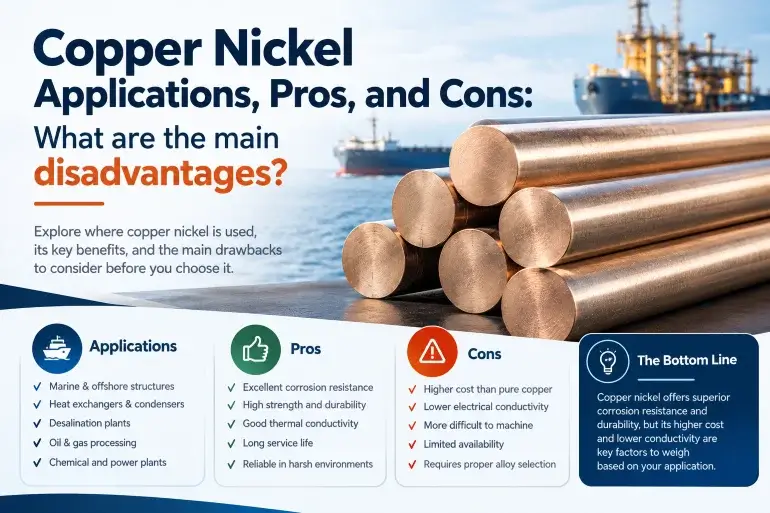
Engineers and procurement teams specify copper nickel (CuNi) alloys for marine, offshore, and desalination projects because the metal resists seawater corrosion and biofouling. But it does not work for every application.
Specifying CuNi means weighing its marine benefits against specific mechanical and environmental limits. Buyers sourcing pipes for heat exchangers or Copper Nickel Round Bars for machined parts need to know where the material fails to avoid project delays and cost overruns.
Table of Contents
The main disadvantages of copper nickel
CuNi performs well in static or slow-moving clean seawater. It struggles in other environments. The primary drawbacks fall into five categories.
Lower mechanical strength than steel
Carbon steel, alloy steel, and duplex stainless steels have much higher yield and tensile strengths. CuNi cannot handle high structural loads. Engineers designing pressure vessels or piping must specify thicker walls to compensate, which increases the overall weight and material volume of the project.
High material costs
Copper and nickel are expensive commodity metals. Alloys like 90/10 and 70/30 cost significantly more upfront than 316L stainless steel or carbon steel. Procurement teams have to justify this initial capital expense by pointing to lower maintenance costs and longer service life.
Susceptibility to impingement attack
CuNi relies on a thin cuprous oxide film for corrosion resistance. If fluid velocity exceeds the design limit, the flow strips this film away. This causes rapid localized pitting and horseshoe-shaped grooves. Generally, 90/10 CuNi handles continuous fluid velocities up to 2.5 m/s, while 70/30 CuNi manages up to 3.0 m/s. The metal is a poor choice for high-velocity pump impellers or areas with heavy turbulence.
Vulnerability to sulfides and ammonia
The alloy resists clean, oxygenated seawater but fails in polluted water. Anaerobic bacteria in harbors produce sulfides, which react with the protective oxide film and cause rapid pitting when the water re-oxygenates. CuNi is also susceptible to stress corrosion cracking in the presence of ammonia, making it unsuitable for environments with agricultural runoff or specific chemical off-gassing.
Machining challenges
Workshops machining Copper Nickel Round Bars into valve stems or pump shafts deal with a gummy material. CuNi work-hardens rapidly if the cutting tool rubs instead of cuts. Machinists need rigid setups, specific tool geometries, and heavy-duty cutting fluids to prevent built-up edge and hold tight tolerances.
Why specify copper nickel?
The drawbacks are manageable in the right environments. When applied correctly, CuNi offers specific benefits that other metals cannot match.
- It resists biofouling. The slow release of copper ions stops barnacles and algae from attaching to surfaces, which reduces the need for chemical biocides in cooling systems.
- It resists general seawater corrosion, pitting, and crevice corrosion in clean, aerated water.
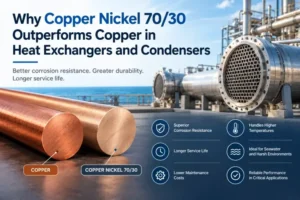
- It has high thermal conductivity, making it efficient for condensers and heat exchangers.
- It resists chloride-induced stress corrosion cracking, a common failure point for austenitic stainless steels in warm seawater.
- It is easy to weld, bend, and form without post-weld heat treatment.
Common grades and international standards
Buyers typically encounter two primary alloys. Specifying the correct grade depends on the required mechanical strength and corrosion resistance.
| Alloy name | UNS number | DIN / EN equivalent | Common standards | Characteristics and sourcing |
|---|---|---|---|---|
| 90/10 CuNi | UNS C70600 | CuNi10Fe1Mn (2.0872) | ASTM B151, EN 12451 | Lower cost and good biofouling resistance. Used for general seawater piping and the widely stocked Copper Nickel 90/10 Round Bar for marine hardware. |
| 70/30 CuNi | UNS C71500 | CuNi30Mn1Fe (2.0882) | ASTM B151, EN 12451 | Higher nickel content increases strength and resistance to flow velocity. Specified as Copper Nickel 70/30 Round Bar for high-stress marine shafts. |
ASTM B151 is the standard specification for copper-nickel rod and bar.
Primary applications
Based on its metallurgical properties, CuNi is heavily utilized in specific sectors.
- Marine and shipbuilding: Seawater cooling systems, heat exchangers, condensers, and firewater lines. Machine shops use the metal for fasteners, propeller shafts, and valve stems.
- Offshore oil and gas: Splash zone sheathing, seawater lift pipes, and platform cooling systems.
- Desalination: Evaporator tubing, brine heaters, and heat recovery sections.
- Power generation: Main condensers and auxiliary cooling systems in coastal plants.
Procurement and sourcing considerations
Buyers issuing an RFQ need to verify the supply chain can meet project specifications.
- Require EN 10204 3.1 mill test certificates. The certificate must verify the exact chemical composition, especially iron and manganese, which control erosion-corrosion resistance.
- Demand heat-number traceability from the final machined part back to the original melt.
- Specify the surface finish. Cold-drawn, turned, or peeled finishes reduce material removal and work-hardening during final machining.
Why procurement teams buy from Euro Steel Bars
Sourcing non-ferrous alloys requires a reliable supply chain. Euro Steel Bars (ESB) supplies physical wholesale stock and handles international project requirements.
- We keep physical stock of premium CuNi round bars to bypass long mill lead times and dispatch urgent orders quickly.
- We cut material to length. Shipping full random mill bars increases freight costs. We deliver Copper Nickel Round Bars sized for your CNC machines, ready for production when they arrive.
- We provide full heat-number traceability and original EN 10204 3.1 mill test certificates with every shipment so your QA teams can approve the material without delays.
- Our export team handles the logistics, crating, and documentation to deliver high-value alloys to shipyards in Singapore, desalination projects in Qatar, or fabrication shops in South Africa.
Frequently asked questions
What is copper nickel used for?
It is used in marine and industrial applications that involve seawater or brackish water. Common uses include seawater cooling systems, heat exchangers, condensers, desalination tubing, offshore firewater lines, and marine hardware.
Why is copper nickel used in boat building?
Boat builders use it for hull sheathing, piping, and cooling systems because it resists biofouling. The alloy releases copper ions that stop barnacles and algae from attaching to the hull, which improves fuel efficiency and removes the need for antifouling paints.
Why do shipyards use copper nickel?
Shipyards specify it for seawater circuits because it lasts a long time in harsh marine environments with minimal maintenance. It resists chloride stress corrosion cracking and macro-fouling, which reduces dry-dock maintenance and prevents system failures.
Is copper nickel worth the investment for my project?
It is worth the cost for seawater and offshore applications. The initial material cost is higher than stainless or carbon steel, but the operating costs are lower. You save money by eliminating biofouling maintenance, chemical biocides, and frequent replacements.
Is copper nickel safe for drinking water systems?
Yes, it is safe for potable water and is used in desalination post-treatment and municipal water lines. It meets international health standards for drinking water contact, though it is usually reserved for marine applications because of the price.
Can I use copper nickel 70/30 for plumbing?
You can, but it is usually too expensive for standard domestic plumbing. UNS C71500 is normally reserved for specialized marine plumbing, offshore rig water systems, or architectural water features that require extreme corrosion resistance.
What are the main advantages of copper nickel?
The main advantages are its resistance to seawater corrosion, natural immunity to marine growth, high thermal conductivity, and resistance to chloride-induced stress corrosion cracking compared to austenitic stainless steels.
Is copper nickel used for valves, pumps and fittings?
Yes. Manufacturers use it to make marine valves, pump components, and fittings. Machine shops turn Copper Nickel 90/10 Round Bar into valve stems, pump shafts, impellers, and flanges because it resists the erosive effects of high-velocity seawater.
Is copper nickel used in offshore oil and gas?
Yes. The offshore sector uses it for splash zone sheathing on platform legs, seawater lift pipes, firewater ring mains, and cooling systems on rigs and FPSO vessels.
Is copper nickel used in aquaculture and fish farming?
Yes. The aquaculture industry uses CuNi alloy mesh and cages. The metal resists corrosion and biofouling, which prevents net occlusion, maintains water flow and oxygen to the fish, and keeps the cages structurally sound in ocean currents without frequent cleaning.