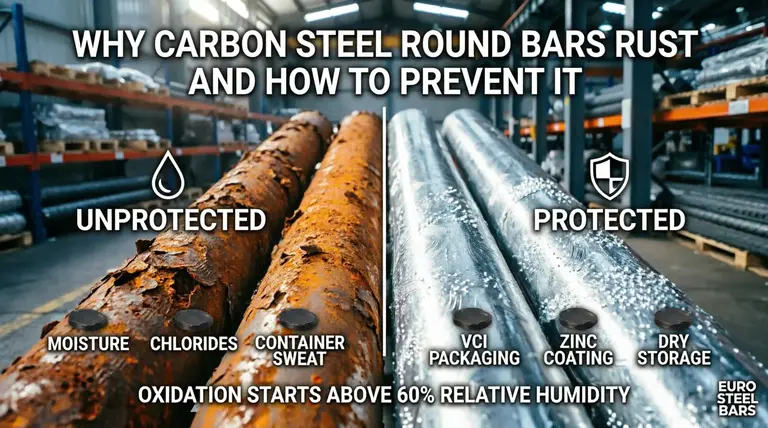
Carbon steel round bars provide high tensile strength, good machinability, and low cost for industrial applications. They lack the chromium oxide layer found in stainless steel, which makes them prone to oxidation. When iron in the steel reacts with oxygen and moisture, it forms hydrated iron oxide, or rust.
Carbon steel round bars rust because their iron content undergoes electrochemical oxidation when exposed to moisture and oxygen. Preventing this requires environmental control, protective packaging like VCI film, surface treatments such as galvanizing, or upgrading to a corrosion-resistant alloy like stainless steel or duplex steel when the environment demands it.
Procurement managers, EPC contractors, and fabricators need to understand how carbon steel corrodes and how to prevent it during transit and use. This knowledge protects material tolerances and prevents project delays. When sourcing carbon steel round bars for industrial projects, recognizing this vulnerability helps prevent material failure.
Table of Contents
The science of rust: Why carbon steel corrodes
The oxidation reaction
Rust forms through an electrochemical process. When a carbon steel round bar is exposed to moisture, even atmospheric humidity, water acts as an electrolyte. Oxygen from the air reacts with the iron at the surface:
4Fe + 3O₂ + 6H₂O → 4Fe(OH)₃ → 2Fe₂O₃·3H₂O (Rust)
This reaction turns hard iron into a flaky, porous compound. Unlike the protective patina on aluminium or the chromium oxide layer on stainless steel, rust does not seal the surface. It penetrates inward and degrades the bar.
The role of carbon content
Carbon steel typically contains 0.05% to 2.1% carbon by weight. Carbon increases hardness and strength, but it also creates micro-galvanic cells within the steel matrix. The carbon regions (cementite, Fe3C) act as cathodic sites, while the surrounding iron acts as the anode. Moisture acts as an electrolyte, and these micro-cells accelerate localized corrosion.
Higher carbon grades like EN8 or AISI 1045 may show slightly faster initial surface rusting than low carbon grades like EN3B or AISI 1018 because of this microstructural effect. Both will corrode without protection.
Types of corrosion on carbon steel round bars
| Corrosion type | Appearance | Risk level | Common cause |
|---|---|---|---|
| Uniform surface rust | Even orange-brown discoloration across the surface | Low to moderate | Ambient humidity, storage in unventilated areas |
| Pitting corrosion | Small, deep craters that penetrate the surface | High | Chloride exposure, stagnant moisture pools |
| Crevice corrosion | Localized attack under straps, bands, or contact points | Moderate to high | Trapped moisture in bundled bars, packaging gaps |
| Galvanic corrosion | Accelerated rust where carbon steel contacts a more noble metal | High | Contact with copper, brass, or stainless steel fittings |
For precision-machined components, even 0.05 mm of pitting can make a round bar unfit for its application.
Environmental accelerators: Why rust happens during transit and storage
Buyers in the Gulf, Middle East, Southeast Asia, coastal Europe, Turkey, and South Africa face climatic conditions that accelerate carbon steel corrosion.
Container sweat and temperature fluctuations
When carbon steel round bars are shipped by sea, temperature differences inside the shipping container cause condensation. This happens often on routes crossing the equator or moving between temperate and tropical zones. The condensation, called container sweat or cargo sweat, deposits a thin film of water directly onto the steel surface. A four to six week voyage gives this moisture enough time to produce visible surface rust on uncoated bars. To manage this risk during long voyages, you can contact our technical sales team to discuss desiccant and VCI packaging options for your shipping route.
High humidity and tropical climates
In regions like Southeast Asia and the Gulf coast, relative humidity regularly exceeds 80%. At humidity levels above 60%, a molecular layer of water adsorbs onto the steel surface. This starts the oxidation process even without visible liquid water. Storing carbon steel round bars outdoors or in poorly ventilated warehouses in these climates speeds up corrosion.
Chlorides and marine environments
Airborne chlorides are a primary corrosion catalyst for buyers in the oil, gas, petrochemical, marine, and offshore sectors. Salt air penetrates packaging and attacks the steel surface. Chloride ions break down any naturally forming oxide film and promote pitting corrosion. This affects:
- Offshore platform construction
- Desalination plants
- Port and harbour infrastructure
- Shipbuilding and marine engineering
Industrial pollutants
Sulphur dioxide, nitrogen oxides, and acidic particulates in industrial atmospheres lower the pH of surface moisture. This turns the moisture into a weak acid that dissolves iron faster. Buyers near refineries, chemical plants, or heavy manufacturing zones need to account for this in their storage planning.
How to prevent rust on carbon steel round bars
Prevention happens at three stages: transit and storage, machining and fabrication, and final application.
Short-term protection: Storage and transit
These measures protect the round bar from the time it leaves the mill until it reaches your facility.
VCI (Volatile Corrosion Inhibitor) packaging uses films, papers, and emitters that release a vapour-phase inhibitor. This condenses on the metal surface and forms a protective molecular layer. This method works well for export shipments because it leaves no oily residue on the steel.
Desiccants and moisture barriers also help. Industrial silica gel packs absorb residual moisture inside sealed packaging. When combined with heavy-duty polyethylene shrink wrap or aluminium foil barriers, desiccants maintain a dry microenvironment around the bars.
Proper warehousing practices are necessary. Store round bars indoors, away from direct rain and ground moisture. Elevate bars on timber dunnage at least 100 mm off the floor to prevent moisture wicking from concrete. Ensure adequate air circulation to prevent condensation buildup, and avoid storing carbon steel in direct contact with stainless steel, copper, or brass components.
Reputable suppliers inspect bars for mill-scale integrity, surface defects, and residual moisture before packaging. A compromised mill scale or a small scratch can start corrosion during a long sea voyage.
Medium-term protection: Machining and fabrication
Once the bar enters your workshop, new corrosion risks appear.
Use corrosion-inhibited cutting fluids. Water-soluble coolants with built-in rust preventers protect freshly machined surfaces during turning, milling, and drilling.
Control swarf contamination. Carbon steel chips left on the surface of a stainless steel or alloy component can start galvanic corrosion. Keep workstations separated by material type.
Apply temporary rust-preventive oils on machined surfaces if the component will sit in inventory before final assembly. Mineral oil-based or synthetic films work well for this.
Long-term protection: End-use surface treatments
For the finished component or installed round bar, surface treatment is the primary defence.
| Treatment | Mechanism | Best suited for | Typical thickness |
|---|---|---|---|
| Hot-dip galvanizing | Zinc sacrificial layer (cathodic protection) | Structural steel, outdoor infrastructure, fencing | 50 to 150 µm |
| Electroplating (zinc/nickel) | Thin metallic barrier and sacrificial action | Automotive, fasteners, precision parts | 5 to 25 µm |
| Black oxide (bluing) | Conversion coating (Fe3O4) and oil seal | Gears, shafts, aesthetic industrial parts | 1 to 2 µm |
| Phosphating | Conversion coating for paint adhesion | Pre-treatment before painting or powder coating | 1 to 5 µm |
| Epoxy or polyurethane coating | Physical barrier against moisture and chemicals | Marine, chemical processing, buried structures | 100 to 500 µm |
| Powder coating | Thermoset polymer barrier | Architectural, agricultural, general engineering | 60 to 120 µm |
For oil, gas, petrochemical, and marine applications in the Middle East and Southeast Asia, combining galvanizing with a high-build epoxy topcoat is the standard approach for long-term corrosion resistance.
Material selection: When to upgrade from carbon steel to corrosion-resistant alloys
The cumulative cost of surface treatment, maintenance, inspection, and re-coating can eventually exceed the price premium of a corrosion-resistant alloy. Procurement teams and design engineers should evaluate the total lifecycle cost rather than just the initial material cost.
Decision framework
| Factor | Stick with carbon steel and protection | Upgrade to an alloy |
|---|---|---|
| Environment | Indoor, dry, or easily maintained | Offshore, high-chloride, chemical, buried |
| Maintenance access | Easy and scheduled | Difficult, expensive, or safety-critical |
| Design life | 10 to 15 years with re-coating | Over 25 years with minimal intervention |
| Regulatory requirement | No specific corrosion mandate | NACE, ISO 12944 C5-M, or similar specs |
| Budget priority | Lowest upfront cost | Lowest total cost of ownership |
If you are unsure whether to stick with protected steel or upgrade to an alloy, you can get in touch with our metallurgical experts to evaluate the total lifecycle cost for your specific environment.
Common alloy alternatives
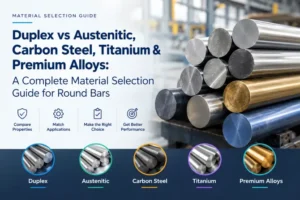
Stainless steel 304 and 316L provide general corrosion resistance for food processing, architectural, and mild marine environments. 316L includes molybdenum for improved chloride resistance.
Duplex 2205 (UNS S31803) offers twice the yield strength of 316L with excellent resistance to stress-corrosion cracking. It is standard for offshore oil and gas, chemical tankers, and desalination.
Super duplex 2507 (UNS S32750) provides superior pitting resistance for aggressive seawater and chemical environments.
Nickel alloys like Inconel 625, Monel 400, and Hastelloy C-276 are used for extreme chemical processing, high temperatures, and highly acidic environments where duplex steels fail.
We stock and supply all of these grades alongside our carbon steel round bar inventory, which lets you make the correct material decision without switching suppliers.
How Euro Steel Bars (ESB) ensures rust-free global delivery
As an international supplier serving the Gulf, Middle East, Southeast Asia, Europe, Turkey, Taiwan, and South Africa, ESB knows that the journey from the mill to the project site is where carbon steel is most vulnerable. Our export packaging and logistics protocols reduce corrosion risk during transit.
Our protective packaging standards include heavy-duty VCI wrapping around each bundle or individual bar. We use waterproof polyethylene and kraft paper layers to block external moisture, along with industrial desiccant packs inside sealed packaging for ocean freight. Timber dunnage and steel strapping prevent mechanical damage and moisture traps. For high-value precision-ground bars, we use wooden crate or steel cradle packaging.
Before dispatch, we perform a full visual and dimensional inspection. Mill Test Certificates (MTC) to EN 10204 3.1 or 3.2 accompany every shipment. We verify surface condition, mill-scale integrity, and freedom from pre-existing rust or contamination. We also provide photographic documentation of the packaging for buyer verification.
Whether your project is in the humid ports of Southeast Asia, the coastal industrial zones of the Arabian Gulf, or the temperate yards of Northern Europe, ESB adjusts packaging specifications to match the destination climate and expected transit duration.
Frequently asked questions
Can surface rust on a carbon steel round bar be removed without affecting tolerances?
Light, uniform surface rust, often called flash rust, can usually be removed by wire brushing, abrasive blasting, or light grinding without affecting dimensional tolerances. Pitting corrosion penetrates below the surface and may require machining that removes material beyond acceptable tolerance limits. Always inspect the depth of corrosion before deciding whether a bar is salvageable.
Does higher carbon content make a round bar rust faster?
Marginally, yes. Higher carbon grades create more micro-galvanic cells within the steel matrix, which can accelerate initial surface oxidation. The difference is small compared to the effect of environmental factors like humidity, chlorides, and temperature. All carbon steel grades will rust without protection.
Is galvanizing sufficient for carbon steel round bars used in offshore oil and gas?
Galvanizing alone is generally not sufficient for long-term offshore exposure. Industry practice typically specifies a duplex system: hot-dip galvanizing plus a high-build epoxy or polyurethane topcoat (ISO 12944 C5-M category). For submerged or splash-zone applications, upgrading to duplex 2205 or super duplex 2507 round bars is often the more reliable engineering choice.
What is the best way to store carbon steel round bars in a humid climate?
Store bars indoors in a ventilated warehouse, elevated at least 100 mm above the floor on timber dunnage. Keep them away from open doors, windows, and exterior walls where condensation forms. If outdoor storage is unavoidable, use heavy-duty waterproof covers with adequate airflow underneath to prevent condensation trapping.
When should I choose stainless steel instead of carbon steel for my project?
Choose stainless steel (304, 316L) or duplex grades when the operating environment includes persistent moisture, chlorides, acidic chemicals, or when maintenance access is restricted. If the component must last over 25 years without re-coating, or if it is subject to regulatory corrosion standards like NACE MR0175 for oil and gas, an alloy upgrade is the correct engineering decision.
How does ESB prevent rust during international shipping?
ESB uses multi-layer export packaging combining VCI film, waterproof barriers, industrial desiccants, and rigid crating. Every shipment is inspected and photographed before dispatch, and packaging specifications are adjusted based on the destination climate and transit route.
Final thoughts
Carbon steel round bar remains an economical and versatile material for structural, mechanical, and engineering applications. Its susceptibility to rust is well understood and manageable when the right prevention measures are applied at the right stage.
Procurement teams and engineers face a few main decisions:
- Specify protective packaging appropriate for the shipping route and destination climate.
- Implement proper storage protocols at the facility to prevent condensation and contamination.
- Select the correct surface treatment for the end-use environment of the component.
- Evaluate total lifecycle cost to determine whether a corrosion-resistant alloy is a better long-term investment.
You can explore our full range of carbon steel round bars to find the exact specifications, grades, and diameters your project requires. Euro Steel Bars supplies carbon steel, stainless steel, duplex, super duplex, nickel alloy, and titanium round bars in all major international standards.
For advice on material selection, corrosion prevention, and custom export packaging, contact our technical sales team for a detailed quote.
Euro Steel Bars (ESB) is an international supplier, stockist, and exporter of steel round bars and related steel products, serving the Gulf, Middle East, Southeast Asia, Europe, Turkey, Taiwan, South Africa, and global markets.