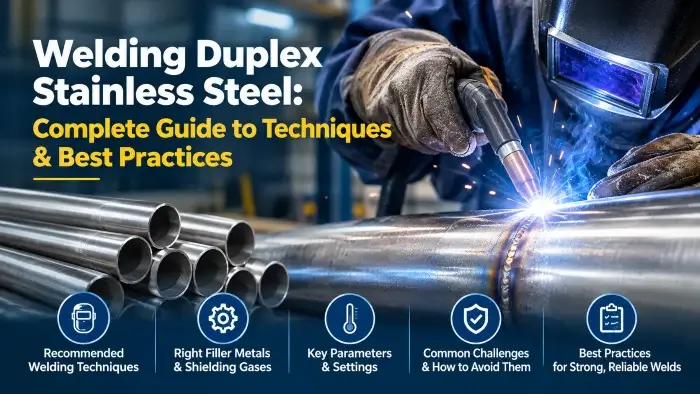
Welding duplex stainless steel comes down to controlling the cooling rate. Keep heat input between 0.5 and 2.5kJ/mm, hold interpass temperature below 150°C, use a nickel over alloyed filler wire such as ER2209 or ER2594, and add 1 to 2% nitrogen to your argon shielding gas. Get those four things right and you preserve the roughly 50/50 mix of austenite and ferrite that gives duplex its strength and corrosion resistance. Get them wrong and the weld zone can end up nearly all ferrite, or worse, riddled with brittle sigma phase. Either way, the joint fails in service.
This guide covers the parameters, consumables, process choices, and inspection steps that fabrication engineers, welding supervisors, and QA teams need to produce sound duplex and super duplex welds for oil and gas, petrochemical, marine, and power generation projects.
Table of Contents
Why duplex behaves differently in the weld zone
Austenitic grades like 304 or 316L are fairly forgiving during welding. Duplex grades, including UNS S32205 (2205) and UNS S32750 (2507 super duplex), are not.
Their properties depend on two phases present in roughly equal amounts:
| Phase | What it provides |
|---|---|
| Ferrite | Yield strength, resistance to stress corrosion cracking |
| Austenite | Toughness, ductility, general corrosion resistance |
When you weld, the metal locally melts and resolidifies. It solidifies as 100% ferrite first. Austenite must then form during cooling. If cooling is too fast, you end up with 80 to 90% ferrite. If cooling is too slow, intermetallic compounds like sigma, chi, and chromium nitrides precipitate in the 600 to 950°C range. Both outcomes degrade toughness and corrosion resistance.
Every parameter in a duplex welding procedure exists to land the cooling rate in a narrow window: fast enough to avoid precipitation, slow enough to let austenite nucleate.
Welding parameters you must control
The table below lists the limits most commonly found in project welding procedure specifications aligned with ASME Section IX, AWS D1.6, and EN ISO 15614.
| Parameter | Standard duplex (2205) | Super duplex (2507) | Reason |
|---|---|---|---|
| Heat input | 0.5 to 2.5kJ/mm | 0.5 to 1.5kJ/mm | Too low gives excess ferrite; too high promotes sigma |
| Max interpass temperature | 150°C | 100°C | Prevents slow cooling through the precipitation range |
| Preheat | Avoid | Avoid | Preheating slows cooling into the sigma range |
| Post weld heat treatment | Avoid | Avoid | PWHT in the 600 to 950°C range causes embrittlement |
| Bead technique | Stringer preferred | Stringer preferred | Wide weaves increase heat input per unit length |
Heat input calculation
Heat input (kJ/mm) = (Volts x Amps x 60) / (Travel speed in mm/min x 1000)
Example: a GTAW root pass at 12V, 110A, and 120mm/min travel speed gives:
(12 x 110 x 60) / (120 x 1000) = 0.66kJ/mm
That sits within the acceptable range. Record actual values during production welding, not just the WPS target. Travel speed variation is the most common reason heat input drifts out of spec on the shop floor.
Interpass temperature
Check with a contact pyrometer or temperature indicating crayon between every pass. If the joint approaches the limit, stop and use forced air or water cooling before depositing the next pass. On thick wall pipe or pressure vessel shells with many passes, cumulative heat builds up in ways a single pass calculation does not show.
Preheat
Carbon steel welders default to preheat. For duplex, do not preheat. The only exception is a minimal warm up (no more than 50°C) to remove surface condensation in cold or humid environments. Anything higher pushes the cooling curve into the sigma phase window.
Post weld heat treatment
PWHT is generally not done on duplex. If stress relief is absolutely necessary, the only acceptable route is a full solution anneal at 1050 to 1100°C followed by water quench. That is rarely practical on an assembled structure, so most project specs simply prohibit PWHT.
Filler metal selection
The weld pool solidifies as 100% ferrite. To get austenite to form during the short cooling window, filler wires are deliberately over alloyed with nickel relative to the base metal.
| Base metal | Matching filler (AWS A5.9) | Ni content in wire | Notes |
|---|---|---|---|
| 2205 (S32205) | ER2209 / E2209 | 8.5 to 10.5% | Standard duplex service |
| 2507 (S32750) | ER2594 / E2594 | 9.0 to 11.0% | Super duplex, high chloride, offshore |
| Joining 2205 to 316L | ER2209 (not ER316L) | 8.5 to 10.5% | Prevents ferrite dilution from the austenitic side |
Do not substitute 316L or 309L filler for a duplex joint. The resulting weld will be almost entirely ferritic, with poor toughness and reduced pitting resistance.
For SMAW electrodes, follow the manufacturer storage and rebake instructions to keep hydrogen out of the weld. Hydrogen can cause cold cracking in high ferrite weld metal.
Shielding gas and backing gas
Argon alone is not enough. The weld pool loses nitrogen to the atmosphere, and nitrogen is one of the strongest austenite stabilisers available.
Shielding gas requires argon with 1 to 2% nitrogen added. Some project specs allow up to 3%. The nitrogen replenishes what the pool loses and shifts the phase balance toward austenite.
Backing gas is used for the root purge. Purge the inside of the joint with argon or argon plus 1 to 2% nitrogen. Verify oxygen content is below 50ppm before striking the arc. Maintain purge until the root is covered by at least two weld passes.
A trailing shield on GTAW extends coverage over the hot heat affected zone and reduces surface oxidation on super duplex or titanium stabilised grades.
If you skip the backing gas, the root pass develops heavy oxidation known as sugaring. That oxide layer becomes a crevice corrosion initiation site in chloride service, which is exactly the failure mode duplex was chosen to prevent.
Process by process guidance
GTAW (TIG) is best for root passes on pipe and thin plate. Use a gas lens for even shielding. Dip the filler rod into the leading edge of the pool. Do not paint the rod across the surface. Hold the torch at roughly 75 to 80 degrees to the work surface. Run stringer beads and avoid wide weaves.
GMAW (MIG) suits fill and cap passes on thicker sections. Use short circuit transfer for out of position work and spray transfer for flat and horizontal positions. Watch heat input. Higher deposition rates tempt faster travel, but too fast travel can quench the weld into excess ferrite. Use a push technique with a 10 to 15 degree gun angle.
SMAW (stick) is practical for field erection, maintenance, and out of position joints. Use low hydrogen electrodes like E2209-17 or E2594-17. Keep arc length short, no more than the electrode diameter. Limit weave width to 2 to 2.5 times the electrode diameter.
SAW (submerged arc) is used on thick pressure vessel shells and large diameter pipe. It requires neutral or alloyed fluxes to control nitrogen and chromium transfer. Multi wire setups need full procedure qualification records that include ferrite measurement and corrosion testing.
Step by step procedure checklist
- Verify base material certificates. Confirm grade, heat number, solution annealed condition, and EN 10204 3.1 or 3.2 documentation before any cutting or fit up.
- Prepare joint edges by machining or grinding. Avoid carbon steel contamination. Remove oxides, oils, and machining fluids within 25mm of the weld zone.
- Fit up and tack using the same over alloyed filler. Grind tacks before the root pass.
- Purge the root. Establish backing gas flow and verify O2 below 50ppm with an analyser.
- Weld the root pass (GTAW preferred). Log volts, amps, and travel speed. Calculate heat input.
- Fill and cap. Check interpass temperature every pass. Run stringer beads.
- Clean after welding. Pickle and passivate per ASTM A380 or A967, or use electrochemical cleaning, to restore the chromium oxide layer.
- Inspect and test.
Inspection and testing
A weld that looks fine visually can still be metallurgically compromised. QA teams should specify the following:
| Test | Purpose | Typical acceptance |
|---|---|---|
| Ferrite Number measurement (portable Ferritescope) | Confirms phase balance in weld and HAZ | 35 to 65 FN |
| Metallographic examination (optical or SEM) | Detects sigma, chi, nitride precipitates; measures phase fraction | No more than 1 to 2% intermetallics; 35 to 65% ferrite |
| ASTM G48 Method A (ferric chloride pitting test) | Validates critical pitting temperature | No pitting at the project specified temperature |
| Radiographic or ultrasonic testing (RT, UT, PAUT) | Volumetric defect detection | Per ASME V or EN ISO 17640 |
| Dye penetrant testing (PT) | Surface crack detection on root and cap | No linear indications |
| Hardness survey | Flags localised embrittlement | Typically 350 HV max for duplex |
For offshore, subsea, and sour service projects, the EPC spec will usually require a full Welding Procedure Qualification Record with destructive testing of a coupon welded under production conditions.
Five mistakes that ruin duplex welds
- Using 316L or 309L filler wire instead of ER2209 or ER2594. The weld ends up nearly 100% ferrite.
- Skipping or shortening the backing gas purge. Root sugaring destroys internal corrosion resistance.
- Letting interpass temperature drift above 150°C. Cumulative heat drives sigma phase precipitation.
- Running wide weave beads. They raise heat input per unit length and slow the cooling rate past the safe window.
- Grinding with a carbon steel wire brush or a wheel previously used on carbon steel. Embedded iron particles rust and pit within days.
Start with the right base material
A perfect welding procedure cannot fix base metal that was improperly heat treated, has off spec chemistry, or lacks traceability. Duplex round bars, pipe, and forgings need to arrive solution annealed and water quenched so the starting microstructure is correct before you strike an arc.
For procurement teams, that means requiring full Mill Test Certificates (EN 10204 Type 3.1 or 3.2) covering chemistry, mechanical properties, hardness, and ferrite content where specified. You must confirm the grade and product standard (ASTM A276, ASTM A479, EN 10088-3, NORSOK M-630) before material enters fabrication.
Sourcing from reliable suppliers ensures every bar traces back to the mill heat number. Euro Steel Bars supplies certified duplex stainless steel round bars to fabricators, EPC contractors, and distributors across the Gulf, Southeast Asia, Europe, Turkey, Taiwan, and South Africa. Our most requested grade for these critical welds is the duplex 2205 round bar, which offers the baseline strength and corrosion resistance required for most oil and gas applications. Shipments carry full documentation and dimensional inspection.
If you need certified material for a fabrication or EPC project, contact our sales team for availability, size ranges, and delivery timelines.
FAQ
What Are the Best Practices for Welding 2205 Duplex Stainless Steel?
Welding Duplex 2205 (UNS S32205/S31803) requires controlled procedures because excessive heat input or incorrect cooling can disturb the required ferritic-austenitic phase balance. Good welding practice includes selecting a suitable filler metal, controlling heat input and interpass temperature, using the correct shielding gas, and avoiding unnecessary preheating or post-weld heat treatment. The welding procedure should also consider joint design, material thickness, welding position, and service requirements. For critical applications, welding should follow an approved WPS/PQR and applicable code or project specification, with inspection and testing appropriate to the application.
What Filler Metal Should I Use for Welding Duplex Stainless Steel?
For Duplex 2205, a duplex stainless steel filler metal with a suitable alloy balance is normally selected to produce the required weld metal properties and corrosion resistance. Common filler designations include ER2209 for GTAW/TIG and GMAW/MIG applications, while suitable matching duplex electrodes are used for SMAW/stick welding. The exact filler should be selected according to the base-metal grade, welding process, joint design, thickness, service conditions, and applicable welding code. Buyers and fabricators should follow the qualified Welding Procedure Specification (WPS) rather than selecting filler metal solely by matching the base-metal name.
What Shielding Gas Is Recommended for Welding Duplex Stainless Steel?
Shielding gas selection depends on the welding process and required weld properties. For TIG/GTAW, high-purity argon is commonly used as the primary shielding gas. Small additions of nitrogen or other controlled gas mixtures may be specified for particular duplex welding procedures to help support the required weld-metal properties. For MIG/GMAW, specialized argon-based gas mixtures may be used. The exact gas composition should follow the qualified WPS and filler manufacturer’s recommendations. Proper shielding is important because contamination, oxidation, or nitrogen loss can affect weld quality, corrosion resistance, and the ferritic-austenitic balance.
Does Welding Duplex Stainless Steel Require Preheating?
Duplex stainless steel generally does not require routine preheating in the same way some carbon or low-alloy steels may. Excessive preheating can increase the time the material spends at elevated temperature and may affect the desired microstructure. The joint should normally be clean, dry, and at a suitable starting temperature before welding. However, specific project conditions, material thickness, ambient conditions, or an approved welding procedure may require temperature controls. The WPS/PQR should define any preheat requirements rather than applying a generic temperature to every Duplex 2205 welding job.
What Welding Processes Work Best for Duplex Stainless Steel: TIG, MIG, or Stick?
Duplex stainless steel can be welded using several processes, including TIG/GTAW, MIG/GMAW, and SMAW/stick, as well as other qualified processes. TIG is commonly used where precise control and high-quality welds are required, particularly for thinner sections and root passes. MIG/GMAW can provide higher productivity for fabrication work, while SMAW can be useful for site work and repairs. The “best” process depends on material thickness, joint design, production requirements, accessibility, welding position, and project specifications. Whichever process is selected should be supported by a qualified welding procedure for the specific duplex grade.
Does Duplex Stainless Steel Need Post-Weld Heat Treatment?
Duplex stainless steel normally does not require conventional post-weld heat treatment (PWHT). In fact, uncontrolled heating can disturb the ferritic-austenitic phase balance and may lead to undesirable phases that affect toughness or corrosion resistance. Duplex welding therefore relies more on controlled welding parameters, suitable filler metal, heat input, and cooling conditions than on heat treatment after welding. Certain applications or project specifications may have specific thermal treatment requirements, so the applicable code and qualified welding procedure must be followed. Fabricators should not apply PWHT to Duplex 2205 simply because it is commonly used for other steel grades.
How Do I Maintain the Phase Balance When Welding Duplex Stainless Steel?
Maintaining the required ferrite-austenite phase balance is one of the main considerations when welding duplex stainless steel. Use a qualified welding procedure with the correct filler metal, controlled heat input, suitable shielding gas, and appropriate cooling rate. Excessive heat input or slow cooling can promote undesirable phases, while excessively rapid cooling can result in excessive ferrite. Surface contamination and incorrect gas protection can also affect weld quality. For critical applications, weld qualification and testing may include ferrite measurement, corrosion testing, mechanical testing, or metallographic examination, depending on the applicable specification.
What Is the Maximum Interpass Temperature When Welding Duplex Stainless Steel?
The maximum interpass temperature depends on the duplex grade, welding procedure, material thickness, welding code, and project specification. For Duplex 2205, a commonly specified maximum interpass temperature is around 150°C (300°F), although the qualified WPS should always take precedence. Controlling interpass temperature helps prevent excessive heat accumulation and undesirable microstructural changes during multi-pass welding. Welders should measure the temperature at the specified location and follow the approved procedure. Buyers and fabricators should not assume that one interpass limit applies to every duplex grade or welding application.
Can Duplex Stainless Steel Be Welded to Carbon Steel?
Yes. Duplex stainless steel can be welded to carbon steel, but the joint requires a qualified dissimilar-metal welding procedure. Filler-metal selection, dilution, shielding, heat input, joint preparation, and corrosion requirements must all be considered. The carbon-steel side may also have different preheating or hydrogen-control requirements from the duplex side. The final weld must meet the mechanical and corrosion requirements of the application. For critical equipment, the joint should be qualified through an appropriate WPS/PQR, with inspection and testing defined by the applicable code or project specification.
What Welding Defects Are Common With Duplex Stainless Steel?
Common welding problems can include porosity, lack of fusion, cracking, excessive ferrite, improper phase balance, oxidation, distortion, and contamination. Duplex stainless steel is particularly sensitive to incorrect heat input, cooling conditions, and shielding because these factors can affect its microstructure and corrosion performance. Poor gas protection can also cause excessive oxidation of the weld surface. Proper joint preparation, filler selection, shielding, heat-input control, and interpass-temperature monitoring help reduce these risks. For critical applications, weld inspection may include visual testing, radiographic or ultrasonic testing, ferrite measurement, PMI, or other specified examinations.
Do I Need a Certified Welder for Duplex Stainless Steel Projects?
For critical industrial projects, welding should be performed by personnel qualified for the applicable welding process, material, and procedure. Whether a formally certified or qualified welder is required depends on the governing code, project specification, industry, and jurisdiction. Applications in oil and gas, petrochemical, pressure equipment, power, and other regulated sectors commonly have specific welder qualification requirements. A qualified WPS/PQR and appropriate welder qualification help demonstrate that the welding process can consistently produce acceptable results. Buyers should confirm these requirements before fabrication, particularly when the finished component requires inspection or third-party approval.