If you are sourcing duplex stainless steel round bars for a pressure vessel, offshore platform, chemical processing line, or structural application, you have probably already encountered a common problem. The term “duplex” covers a family of alloys with meaningfully different chemistries, strength levels, corrosion resistance, and price points. Specifying the wrong grade can mean premature failure in service or paying 40-60% more than necessary for performance you do not need.
This guide breaks down every major duplex and super duplex grade you will encounter in round bar form, including 2101, 2304, 2404, 2205, 329, 2507, and Zeron 100. We provide the composition data, mechanical properties, corrosion metrics, standards, and practical selection criteria that engineers, procurement teams, and fabricators actually use to make decisions.
Table of Contents
What Makes Duplex Stainless Steel “Duplex”?
Duplex stainless steels have a two-phase microstructure consisting of roughly 50% ferrite (α) and 50% austenite (γ). This is engineered through balanced alloying rather than an accident of processing.
The ferrite phase delivers:
- Higher yield strength (typically double that of 304/316 austenitic grades)
- Better resistance to stress corrosion cracking (SCC) in chloride environments
- Good thermal conductivity and lower thermal expansion
The austenite phase provides:
- Toughness and ductility (especially at low temperatures)
- Weldability
- Resistance to intergranular corrosion
The result is a material that outperforms standard austenitics in strength and chloride resistance while remaining fabricable. However, not all duplex grades deliver these benefits equally. The alloying balance shifts significantly from lean duplex through standard duplex to super duplex, and each step changes what the material can do.
The Duplex Family at a Glance
| Category | Grades | Typical PREN Range | Yield Strength (MPa, min) | Relative Cost Index |
|---|---|---|---|---|
| Lean Duplex | 2101 (S32101), 2304 (S32304), 2404 (S82441) | 24-28 | 450-500MPa | 1.0x (baseline) |
| Standard Duplex | 2205 (S32205/S31803), 329 (S32900) | 30-36 | 450-550MPa | 1.3-1.6x |
| Super Duplex | 2507 (S32750), Zeron 100 (S32760) | 40-45+ | 550-620MPa | 2.0-2.8x |
PREN (Pitting Resistance Equivalent Number) = %Cr + 3.3x%Mo + 16x%N. Some calculations include 30x%N or add a tungsten term for Zeron 100.
Grade-by-Grade Breakdown
1. LDX 2101 (UNS S32101 / EN 1.4162)
Category: Lean Duplex
Key Composition (wt%):
Cr 21.0-22.0% | Ni 1.35-1.70% | Mn 4.0-6.0% | N 0.20-0.25% | Mo ≤0.80% | C ≤0.04%
Mechanical Properties (round bar, solution annealed):
- Yield strength: ≥450MPa
- Tensile strength: 650-880MPa
- Elongation: ≥30%
- Hardness: ≤290HB
What defines it: 2101 replaces expensive nickel with manganese and nitrogen to stabilise the austenite phase. This makes it the most cost-effective duplex grade. It has no molybdenum, so its pitting resistance is moderate.
Typical round bar applications:
- Structural members in bridges, buildings, and water treatment plants
- Replacing 304/316 in non-critical chloride exposure
- General engineering shafts, fasteners, and fittings where SCC resistance matters
- Pulp and paper industry components
Standards for round bars: ASTM A276, EN 10088-3, EN 10272, NORSOK M-630
Practical note: Because of the high manganese content, 2101 has slightly different hot-working behaviour than molybdenum-bearing duplex grades. If you are machining round bars, expect chip characteristics closer to carbon steel than to 316. For detailed specifications, review our Duplex Stainless Steel 2101 Round Bar product data.
2. LDX 2304 (UNS S32304 / EN 1.4362)
Category: Lean Duplex
Key Composition (wt%):
Cr 22.0-24.0% | Ni 3.0-5.0% | N 0.05-0.20% | Mo ≤0.60% | Mn ≤2.5% | C ≤0.03%
Mechanical Properties (round bar, solution annealed):
- Yield strength: ≥400MPa
- Tensile strength: 600-800MPa
- Elongation: ≥25%
- Hardness: ≤290HB
What defines it: 2304 was one of the earliest lean duplex grades. Compared to 2101, it uses more nickel and less manganese, giving it slightly better toughness and weldability. It still carries no intentional molybdenum addition.
Typical round bar applications:
- Replacement for 304 and 316 in mildly corrosive environments
- Storage tanks, heat exchanger tubesheets, and structural components
- Food processing and brewing equipment
- Desalination plant structures (non-critical sections)
Standards for round bars: ASTM A276, EN 10088-3, EN 10272
Practical note: 2304 is less commonly stocked than 2101 or 2205 in round bar form. If you need it, lead times may be longer. Confirm availability with your supplier before committing to a project schedule. View full details on our Duplex Stainless Steel 2304 Round Bar inventory.
3. LDX 2404 (UNS S82441 / EN 1.4662)
Category: Lean Duplex
Key Composition (wt%):
Cr 23.0-25.0% | Ni 3.0-5.0% | Mo 0.1-0.8% | N 0.15-0.25% | Mn 1.0-2.5% | C ≤0.03%
Mechanical Properties (round bar, solution annealed):
- Yield strength: ≥450MPa
- Tensile strength: 650-850MPa
- Elongation: ≥25%
- Hardness: ≤290HB
What defines it: 2404 bridges the gap between lean and standard duplex. It offers slightly higher corrosion resistance than 2304 due to optimized nitrogen and chromium levels, while maintaining the cost advantages of a lean duplex chemistry.
Typical round bar applications:
- Structural components in aggressive coastal environments
- Water treatment and desalination infrastructure
- Architectural and offshore structural supports
Practical note: 2404 is an excellent alternative when 2304 falls just short of the required PREN, but 2205 is unnecessarily expensive. Explore our Duplex Stainless Steel 2404 Round Bar options for your next structural project.
4. SAF 2205 (UNS S32205 / S31803 / EN 1.4462)
Category: Standard Duplex
Key Composition (wt%):
Cr 22.0-23.0% | Ni 4.5-6.5% | Mo 3.0-3.5% | N 0.14-0.20% | Mn ≤2.0% | C ≤0.03%
Mechanical Properties (round bar, solution annealed):
- Yield strength: ≥450MPa (typically 500-550MPa)
- Tensile strength: 655-880MPa
- Elongation: ≥25%
- Hardness: ≤293HB
What defines it: 2205 is the workhorse of the duplex family. The addition of roughly 3% molybdenum pushes the PREN to 34-36, giving it genuine resistance to pitting and crevice corrosion in chloride-containing environments. It accounts for the majority of duplex stainless steel consumed globally.
Typical round bar applications:
- Oil and gas: subsea equipment, flowlines, wellhead components, Christmas trees
- Chemical processing: reactor shafts, agitators, pump shafts
- Marine: propeller shafts, fasteners, seawater piping systems
- Pulp and paper: digester components, washer parts
- Structural: bridges and offshore platforms in splash zones
Standards for round bars: ASTM A276, ASTM A479, EN 10088-3, EN 10272, NORSOK M-630, API 6A
Practical note: S32205 and S31803 are often used interchangeably, but S32205 is the tighter-composition variant (higher minimum Cr, Mo, and N). For critical service, specify S32205 explicitly. Check our stock of Duplex Stainless Steel 2205 Round Bar for immediate global dispatch.
5. Alloy 329 (UNS S32900 / EN 1.4477)
Category: Standard Duplex (older generation)
Key Composition (wt%):
Cr 23.0-28.0% | Ni 2.5-5.0% | Mo 1.0-2.0% | C ≤0.08% | N ≤0.10%
Mechanical Properties (round bar, solution annealed):
- Yield strength: ≥450MPa
- Tensile strength: ≥620MPa
- Elongation: ≥20%
What defines it: 329 is one of the original duplex grades, developed before the modern low-carbon, nitrogen-alloyed duplex steels. Its higher carbon limit (up to 0.08%) and lower nitrogen mean it is more susceptible to carbide precipitation during welding and slow cooling.
Typical round bar applications:
- Legacy equipment in chemical and petrochemical plants
- Heat exchanger components
- Some pump and valve parts in older specifications
- Replacement parts where original equipment was specified in 329
Standards for round bars: ASTM A276, JIS G4303
Practical note: 329 is largely superseded by 2205 for new projects. However, it still appears in maintenance, repair, and replacement orders for older plants, particularly in Japanese and some European specifications. Review our Duplex Stainless Steel 329 Round Bar specifications for legacy project matching.
6. SAF 2507 (UNS S32750 / EN 1.4410)
Category: Super Duplex
Key Composition (wt%):
Cr 24.0-26.0% | Ni 6.0-8.0% | Mo 3.0-5.0% | N 0.24-0.32% | Mn ≤1.2% | C ≤0.03% | Cu ≤0.5%
Mechanical Properties (round bar, solution annealed):
- Yield strength: ≥550MPa
- Tensile strength: ≥795MPa
- Elongation: ≥15%
- Hardness: ≤310HB
What defines it: 2507 is the most widely used super duplex grade. The combination of 25% Cr, roughly 4% Mo, and roughly 0.28% N pushes the PREN above 42, providing excellent resistance to pitting, crevice corrosion, and stress corrosion cracking in aggressive chloride environments.
Typical round bar applications:
- Offshore oil and gas: subsea manifolds, connectors, fasteners, valve bodies
- Desalination: high-pressure pump shafts, RO system components
- Chemical processing: FGD (flue gas desulphurisation) systems, acid handling
- Marine: seawater intake systems, ballast water treatment
Standards for round bars: ASTM A276, ASTM A479, EN 10088-3, EN 10272, NORSOK M-630, API 6A, DNV-OS-F101
Practical note: 2507 round bars require stricter heat treatment control than 2205. The solution annealing temperature window is narrower (1050-1125°C), and cooling must be rapid (water quench) to avoid sigma phase precipitation. When ordering, request mill test certificates that confirm the heat treatment condition and ferrite balance (typically 40-60% ferrite).
7. Zeron 100 (UNS S32760 / EN 1.4501)
Category: Super Duplex (with tungsten and copper)
Key Composition (wt%):
Cr 24.0-26.0% | Ni 6.0-8.0% | Mo 3.0-4.0% | W 0.5-1.0% | Cu 0.5-1.0% | N 0.20-0.30% | C ≤0.03%
Mechanical Properties (round bar, solution annealed):
- Yield strength: ≥550MPa
- Tensile strength: ≥750MPa
- Elongation: ≥25%
- Hardness: ≤270HB
What defines it: Zeron 100 differentiates itself from 2507 through the addition of tungsten and copper. Tungsten contributes to the PREN calculation (PREN = %Cr + 3.3x%Mo + 16x%N + 1.5x%W), pushing it above 40. Copper improves resistance to sulphuric acid and enhances castability.
Typical round bar applications:
- Subsea oil and gas equipment (particularly in North Sea and deepwater projects)
- Seawater pumps, valves, and fittings
- FGD systems in power generation
- Chemical tankers and marine exhaust scrubbers
Standards for round bars: ASTM A276, EN 10088-3, NORSOK M-630, DNV standards
Practical note: Zeron 100 is specified heavily in North Sea oil and gas projects and by operators who follow NORSOK or DNV standards. It is not always interchangeable with 2507 in project specifications. Check the project’s approved materials list (AML) before substituting.
Head-to-Head: Composition Comparison
| Element (wt%) | 2101 | 2304 | 2404 | 2205 | 329 | 2507 | Zeron 100 |
|---|---|---|---|---|---|---|---|
| Cr | 21.5% | 23.0% | 24.0% | 22.0% | 25.0% | 25.0% | 25.0% |
| Ni | 1.5% | 4.0% | 4.0% | 5.5% | 3.5% | 7.0% | 7.0% |
| Mo | 0% | 0% | 0.4% | 3.0% | 1.5% | 4.0% | 3.5% |
| N | 0.22% | 0.10% | 0.20% | 0.17% | ≤0.10% | 0.28% | 0.25% |
| Mn | 5.0% | 1.5% | 1.5% | 1.5% | ≤1.0% | 0.8% | 0.8% |
| W | 0% | 0% | 0% | 0% | 0% | 0% | 0.7% |
| Cu | 0% | 0% | 0% | 0% | 0% | ≤0.5% | 0.7% |
| C (max) | 0.04% | 0.03% | 0.03% | 0.03% | 0.08% | 0.03% | 0.03% |
| PREN | ~26 | ~25 | ~28 | ~35 | ~30 | ~43 | ~41 |
Values are nominal/mid-range. Actual composition depends on the mill heat. Always verify against the mill test certificate.
Mechanical Properties Compared (Round Bar, Solution Annealed)
| Property | 2101 | 2304 | 2404 | 2205 | 329 | 2507 | Zeron 100 |
|---|---|---|---|---|---|---|---|
| Yield (MPa, min) | 450MPa | 400MPa | 450MPa | 450MPa | 450MPa | 550MPa | 550MPa |
| Tensile (MPa, min) | 650MPa | 600MPa | 650MPa | 655MPa | 620MPa | 795MPa | 750MPa |
| Elongation (%) | 30% | 25% | 25% | 25% | 20% | 15% | 25% |
| Impact (J, RT) | ≥100J | ≥100J | ≥100J | ≥100J | ≥80J | ≥54J | ≥70J |
| Max service temp (°C) | ~250°C | ~250°C | ~250°C | ~300°C | ~300°C | ~300°C | ~300°C |
Duplex grades are not recommended for sustained service above 300°C due to embrittlement risks (475°C embrittlement, sigma phase formation). For high-temperature service, consider austenitic or nickel alloy alternatives.
Corrosion Resistance: Where Each Grade Fits
Mild atmospheric, freshwater, and food-grade environments:
2101, 2304, and 2404 perform well. They replace 304 and 316 at lower cost with higher strength.
Chloride-bearing water, brackish water, and mild chemical exposure:
2205 is the standard choice. It handles seawater at ambient temperatures, dilute sulphuric acid, and many organic acids.
Hot seawater, concentrated brines, and sour gas (H₂S + CO₂ + Cl⁻):
2507 or Zeron 100. These are the grades specified for subsea oil and gas, desalination high-pressure circuits, and FGD absorber zones.
Sulphuric acid service (dilute to moderate concentration):
Zeron 100’s copper addition gives it an edge over 2507 in H₂SO₄ environments. For concentrated sulphuric acid, neither duplex nor super duplex is appropriate. Move to high-nickel alloys.
Stress corrosion cracking (SCC) resistance:
All duplex grades significantly outperform 304 and 316 in chloride SCC resistance. This is one of the primary reasons duplex grades are specified in place of austenitics.
Round Bar Specifics: What to Specify When Ordering
When you request a quotation or place an order for duplex round bars, the following details matter:
1. Grade designation: Use both the UNS number and the EN number (e.g., UNS S32205 / EN 1.4462). This avoids ambiguity, especially in international trade.
2. Standard and delivery condition:
- ASTM A276 (hot-finished or cold-finished bars)
- ASTM A479 (bars for pressure vessels and boilers)
- EN 10088-3 (stainless steel bars for general purposes)
- EN 10272 (stainless steel bars for pressure purposes)
- NORSOK M-630 (if the project requires it)
3. Diameter and length: Specify the exact diameter (or range) and whether you need random lengths, fixed lengths, or cut-to-size.
4. Surface condition: Black (as-rolled), peeled/turned, ground, or polished. For machining applications, peeled or ground bars reduce stock removal.
5. Heat treatment: Duplex round bars must be supplied in the solution-annealed and quenched condition. Confirm this on the mill test certificate.
6. Testing and certification:
- Mill Test Certificate (MTC) per EN 10204 Type 3.1/3.2
- Charpy impact test (especially for offshore/subsea applications)
- Hardness test
- Ferrite content measurement (typically by Fischer scope or metallographic method)
- Corrosion testing (ASTM G48 Method A or B) for critical applications
- PMI (Positive Material Identification)
7. Quantity and packaging: Bundled, bundled with wooden crates for export, or loose. For sea freight to the Gulf, Southeast Asia, or Africa, specify export-worthy packaging to prevent corrosion during transit.
Selecting the Right Grade: A Practical Decision Framework
Ask yourself these questions in order:
Step 1: What is the service environment?
- No significant chlorides, ambient temperatures: 2101, 2304, or 2404 may suffice.
- Chloride-containing water, mild acids: 2205.
- Hot seawater, high chloride concentration, sour service: 2507 or Zeron 100.
Step 2: What does the project specification require?
Many oil and gas, EPC, and marine projects have an Approved Materials List (AML). If the AML calls for S32750, you cannot substitute S32205 without a formal deviation request. Check the specification before selecting a cheaper grade.
Step 3: What mechanical properties are needed?
If your design requires yield strength above 500MPa, lean duplex grades may not meet the requirement. 2205 and above are needed. For subsea or high-pressure applications requiring ≥550MPa yield, super duplex is mandatory.
Step 4: What is the fabrication route?
- Heavy machining: 2205 and 2507 machine reasonably well. Lean duplex grades (high Mn) produce different chip morphology.
- Welding: All duplex grades require controlled heat input and interpass temperature. Super duplex is more sensitive.
- Cold forming: Lean duplex grades have better formability than super duplex.
Step 5: What is the budget?
As a rough guide (prices fluctuate with nickel, molybdenum, and chromium markets):
- 2101 is 15-30% cheaper than 316.
- 2205 is roughly 10-20% more than 316.
- 2507/Zeron 100 can be 60-100% more than 316.
If the application allows it, specifying 2205 instead of 2507 can save significant cost without compromising performance.
Common Pitfalls to Avoid
Assuming all “duplex” is the same. A buyer who specifies “duplex stainless steel” without a grade number may receive 2101 when they needed 2205, or 2205 when the project requires 2507. Always specify the UNS/EN number.
Ignoring the heat treatment condition. Duplex round bars that have not been properly solution annealed and quenched may contain sigma phase or excessive ferrite, leading to embrittlement and reduced corrosion resistance. Always request the MTC and verify the heat treatment record.
Overlooking ferrite balance. The acceptable ferrite range for most duplex grades is 35-65% (target ~50%). Bars outside this range may have compromised toughness or corrosion resistance.
Mixing up S31803 and S32205. S31803 is the older, wider-composition designation. S32205 has tighter limits on Cr, Mo, and N. For critical applications, specify S32205.
Storing duplex bars next to carbon steel. Iron contamination on the surface of duplex bars can initiate rust and compromise the passive layer. Use separate storage racks and avoid carbon steel wire brushes.
Availability in Round Bar Form
At Euro Steel Bars, we stock and supply duplex and super duplex round bars across a wide diameter range, typically from 12mm to 400mm (and larger diameters on request, subject to mill capability). Bars are available in hot-finished, peeled, turned, and ground conditions.
We supply against ASTM, EN, NORSOK, and customer-specific specifications, with full mill test certification (EN 10204 3.1/3.2), PMI, and third-party inspection where required.
Our export markets include the Gulf states (UAE, Saudi Arabia, Qatar, Oman, Kuwait, Bahrain), Southeast Asia, Europe, Turkey, Taiwan, and South Africa. All export shipments are packed for sea freight with appropriate corrosion protection.
If you need a specific grade, diameter, or certification that isn’t immediately in stock, we work with established mills to source and deliver within defined lead times.
[Request a Quotation] or contact our sales team with your specification, quantity, and delivery destination.
Frequently Asked Questions
Duplex vs Super Duplex Stainless Steel: What’s the Difference?
Standard duplex grades like 2205 have a PREN of roughly 34-36, yield strength around 450-550MPa, and contain about 22% chromium with 3% molybdenum. Super duplex grades like 2507 and Zeron 100 push the PREN above 40, with 25% chromium, 3.5-4% molybdenum, and higher nitrogen. This gives super duplex significantly better resistance to pitting, crevice corrosion, and stress corrosion cracking in hot, concentrated chloride environments. The trade-off is higher cost and tighter fabrication controls.
What’s the Difference Between Super Duplex and Lean Duplex?
Lean duplex grades (2101, 2304, 2404) minimise expensive alloying elements like nickel and molybdenum by using manganese and nitrogen to stabilise the microstructure. Their PREN sits around 24-28, and they suit structural or mildly corrosive applications. Super duplex grades (2507, Zeron 100) carry high levels of chromium, molybdenum, nickel, and nitrogen, achieving PREN values above 40. They are designed for aggressive environments like hot seawater and subsea oil and gas. Super duplex can cost two to three times more than lean duplex.
Lean Duplex 2101 vs 2304: Which Grade Is Right for Me?
Both are lean duplex grades with similar strength and moderate corrosion resistance. 2101 uses high manganese (5%) and very low nickel (1.5%), making it cheaper but giving it slightly different machining and welding characteristics. 2304 uses more nickel (~4%) and less manganese, offering marginally better toughness and weldability. For structural applications and general engineering where cost matters, 2101 is often preferred. Where weldability and toughness are prioritised and the budget allows slightly more, 2304 is the better fit.
Is Duplex 2101 Better Than 2205 for My Application?
Not inherently. 2101 and 2205 serve different roles. 2101 is a lean duplex with no molybdenum and a PREN around 26, suited to structural, atmospheric, and freshwater applications. 2205 contains 3% molybdenum and has a PREN around 35, making it far more resistant to pitting and crevice corrosion in chloride environments. If your application involves seawater, chemical exposure, or oil and gas service, 2205 is the appropriate grade. 2101 is the right choice when you need SCC resistance and strength but want to control cost.
Is 2205 Duplex or Super Duplex Better for My Application?
This depends entirely on the service environment. 2205 handles ambient-temperature seawater, many chemical process streams, and general chloride-bearing applications very well. Super duplex (2507 or Zeron 100) becomes necessary when you face elevated temperatures combined with high chloride concentrations, sour gas (H₂S), concentrated brines, or aggressive acid mixtures. If the project specification calls for a PREN above 40, super duplex is mandatory. If PREN 35 is adequate, 2205 delivers the required performance at significantly lower cost.
What’s Special About Zeron 100 Super Duplex Stainless?
Zeron 100 (UNS S32760) distinguishes itself from 2507 through additions of tungsten (0.7%) and copper (0.7%). Tungsten raises the PREN and enhances pitting resistance, while copper improves resistance to sulphuric acid and certain reducing acids. It was originally developed for North Sea oil and gas applications and is widely specified under NORSOK and DNV standards. In round bar form, it is used for subsea valve components, pump shafts, and fasteners. It is not always interchangeable with 2507, so check the project specification before substituting.
What Grades of Duplex Stainless Steel Are Available?
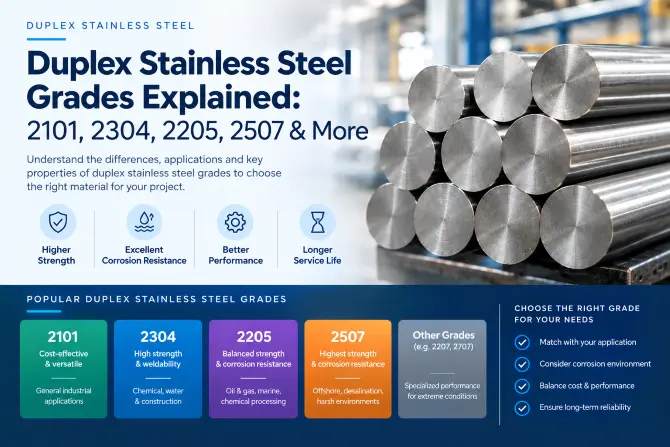
The principal duplex grades available in round bar form are: lean duplex 2101 (S32101), 2304 (S32304), and 2404 (S82441); standard duplex 2205 (S32205/S31803) and 329 (S32900); and super duplex 2507 (S32750) and Zeron 100 (S32760). 2205 is by far the most widely stocked and used. Lean duplex grades are increasingly popular for structural and water treatment applications. Super duplex grades are stocked for oil and gas, desalination, and chemical processing. Availability in specific diameters varies by supplier.
What’s the Difference Between Duplex and Super Duplex Stainless Steel?
The core difference is alloy content and resulting corrosion resistance. Standard duplex (2205) contains ~22% Cr, ~3% Mo, ~5.5% Ni, and ~0.17% N, giving a PREN of about 35. Super duplex (2507, Zeron 100) contains ~25% Cr, ~3.5-4% Mo, ~7% Ni, and ~0.25-0.28% N, yielding a PREN above 40. Super duplex also has higher minimum yield strength (550MPa vs 450MPa). The practical consequence is that super duplex withstands hotter, more concentrated chloride environments and is specified for subsea, desalination, and aggressive chemical service where 2205 would be at risk of pitting.
How Do I Know Which Stainless Steel Grade to Buy?
Start with the service environment: identify the chemicals, chlorides, temperature, pressure, and whether the component is structural or pressure-containing. Next, check the project specification or approved materials list. Many oil and gas, EPC, and marine projects mandate specific grades. Then match the required PREN, yield strength, and impact toughness to the appropriate grade. Finally, confirm availability in the diameter, length, surface condition, and certification you need. If you are unsure, share your application details with your supplier’s technical team.
How do I choose between lean duplex, standard duplex and super duplex for my project?
Work through three filters. Corrosion: If the environment is atmospheric, freshwater, or mildly corrosive, lean duplex (2101/2304/2404) is sufficient. For chlorides, mild acids, or oil and gas service, standard duplex 2205 is the default. For hot seawater, sour gas, or concentrated brines, super duplex (2507/Zeron 100) is required. Mechanical: If yield strength above 500MPa is needed, move to 2205 or above. Budget: Lean duplex is cheapest; super duplex costs roughly double. Always confirm against the project specification before downgrading.