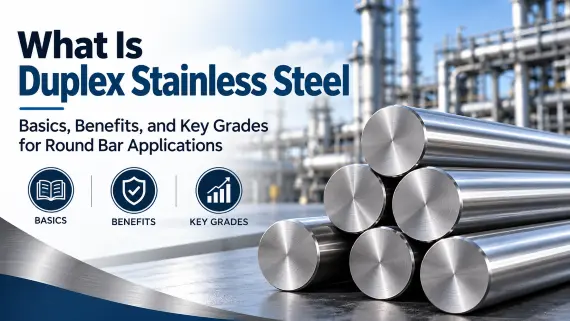
Duplex stainless steel (DSS) is a family of stainless steels whose microstructure contains roughly equal proportions of two crystalline phases: austenite (face-centred cubic, γ) and ferrite (body-centred cubic, α). This dual-phase structure gives duplex grades a combination of high strength, corrosion resistance, and stress-corrosion-cracking resistance that neither fully austenitic nor fully ferritic stainless steels can deliver alone.
The name “duplex” comes directly from this two-phase (Latin: duplex, meaning “twofold”) microstructure. It is not a surface treatment, a coating, or a separate category outside stainless steel. It is a distinct family within the stainless steel classification system, alongside austenitic, ferritic, martensitic, and precipitation-hardening grades, defined by its metallurgy rather than by a single alloying addition. In industry shorthand, you will also see it referred to as SDSS (Super Duplex Stainless Steel, for the higher-alloy variants) or simply by its common grade designations: 2101, 2205, 2507.
Table of Contents
Austenite and Ferrite Phases Explained
To understand duplex stainless steel, you need to understand its two constituent phases and why their balance matters.
Ferrite Phase (α: Body-Centred Cubic)
Ferrite is a body-centred cubic (BCC) iron phase. In duplex stainless steels, the ferrite phase provides:
- High yield strength
- Good resistance to chloride stress corrosion cracking (SCC)
- Magnetic behaviour (measurable permeability)
- Slightly lower toughness at cryogenic temperatures compared to austenite
Austenite Phase (γ: Face-Centred Cubic)
Austenite is a face-centred cubic (FCC) iron phase. In duplex stainless steels, the austenite phase provides:
- Excellent toughness, including at sub-zero temperatures
- Good ductility and formability
- Resistance to a broad range of corrosive media
- Non-magnetic character in the pure austenitic state
The Duplex Phase Balance
In a duplex stainless steel, neither phase dominates. The typical target ratio is 40-60% ferrite and 40-60% austenite, with the most common balance sitting close to 50/50. This balance is achieved through careful control of alloying elements during melting and subsequent solution annealing:
- Ferrite stabilisers: chromium (Cr), molybdenum (Mo), silicon (Si), niobium (Nb) promote the ferritic phase.
- Austenite stabilisers: nickel (Ni), nitrogen (N), manganese (Mn), carbon (C) promote the austenitic phase.
The interaction between these two phases is what makes duplex stainless steel genuinely different from 304, 316, or 430. Ferrite contributes strength and SCC resistance; austenite contributes toughness and general corrosion resistance. The result is a material that outperforms either parent family in several critical areas simultaneously.
Why the Phase Ratio Must Be Controlled
If the phase balance drifts too far toward ferrite, the steel loses impact toughness and becomes more susceptible to intermetallic precipitation (sigma phase, chi phase) during welding or prolonged high-temperature exposure. If it drifts too far toward austenite, the material begins to behave more like a 300-series stainless and loses its SCC advantage.
Reputable mills control this balance within tight windows and verify it through:
- Metallographic testing (ASTM E562 or ASTM E1245)
- Ferrite measurement (Fischer Feritscope or magnetic-induction methods)
- Charpy V-notch impact testing at specified temperatures
What Makes Duplex Stainless Steel Different?
This is the central question most buyers ask. Duplex stainless steel differs from standard austenitic and ferritic grades in composition, microstructure, mechanical properties, and corrosion performance.
Duplex vs. Austenitic vs. Ferritic Stainless Steel: Property Comparison
| Property | Austenitic (e.g. 304, 316) | Ferritic (e.g. 430) | Duplex (e.g. 2205 / 1.4462) |
|---|---|---|---|
| Yield strength (MPa) | 200-300 | 200-280 | 400-550 |
| Tensile strength (MPa) | 500-700 | 400-600 | 620-880 |
| Chloride SCC resistance | Poor to moderate | Good | Very good |
| General corrosion resistance | Good to very good | Moderate | Good to excellent |
| Pitting resistance (PREN range) | 18-26 | 12-18 | 25-42+ |
| Toughness at -46°C | Excellent | Limited | Good |
| Magnetic? | No | Yes | Slightly yes (ferrite content) |
| Weldability | Easy | Moderate | Requires controlled heat input |
| Relative cost | Baseline | Lower | Higher alloy cost, offset by thinner sections |
The practical takeaway: duplex gives you roughly double the yield strength of 304 or 316, meaning you can use smaller cross-sections, lighter components, or achieve higher pressure ratings without stepping up to a nickel alloy. At the same time, its resistance to chloride stress corrosion cracking is dramatically better than 304 or 316, which makes it the go-to choice in offshore, chemical, desalination, and marine environments.
Pitting Resistance Equivalent Number (PREN)
A standard quick-reference metric for comparing pitting and crevice corrosion resistance across stainless grades is:
PREN = %Cr + 3.3 × %Mo + 16 × %N
| Grade | Typical PREN |
|---|---|
| 304 (UNS S30400) | ≈19 |
| 316 (UNS S31600) | ≈24-26 |
| Duplex 2205 (UNS S31803 / S32205 / 1.4462) | ≈34-38 |
| Super Duplex 2507 (UNS S32750 / 1.4410) | ≈40-42 |
A PREN above 33 is generally considered the threshold for reliable performance in seawater and high-chloride process environments. Duplex 2205 clears that threshold; 316 does not.
Duplex Stainless Steel Grades: 2101, 2205, and 2507
Not all duplex steels are the same. The family spans several alloy levels, each designed for a different performance and cost point.
Lean Duplex 2101: UNS S32101 / 1.4162
- Composition: Cr ≈21.5%, Ni ≈1.5%, Mn ≈5%, Mo ≈0.3%, N ≈0.22%
- Yield strength: ≈450MPa
- PREN: ≈24-26
- Purpose: Designed to replace 304/316 in structural and moderately corrosive applications at a lower nickel cost
- Typical uses: construction, bridges, storage tanks, general engineering, reinforcement bar. Check out our Duplex Stainless Steel 2101 Round Bar for structural applications.
Standard Duplex 2205: UNS S31803 / S32205 / 1.4462
- Composition: Cr ≈22%, Ni ≈5%, Mo ≈3%, N ≈0.15-0.18%
- Yield strength: ≈450-500MPa
- PREN: ≈34-38
- Purpose: The workhorse duplex grade, specified heavily in oil and gas, chemical processing, pulp and paper, desalination, and marine hardware
- Round bar availability: commonly stocked from roughly 10mm up to 250mm+ diameter; larger sizes available to order. View details for our Duplex Stainless Steel 2205 Round Bar.
Super Duplex 2507: UNS S32750 / S32760 / 1.4410 / 1.4501
- Composition: Cr ≈25%, Ni ≈7%, Mo ≈3.5-4%, N ≈0.24-0.32%
- Yield strength: ≈550MPa
- PREN: ≈40-42
- Purpose: Used where 2205 is insufficient, such as hot seawater, high-pressure sour service, FGD scrubbers, and subsea components
- Round bar availability: available, but lead times and minimum order quantities are typically longer and higher than 2205
Hyper Duplex (e.g. UNS S32707, S33207)
- PREN > 45
- Reserved for extreme environments; less commonly stocked in round bar form
For most B2B procurement, the conversation centres on 2101, 2205, and 2507. If a project specification calls for “duplex” without further qualification, it almost always means 2205 unless otherwise stated.
Key Benefits of Duplex Stainless Steel
1. Higher Strength, Less Material
Because duplex yield strength is roughly twice that of 304 or 316, designers can reduce wall thickness, shaft diameter, or bar cross-section while maintaining the same load rating. In round bar applications like shafts, fasteners, pump rods, valve stems, and tie bars, this means lighter components, lower material cost per finished part, and sometimes the ability to use a smaller bar diameter that is more readily available from stock.
2. Chloride Stress Corrosion Cracking Resistance
This is arguably the single biggest reason duplex is specified over 316 in oil and gas, offshore, marine, and chemical service. Austenitic grades are susceptible to SCC in the presence of chlorides, tensile stress, and temperatures above roughly 60°C. The duplex microstructure largely eliminates this failure mode.
3. Pitting and Crevice Corrosion Resistance
The combination of chromium, molybdenum, and nitrogen gives 2205 and 2507 significantly higher resistance to localised corrosion than 316. In seawater, brine, and acidic chloride solutions, this translates to longer service life and fewer unplanned shutdowns.
4. Cost-Effectiveness at the Alloy Level
Duplex grades use less nickel than 316 or 316L (roughly 5% vs. 10-12%), which reduces exposure to nickel price volatility. Lean duplex 2101 uses almost no nickel at all, relying instead on manganese and nitrogen to stabilise the austenite phase. For projects with large tonnage requirements, the alloy surcharge saving can be substantial.
5. Good Weldability (With Discipline)
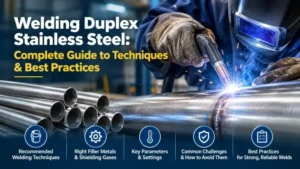
Duplex is weldable, but it demands more control than 304. Heat input must be managed (typically 0.5-2.5kJ/mm depending on thickness and grade), interpass temperature kept below 150°C, and appropriate filler metals used (e.g. ER2209 for 2205, ER2594 for 2507). Post-weld heat treatment is generally not recommended. For round bar buyers who will be machining rather than welding, this is less of a concern, but it matters if the bar will be welded into a fabricated assembly.
Duplex Stainless Steel Round Bar: Practical Sourcing Considerations
If you are procuring duplex stainless steel in round bar form, the following practical points will affect your specification and order:
Size Range
Standard 2205 round bars are commonly stocked from about 10mm to 250mm diameter. Larger diameters (300mm, 350mm, 500mm+) are available from select mills but often carry longer lead times and higher minimum order quantities. To see our full inventory and available sizes, visit our duplex stainless steel round bars product category.
Supply Condition
Bars are typically supplied solution-annealed and quenched (for corrosion resistance and correct phase balance) in the hot-rolled or hot-rolled-and-peeled condition. Cold-drawn or cold-finished bars are available in smaller diameters for tighter dimensional tolerances (h9, h11, etc.).
Testing and Certification
For oil and gas, petrochemical, or pressure-equipment applications, buyers routinely require:
- Mill test certificate (MTC / EN 10204 Type 3.1 or 3.2)
- Charpy V-notch impact testing (often at -46°C for offshore service)
- Ferrite content verification (metallographic or Feritscope)
- Hardness testing (especially for NACE MR0175 / ISO 15156 sour-service compliance)
- Ultrasonic testing (UT) for larger diameters
- PMI (Positive Material Identification) for grade verification on receipt
Applicable Standards
Common specifications for duplex stainless steel round bar include:
- ASTM A276: Stainless Steel Bars and Shapes
- ASTM A479: Stainless Steel Bars for Pressure Vessels and Boilers
- EN 10060 / EN 10277: European bar dimension and tolerance standards
- NORSOK M-630: Oil and gas sector material qualification
- ASME SA-276 / SA-479: Pressure equipment applications
Confirm which standard your project or end-user requires before placing an order.
Machinability
Duplex is tougher and work-hardens more readily than 304. Tool selection, speeds, feeds, and coolant strategy need adjustment. Inform your machining shop of the specific grade (2101, 2205, or 2507) so they can set up appropriately. Carbide tooling and generous coolant flow are standard practice.
Storage and Handling
Keep duplex bars separated from carbon steel to avoid iron contamination, which can initiate surface rust and compromise the passive oxide layer. Store in a covered, dry area. Use dedicated stainless-steel handling equipment or protective barriers where possible.
Applications for Duplex Stainless Steel Round Bar
Duplex round bars are specified across a wide range of industries and components:
- Oil and gas: valve stems, pump shafts, fasteners, downhole tool components, manifold parts, subsea hardware
- Chemical and petrochemical processing: agitator shafts, reactor internals, heat-exchanger tie rods, pressure-vessel studs
- Desalination and water treatment: pump shafts, impeller stock, screen supports, structural tie bars
- Marine and offshore: propeller shafts, mooring hardware, platform structural pins, hydraulic cylinder rods
- Pulp and paper: digester components, washer shafts, rolls
- Construction and infrastructure: reinforcement bars (rebar), structural connectors, bridge pins (especially lean duplex 2101)
- Power generation: FGD system internals, condenser components, turbine auxiliary shafts
When to Choose Duplex Over Standard Stainless Steel
A quick decision framework for specifying engineers and procurement teams:
| Choose duplex when… | Standard 316 may suffice when… |
|---|---|
| Chloride concentrations exceed a few hundred ppm and temperatures are above 60°C | Chloride exposure is low or intermittent |
| SCC resistance is a design requirement | General atmospheric or mild chemical corrosion is the concern |
| You need higher strength without increasing section size | Strength is not the limiting factor |
| Seawater, brine, or sour-service exposure is expected | The environment is non-aggressive (food, pharma, architectural) |
| Weight or material cost savings from thinner sections justify the higher alloy price | Section size is already small and alloy cost difference is negligible |
If you are unsure, share your operating environment (medium, temperature, pressure, chloride content, pH) and mechanical requirements with your material supplier. A knowledgeable supplier will help you confirm the grade before you commit to a purchase.
Limitations of Duplex Stainless Steel
Duplex is not a universal solution. A few constraints to keep in mind:
- Temperature window. Duplex should generally not be used continuously above 250-300°C (depending on grade) because prolonged exposure risks intermetallic phase precipitation (sigma, chi), which embrittles the material. It is also less suitable for cryogenic service below roughly -50°C compared to fully austenitic grades.
- Welding discipline. Welding requires controlled heat input and correct filler metals. Improper welding can shift the phase balance or precipitate harmful phases in the heat-affected zone.
- Hot working and forming. Duplex is stronger and less ductile than 304. Hot forming requires careful temperature control (typically 1050-1150°C for 2205, followed by rapid water quench). Cold forming is possible but requires higher forces.
- Availability. While 2205 is widely stocked globally, super duplex and lean duplex round bars may have fewer stocking sources and longer lead times, particularly in larger diameters or specific tolerance classes.
Frequently Asked Questions About Duplex Stainless Steel
Is 304 Stainless Steel a Duplex Grade?
No. 304 (UNS S30400) is a fully austenitic stainless steel, meaning its microstructure is essentially 100% austenite. It contains roughly 18% chromium and 8% nickel, with no intentional ferrite phase. Duplex grades, by contrast, are engineered to contain a deliberate mixture of austenite and ferrite. If a project specification calls for duplex stainless steel, 304 does not meet it.
What Grade of Stainless Steel Round Bar Do I Need?
The correct grade depends on your operating environment, mechanical loads, corrosion exposure, applicable code, and budget. For general corrosion resistance, 304 or 316 may suffice. For chloride-bearing, high-strength, or SCC-critical applications, duplex 2205 or super duplex 2507 is typically specified. Share your service conditions, required standard (ASTM A276, A479, EN 10060, etc.), size, and any NACE or PED requirements with your supplier to confirm the right grade.
How Do I Know If I Need Duplex Instead of Standard Stainless Steel?
If your application involves chlorides above a few hundred ppm, service temperatures above 60°C, risk of stress corrosion cracking, or a requirement for yield strength above 300MPa, duplex is likely the better choice. Standard 316 struggles in these conditions. If the environment is mild, atmospheric, or low-chloride, 304 or 316 is usually adequate and more economical. When in doubt, provide your process parameters to a materials engineer or your steel supplier for confirmation.
Duplex 2101 vs Regular Stainless Steel: Which Should I Choose?
Lean duplex 2101 (UNS S32101) offers roughly double the yield strength of 304 and better chloride SCC resistance, at a lower nickel cost. It is a strong candidate for structural components, bridges, storage tanks, and general engineering where 304 or 316 would otherwise be specified but higher strength or moderate corrosion resistance is needed. However, in highly aggressive chemical or seawater service, 2205 or 2507 is more appropriate. The choice hinges on your specific corrosion and mechanical requirements.
What Grade of Stainless Steel Do I Actually Need?
There is no single answer; it depends entirely on your application. Define the service medium, temperature, pressure, chloride content, required mechanical properties, applicable code or standard, and any special certifications (NACE, PED, NORSOK). With that information, a materials specialist can narrow the selection. As a general guide: 304 for mild environments, 316 for moderate chemical exposure, 2205 for high-chloride and high-strength applications, and 2507 for severe or subsea conditions.
Is Duplex Stainless Steel Magnetic?
Yes, slightly. Because duplex stainless steel contains a significant ferrite phase (typically 40-60%), it exhibits measurable magnetic permeability, unlike fully austenitic grades such as 304 or 316, which are essentially non-magnetic. This is a normal characteristic of the two-phase microstructure, not a defect. Some buyers use a magnet as a quick field check to distinguish duplex from austenitic stainless, though laboratory phase-balance testing is the proper verification method.
What Is the Microstructure of Duplex Stainless Steel?
Duplex stainless steel contains two distinct crystalline phases in its solid-state microstructure: austenite (face-centred cubic, γ) and ferrite (body-centred cubic, α). The target ratio is approximately 50% austenite and 50% ferrite, though specifications typically allow a range of 35-65% ferrite. This dual-phase structure is achieved by balancing ferrite-forming elements (Cr, Mo) against austenite-forming elements (Ni, N, Mn) during melting and is locked in through solution annealing and rapid quenching.
Why Is It Called “Duplex” Stainless Steel?
The term “duplex” comes from the Latin word for “twofold” or “double.” It refers directly to the two-phase microstructure (austenite plus ferrite) that defines this family of stainless steels. Unlike austenitic stainless (one phase) or ferritic stainless (one phase), duplex contains both phases simultaneously in roughly equal proportions. The name has been in common metallurgical usage since the 1930s when the first commercial duplex alloys were developed.
What Are the Two Phases in Duplex Stainless Steel and Why Do They Matter?
The two phases are austenite (γ, FCC) and ferrite (α, BCC). Ferrite provides high yield strength and resistance to chloride stress corrosion cracking. Austenite provides toughness, ductility, and general corrosion resistance. Together, they give duplex a property profile that neither phase alone can match. The ratio between them is critical: too much ferrite reduces toughness; too much austenite diminishes SCC resistance. Mills control and verify this balance to specification.
Is Duplex Stainless Steel a Type of Stainless Steel or a Separate Category?
Duplex is a type of stainless steel, not a separate category. It sits within the broader stainless steel family alongside austenitic, ferritic, martensitic, and precipitation-hardening grades. What distinguishes duplex is its metallurgical structure (two phases instead of one) and its specific alloy chemistry. It is classified under its own group in standards such as ASTM, EN, and UNS, but it remains firmly within the stainless steel designation system and is subject to the same general melting, testing, and certification frameworks.
Final Note
Duplex stainless steel occupies a specific and valuable position in the stainless steel family. It is not a replacement for 304 or 316 in every application, but in environments where chlorides, stress corrosion cracking, and mechanical strength converge, it is often the most technically sound and economically sensible choice.
If you are specifying or procuring duplex stainless steel round bars, whether in 2101, 2205, or 2507, confirm the grade, size range, dimensional standard, testing requirements, and applicable certifications early in the process. This avoids delays, ensures the material matches your project specification, and keeps the supply chain moving.
For availability, sizing, and documentation requirements, reach out to a stocking supplier who carries duplex round bars across multiple grades and can provide full mill certification, third-party inspection coordination, and export-ready documentation for your destination market.
Euro Steel Bars (ESB) stocks and supplies stainless steel, duplex, super duplex, nickel alloy, titanium, and carbon steel round bars in a range of specifications and standards for industrial buyers across the Middle East, Southeast Asia, Europe, Turkey, Taiwan, and South Africa. For enquiries on duplex stainless steel round bar availability, sizes, and certification, contact our sales team with your project requirements.