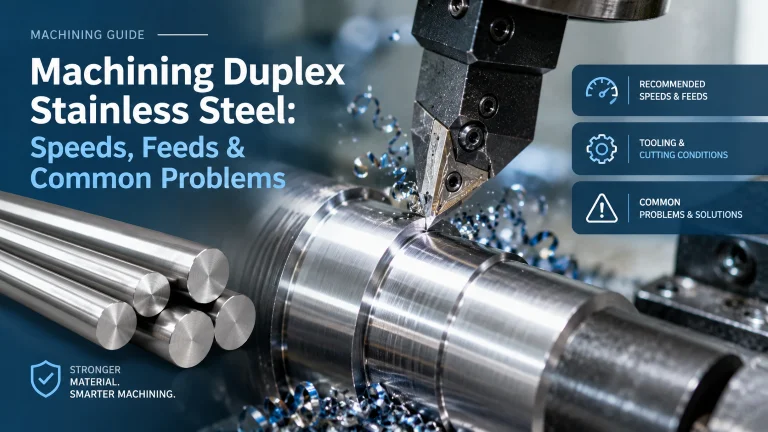
Duplex stainless steel does not machine like 304 or 316. The higher strength, poor thermal conductivity and aggressive work hardening mean you need lower cutting speeds, higher feed rates, deeper cuts and a rigid setup. If you apply standard austenitic parameters to a 2205 or 2507 bar, you will see rapid tool wear, glazed surfaces and dimensional problems within the first few parts.
This guide covers the practical parameters, tooling choices, coolant strategy and troubleshooting steps for machining duplex stainless steel round bars in turning, milling and drilling operations.
Table of Contents
Why duplex is harder to machine than 304/316
Duplex grades like UNS S31803/S32205 (2205) and UNS S32750/S32760 (2507) get their strength and corrosion resistance from a roughly 50/50 mix of austenite and ferrite. That structure creates four problems at the cutting edge:
| Property | Effect on machining |
|---|---|
| High yield and tensile strength (2205 yield around 450MPa, 2507 yield around 550MPa) | Higher cutting forces. Demands rigid setups and tough tool substrates. |
| Low thermal conductivity (around 15W/m·K, roughly half that of carbon steel) | Heat stays at the cutting edge and workpiece surface instead of leaving with the chip. |
| High work hardening rate | Any rubbing, dwelling or light pass hardens the surface immediately, accelerating wear on the next pass. |
| Abrasive dual phase microstructure | The hard ferrite phase accelerates flank wear and notch wear on carbide tools. |
If you have machined 316L before and switch to 2205 with the same parameters, expect the tool to fail two to three times faster.
Tooling and machine setup
Getting the tooling right matters more than fine tuning speeds and feeds. A flexible setup or the wrong carbide grade will cause problems no parameter change can fix.
Rigidity
Use the shortest tool overhang you can. Every extra millimetre multiplies deflection under the higher cutting forces duplex demands. Clamp the workpiece securely. Hydraulic or mechanical chucks rated for high force work are preferable. Avoid long unsupported spans on bar work. Confirm the machine spindle and axis drives can handle the increased torque without stalling or servo lag.
Carbide grade and coating
Pick a tough, medium to coarse grain carbide substrate designed for stainless steel or heat resistant alloys. Avoid ultra hard, brittle grades that chip under intermittent loads. PVD coatings like TiAlN, AlTiN or AlCrN work well. They resist heat while keeping the cutting edge sharp. Avoid thick CVD coatings because they blunt the edge and increase cutting forces. For drilling and some finishing operations, a polished, uncoated or lightly coated carbide can reduce built up edge.
Tool geometry
Sharp cutting edges matter. Honed or heavily chamfered edges increase rubbing and accelerate work hardening. Use positive rake angles, typically +6° to +12°, to reduce cutting forces and direct heat into the chip. Select chipbreakers with open geometries suited to stainless steel. Duplex produces long, stringy chips, and a poor chipbreaker will cause recutting and surface damage.
Speeds, feeds and depth of cut
The working principle for duplex machining is straightforward: reduce cutting speed, increase feed rate and keep the depth of cut deep enough to stay below the work hardened surface layer.
Cut too slowly with too light a feed and the tool rubs instead of cutting, which work hardens the surface. Cut too fast and the heat has nowhere to go because the material conducts it poorly, so the tool edge degrades quickly.
Turning
| Parameter | Roughing | Finishing |
|---|---|---|
| Cutting speed (Vc) | 40 to 70m/min (130 to 230SFM) | 60 to 100m/min (200 to 330SFM) |
| Feed rate (f) | 0.25 to 0.45mm/rev (0.010 to 0.018in/rev) | 0.10 to 0.20mm/rev (0.004 to 0.008in/rev) |
| Depth of cut (ap) | 2.0 to 5.0mm (0.080 to 0.200in) | 0.3 to 1.0mm (0.012 to 0.040in) |
| Coolant | High pressure through tool or flood | High pressure through tool or flood |
One rule to follow strictly: never take a finishing pass lighter than 0.5mm unless you are certain the previous pass left no work hardened layer. The tool must cut into fresh material, not skim over a glazed surface.
Milling
| Parameter | Face/shoulder milling | Slotting |
|---|---|---|
| Cutting speed (Vc) | 50 to 80m/min (165 to 260SFM) | 40 to 60m/min (130 to 200SFM) |
| Feed per tooth (fz) | 0.10 to 0.25mm/tooth (0.004 to 0.010in/tooth) | 0.08 to 0.15mm/tooth (0.003 to 0.006in/tooth) |
| Axial depth (ap) | Up to 1x cutter diameter | Up to 0.5x cutter diameter |
| Radial depth (ae) | 30 to 70% of cutter diameter | Full width (slot) |
Use climb milling only. Conventional milling causes the tooth to rub against the work hardened surface before it engages, which increases tool wear significantly. Enter the cut with a ramp or circular interpolation rather than a straight plunge. Plunging concentrates heat and shock on the tool tip. Make sure every tooth engages with a full chip load. Light radial engagement at high speed causes rubbing rather than cutting.
Drilling
| Parameter | Solid carbide drill (6 to 20mm diameter) | Indexable insert drill |
|---|---|---|
| Cutting speed (Vc) | 30 to 60m/min (100 to 200SFM) | 40 to 70m/min (130 to 230SFM) |
| Feed rate (f) | 0.10 to 0.25mm/rev (0.004 to 0.010in/rev) | 0.15 to 0.30mm/rev (0.006 to 0.012in/rev) |
| Coolant | Through tool, high pressure (minimum 40bar / 580psi) | Through tool, high pressure |
Avoid peck drilling where possible. Each retract and re enter cycle lets the hole bottom work harden before the next entry. If you must peck for deep holes or poor chip evacuation, use short pecks, maintain feed into the material and never let the drill dwell at the bottom. Use drills with a 140° point angle and a strong, short chisel edge. This reduces thrust force and improves centring. For holes above 12mm, drill a pilot hole at 30 to 50% of the final diameter. This reduces load on the full size drill and improves accuracy.
Coolant and chip control
Because duplex conducts heat poorly, the cutting zone temperature rises fast and attacks the tool edge. Coolant strategy is not optional here.
Coolant delivery
High pressure through tool coolant at 40 to 70bar (580 to 1,000psi) is the most effective method. It penetrates the cutting zone, cools the edge and breaks chips at the source. If high pressure systems are not available, use generous flood coolant at high flow rate, aimed directly at the cutting edge rather than the workpiece surface. Maintain coolant concentration at 8 to 12% for effective lubrication and heat transfer. For drilling, through tool coolant is necessary for chip evacuation and preventing seizure. Without it, chips pack in the flutes and the drill seizes.
Chip control
Duplex produces long, tough, stringy chips. Left uncontrolled, they wrap around the tool or workpiece, scratch finished surfaces and cause recutting. Use chipbreakers with a positive, open geometry suited to stainless steel. In turning, program chip breaking cycles like brief feed interruptions or oscillation if the chipbreaker alone cannot curl and break the chip. In milling, make sure coolant flow or air blast evacuates chips from deep pockets before the next tooth engages.
Common problems and how to fix them
| Problem | Likely cause | Fix |
|---|---|---|
| Rapid flank wear | Cutting speed too high, inadequate coolant or wrong carbide grade | Reduce Vc by 10 to 20%. Increase coolant pressure or concentration. Switch to a tougher, more heat resistant grade. |
| Notch wear at depth of cut line | Abrasive ferrite phase at the cut boundary or constant engagement at the same depth | Vary depth of cut by ±0.5mm between passes. Use a tougher substrate. Aim high pressure coolant at the notch zone. |
| Work hardening or surface glazing | Feed too low, tool rubbing instead of cutting, dwelling or light passes over a hardened layer | Increase feed rate. Ensure depth of cut exceeds the hardened layer (at least 0.5mm). Eliminate dwells. Use sharp tools. |
| Built up edge (BUE) | Cutting speed too low, poor lubrication or dull tool edge | Increase Vc slightly. Improve coolant delivery. Replace or resharpen the insert. Try a polished rake or coated tool. |
| Chatter and vibration | Insufficient rigidity, excessive overhang or cutting forces too high | Shorten tool overhang. Reduce ap or ae. Use a heavier or vibration damping toolholder. Verify workpiece clamping. |
| Poor surface finish | BUE transfer, chip recutting, wrong feed/speed combination or worn tool | Adjust feed and speed. Improve chip evacuation. Replace worn insert. Verify coolant reaches the cutting edge. |
| Drill walking or poor hole accuracy | No pilot hole, dull chisel edge or inadequate rigidity | Use a centre drill or pilot hole. Use a 140° point angle drill. Confirm through tool coolant. Check spindle runout. |
| Tool chipping or fracture | Intermittent cuts with a brittle grade, excessive depth of cut or thermal shock | Switch to a tougher substrate. Reduce ap. Keep coolant flow consistent to avoid thermal cracking. |
Does super duplex (2507) machine differently from standard duplex (2205)?
Super duplex grades like UNS S32750 (2507) and UNS S32760 (F55) contain higher chromium, molybdenum and nitrogen. This pushes strength and hardness higher than 2205. In practice, you should reduce cutting speeds by a further 10 to 20% compared to 2205 parameters. Expect higher cutting forces and verify machine rigidity accordingly. Tool wear rates increase, so budget for more frequent insert changes. All other principles like high feed, adequate depth of cut, high pressure coolant and rigid setup remain the same and become more important.
Material quality affects machinability
Even with correct parameters, inconsistent bar stock causes unpredictable tool wear, surface defects and dimensional problems. Machinability depends on consistent chemistry within the specified range, proper solution annealing and quenching (typically around 1050°C) to achieve the correct austenite ferrite ratio, uniform grain structure free from segregation and straightness of the bar.
Sourcing duplex round bars with full mill test certificates and verified heat treatment records matters as much as the machining parameters themselves. Euro Steel Bars (ESB) supplies certified duplex and super duplex stainless steel round bars to international specifications. We stock grades including duplex stainless steel 2205 round bar, along with lean duplex options. You can view our full range of duplex stainless steel round bars online. Bars are available in a wide range of diameters and lengths, fully traceable, with the documentation procurement and engineering teams require. Consistent material means predictable machining, fewer tool changes and reliable component quality.
Quick reference summary
- Do not machine duplex like 304 or 316. Lower the speed, raise the feed, go deeper.
- Keep depth of cut above 0.5mm on roughing and semi finishing passes to stay below the work hardened layer.
- Use climb milling only. Conventional milling rubs and work hardens.
- Select tough carbide with PVD coatings like TiAlN or AlTiN. Avoid thick CVD.
- Keep cutting edges sharp with positive rake angles. Replace inserts at the first sign of wear.
- Apply high pressure through tool coolant (minimum 40bar). If unavailable, use high volume flood aimed at the cutting edge.
- Eliminate dwells, light passes and rubbing. Every moment the tool contacts the surface without cutting, the surface hardens.
- Verify material certification before machining. Inconsistent chemistry or heat treatment in the bar will undermine every parameter you set.
Frequently asked questions
What cutting speed should I use for machining duplex stainless steel 2205?
For turning with coated carbide, start at 50 to 70m/min (165 to 230SFM) for roughing and 70 to 100m/min (230 to 330SFM) for finishing. For super duplex 2507, reduce these values by 10 to 20%.
Why does my tool wear out so quickly when machining duplex stainless steel?
The most common causes are cutting speed set too high, insufficient coolant at the cutting zone and a carbide grade that is too hard and brittle for the cutting forces involved. Reduce speed, increase coolant pressure and switch to a tougher substrate.
Can I peck drill duplex stainless steel?
It is best avoided. Each retract lets the hole bottom work harden, making re entry harder and accelerating drill wear. If pecking is necessary for deep holes or poor chip evacuation, use short pecks, maintain high coolant pressure and never let the drill dwell at the bottom.
What is the minimum depth of cut for duplex stainless steel?
Keep depth of cut at or above 0.5mm on any pass that follows a previous cut. This ensures the tool engages fresh material below the work hardened surface layer. Lighter passes cause rubbing and rapid tool degradation.
Is duplex stainless steel harder to machine than 316L?
Yes. Duplex 2205 has roughly twice the yield strength of 316L and lower thermal conductivity. That means higher cutting forces, more heat at the tool edge and a greater tendency to work harden. Reduce cutting speeds and increase feeds compared to 316L parameters.
What coolant works best for machining duplex stainless steel?
High pressure through tool coolant at 40 to 70bar (580 to 1,000psi) with a concentration of 8 to 12% is the most effective option. If high pressure systems are not available, use high volume flood coolant aimed directly at the cutting edge.
If you need technical support or want to discuss project specific supply solutions, contact our team to request a quotation.