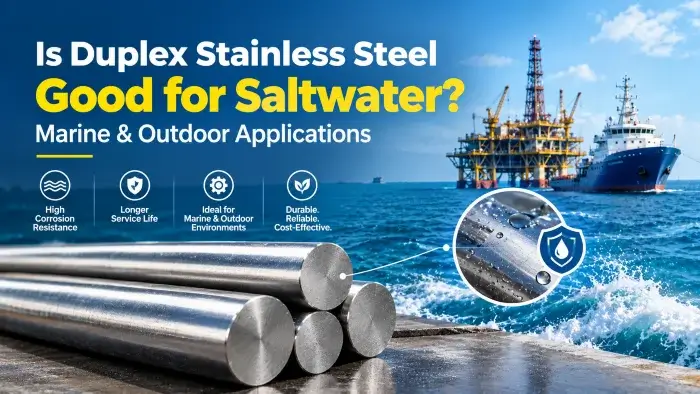
Duplex stainless steel resists saltwater corrosion. Its two-phase microstructure contains roughly 50% austenite and 50% ferrite. This mix provides better resistance to chloride pitting, crevice corrosion, and stress corrosion cracking than standard austenitic grades like 316L.
However, duplex is not a single material. Standard Duplex 2205 works in splash zones and cooler seawater. Super Duplex 2507 is necessary for warm, stagnant, or highly saline conditions like those in the Arabian Gulf, tropical Southeast Asia, or deep subsea service. Specifying the wrong grade for the environment is a common error in marine and offshore procurement.
This article covers how duplex grades perform in saltwater, where each one fits, how they compare to 316L, and what to watch for during fabrication and sourcing.
Table of Contents
Why saltwater attacks stainless steel
Saltwater is an electrolyte loaded with chloride ions. Those ions break through the passive chromium oxide film that protects stainless steel. Once the film breaches locally, three types of damage follow.
Pitting corrosion occurs when chloride ions create small, deep cavities in the surface. This is the most common failure mode in warm or stagnant seawater.
Crevice corrosion happens when differential oxygen concentration builds up under gaskets, bolt heads, overlapping plates, or tight gaps. The metal inside the crevice corrodes faster than the exposed surface. This causes problems in flanged connections and submerged assemblies.
Chloride stress corrosion cracking (CSCC) involves tensile stress combined with chloride exposure causing intergranular cracking. Austenitic grades like 304 and 316L are especially vulnerable above 60°C. Duplex grades resist this mechanism better because of their ferrite content.
The PREN value: how engineers compare grades
The Pitting Resistance Equivalent Number (PREN) predicts how well an alloy resists localized chloride attack. The formula is:
PREN = %Cr + 3.3 x %Mo + 16 x %N
As a rough guide:
- PREN below 25: not suitable for sustained seawater contact
- PREN 30 to 35: acceptable for moderate marine exposure
- PREN above 40: handles aggressive, warm, or stagnant seawater
The higher molybdenum and nitrogen content in duplex grades pushes the PREN past the threshold needed for reliable saltwater service.
Duplex 2205 vs. Super Duplex 2507: which grade fits your saltwater environment?
Both are duplex stainless steels. Their performance envelopes in seawater differ enough that specifying the wrong one leads to premature failure.
Standard Duplex 2205 (UNS S31803 / S32205)
Duplex 2205 has a PREN around 34 to 38. It resists pitting and CSCC far better than 316L, but it has a practical limit in warm, stagnant seawater. Above roughly 25°C to 30°C in crevice conditions, 2205 becomes vulnerable.
Where 2205 works well:
- Splash zones and tidal zones
- Coastal atmospheric exposure for structures within a few hundred meters of open ocean
- Well-aerated, flowing seawater systems in cooler climates
- General offshore structural use where full submersion in warm water is not a factor
A note for buyers in the Gulf and Middle East: Arabian Gulf seawater temperatures regularly exceed 33°C in summer, with salinity above 40ppt. In those conditions, 2205 is often insufficient for submerged or crevice-prone components. Super Duplex or 6% Mo alloys become necessary.
Super Duplex 2507 (UNS S32750 / S32760)
Super Duplex 2507 has a PREN around 42 to 45. The higher chromium, molybdenum, and nitrogen content give it strong resistance to pitting and crevice corrosion even in warm, stagnant, high-salinity seawater. It is built for prolonged submersion.
Where 2507 works well:
- Subsea pipelines, risers, and connectors
- Seawater intake and cooling systems in desalination plants
- Offshore oil and gas production equipment
- Marine pump shafts, valve stems, and heat exchanger components
- High-pressure reverse osmosis vessels
Side-by-side comparison
| Parameter | Duplex 2205 | Super Duplex 2507 | 316L |
|---|---|---|---|
| PREN | 34 to 38 | 42 to 45 | 24 to 26 |
| Yield strength | 450MPa to 480MPa | 550MPa to 580MPa | 170MPa to 200MPa |
| Max continuous service temp | 300°C | 300°C | 450°C |
| Warm stagnant seawater | Limited | Handles it well | Poor |
| CSCC resistance | High | Very high | Low |
| Relative alloy cost | Moderate | Higher | Lower |
Duplex stainless steel vs. 316L for marine environments
316L was the default marine-grade stainless for decades. In demanding industrial and offshore work, duplex has largely replaced it. Three reasons stand out.
Corrosion resistance: 316L contains 2% to 3% molybdenum and has a PREN of roughly 24 to 26. In stagnant or warm seawater, it pits and suffers crevice corrosion within months. Duplex 2205 doubles the molybdenum and adds nitrogen. Super Duplex 2507 goes further. The result is a material that stays submerged in aggressive seawater for decades without localized attack.
Mechanical strength: Duplex grades have roughly twice the yield strength of 316L. Engineers designing shafts, fasteners, and structural supports can use smaller cross-sections and lighter components. Procurement teams can offset the higher per-kg alloy cost by needing less material overall.
Lifecycle cost: Duplex components in saltwater service typically need no protective coatings, no cathodic protection, and fewer inspection cycles. A design life of 25 to 40 years in marine service is common. This reduces operating expenses and avoids shutdowns for EPC contractors and asset owners.
Proven marine and outdoor industrial applications
Engineers use duplex stainless steel in nearly every sector where steel meets seawater. Because Euro Steel Bars supplies duplex stainless steel round bars and long products, many of these applications start with the correct bar specification.
Marine and shipbuilding:
- Propeller shafts and rudder stocks machined from large-diameter duplex or super duplex round bars
- Valve stems, pump shafts, and marine fasteners made from high-strength bar stock
- Seawater cooling system piping and headers
- Ballast water treatment system components
Offshore oil and gas:
- Subsea manifold components and connector bodies
- Topside seawater and fire-water piping
- Umbilical tubing and control-line carriers
- Structural fasteners and tensioning hardware on FPSOs and fixed platforms
Desalination and water treatment:
- High-pressure RO pump shafts and impeller stems
- Brine handling piping and valve bodies
- Intake screen supports and trash-rack components
Coastal infrastructure and heavy outdoor exposure:
- Bridge cable anchorages and structural tie-bars in coastal highway projects
- Structural steelwork in high-salinity urban environments like waterfront developments in the Gulf or Southeast Asian port cities
- Lock gates, sluice mechanisms, and tidal barrier components
Power generation:
- Condenser tube support plates and water-box internals
- Seawater intake trash-rack bars and screening components
- Flue-gas desulphurisation hardware exposed to chloride-laden condensate
Design and fabrication limitations
Duplex stainless steel is not a universal solution. A few constraints matter during design and sourcing.
Temperature ceiling:
Duplex and super duplex grades should not be used continuously above 300°C. Long-term exposure in the 300°C to 550°C range risks embrittlement. Sigma and chi phase precipitation makes the steel brittle and destroys corrosion resistance. This is primarily a concern during welding or if the material is held between 600°C and 950°C. Austenitic or nickel-based alloys are the correct choice for high-temperature marine exhaust or thermal applications.
Welding and heat input control:
The 50/50 austenite-ferrite balance is sensitive to thermal cycling. Welding procedures need to control heat input, typically 0.5 to 2.5kJ/mm depending on grade and thickness. Fabricators must use matching or over-alloyed filler metals, keep interpass temperatures below 150°C, and use adequate shielding gas. Poor welding practice reduces the corrosion resistance of the heat-affected zone below that of the parent metal.
Machining and cold forming:
Duplex round bars are tougher and more prone to work-hardening than 316L. Fabricators should use carbide or CBN tooling at reduced speeds, rigid fixturing to handle higher cutting forces, and generous coolant supply.
Galvanic coupling:
Bolting duplex components to carbon steel or aluminium structures in seawater causes galvanic corrosion that attacks the less-noble metal. Designs must include isolation kits, gaskets, or sacrificial anodes.
Sourcing duplex stainless steel
The material is only as good as its traceability and certification.
Relevant standards for duplex round bars and bar stock:
- ASTM A276: Stainless steel bars and shapes
- ASTM A479: Stainless steel bars for boilers and pressure vessels
- EN 10088-3: European standard for semi-finished stainless steel products
- NORSOK M-650: Qualification of manufacturers for offshore and corrosive service
- NACE MR0175 / ISO 15156: Materials for use in H2S-containing environments
What to request from your supplier:
- Mill Test Certificate per EN 10204 3.1 or 3.2 confirming chemical composition, mechanical properties, and PREN calculation
- Charpy impact test results for subsea and offshore structural components
- Confirmation of solution-annealed and quenched condition
- Surface condition and dimensional tolerance per ASTM A276 or your project specification
- Heat number traceability from melt to delivery
Supply and logistics for international projects:
Sourcing certified duplex and super duplex round bars for projects in the Gulf, Middle East, Southeast Asia, Europe, Turkey, Taiwan, or South Africa requires a stockist who can deliver consistent availability across a wide size range, typically 6mm to 300mm diameter. Buyers need short lead times and export-ready documentation including commercial invoices, packing lists, certificates of origin, and MTCs.
Euro Steel Bars stocks and exports Duplex 2205, Super Duplex 2507, and related specialty-grade stainless steel round bars to industrial buyers worldwide. All material ships with full mill certification and can be processed to project-specific dimensional requirements.
Frequently asked questions
2205 Duplex Stainless Steel in Saltwater: Is It Corrosion Resistant?
Yes, Duplex 2205 (UNS S32205/S31803) offers good corrosion resistance in many chloride-containing environments and is more resistant to chloride stress corrosion cracking than common 304 stainless steel. Its chromium, molybdenum, and nitrogen content also provide good resistance to pitting and crevice corrosion. However, seawater is a severe environment, and performance depends on temperature, chloride concentration, oxygen, flow conditions, deposits, crevices, and surface condition. For continuous seawater or severe offshore service, buyers may need to consider a super duplex grade rather than assuming 2205 is suitable for every application.
How Long Does Duplex Stainless Steel Last in Harsh Environments?
There is no fixed service life for duplex stainless steel because durability depends on the environment, grade, temperature, chloride exposure, mechanical loading, fabrication quality, and maintenance. Properly selected duplex stainless steel can provide long service in demanding industrial and outdoor applications. However, seawater, stagnant chloride deposits, crevices, and elevated temperatures can increase corrosion risk. The correct approach is to select the grade based on the actual service conditions and applicable design requirements. Buyers should consider corrosion mechanisms such as pitting, crevice corrosion, and chloride stress corrosion cracking rather than relying on a guaranteed number of service years.
How Long Does 2205 Duplex Stainless Last in Harsh Environments?
Duplex 2205 can provide a long service life when it is correctly selected, fabricated, and maintained for the application. However, there is no universal lifespan for 2205 because performance depends on chloride concentration, temperature, seawater exposure, crevices, deposits, mechanical stresses, and surface condition. Direct seawater service is more demanding than normal outdoor exposure. In severe marine environments, engineers may consider higher-alloy grades such as super duplex. For procurement, the important question is whether 2205 meets the project’s corrosion and mechanical requirements for the expected service conditions, rather than specifying a fixed number of years.
How Long Does Duplex Stainless Steel Last?
Duplex stainless steel does not have a standard expiration period. Its service life depends on the grade, environment, design, fabrication, installation, and maintenance. A properly selected duplex grade can remain in service for many years, but corrosion resistance can vary considerably between applications. For example, atmospheric exposure is generally less demanding than continuous seawater or chemical service. Welding quality and surface condition can also influence performance. Buyers should therefore evaluate the expected service environment, including chlorides, temperature, moisture, chemical exposure, stress, and crevice conditions, before selecting a duplex round bar or finished component.
Best Metal Bars for Outdoor Installations That Won’t Rust
No metal bar can be guaranteed never to rust or corrode in every outdoor environment. Stainless steel grades such as 304, 316, duplex 2205, and selected super duplex grades can provide different levels of corrosion resistance depending on the conditions. For ordinary outdoor exposure, 304 may be adequate in many applications, while 316 is often considered where chloride exposure is higher. Duplex 2205 can provide higher strength and strong corrosion resistance for more demanding service. Near seawater or in severe marine environments, the grade should be selected based on chlorides, temperature, exposure, design life, and applicable engineering requirements.
Can I Use Duplex Stainless Steel for Outdoor Projects?
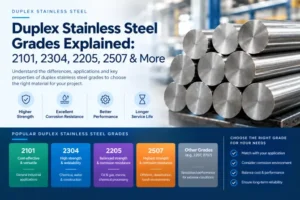
Yes, duplex stainless steel can be used for many outdoor applications where corrosion resistance and mechanical strength are important. It can be suitable for structures, equipment, supports, shafts, fasteners, and other components exposed to moisture and atmospheric conditions. However, the correct grade depends on the environment. Coastal and marine locations can expose the material to higher chloride levels than inland environments. Duplex 2304, 2101, 2205, and super duplex grades have different performance characteristics. Buyers should consider chloride exposure, temperature, surface condition, mechanical loads, fabrication, and maintenance requirements before choosing the appropriate grade.
Can I Use Duplex 2101 Round Bar for Outdoor Projects?
Duplex 2101 is a lean duplex stainless steel that can be suitable for many outdoor applications, particularly where good mechanical strength and general corrosion resistance are required. However, it should not automatically be treated as a substitute for 2205 in severe marine or chloride environments. Its suitability depends on the actual exposure conditions, including chloride concentration, humidity, temperature, deposits, and service duration. For inland outdoor applications, 2101 may be a practical material choice in suitable conditions. For coastal, offshore, or direct seawater exposure, buyers should have the grade evaluated against the project’s corrosion requirements.
Will Duplex Stainless Steel Last Longer Than 304?
Duplex stainless steel can provide better performance than 304 in certain demanding environments, particularly where chloride exposure and mechanical strength are important. Duplex grades such as 2205 generally offer higher strength and better resistance to chloride stress corrosion cracking than 304. However, “last longer” depends on the actual application. A properly selected 304 grade may perform well for many indoor or mild outdoor environments, while duplex can offer advantages in more aggressive service. Buyers should compare the corrosion conditions, temperature, mechanical loads, fabrication requirements, and expected service life rather than choosing solely on grade hierarchy.
Which Duplex Grade Is Best for Offshore and Subsea Applications?
There is no single duplex grade that is best for every offshore or subsea application. Duplex 2205 is widely considered for demanding applications where strength and corrosion resistance are required, while super duplex grades such as 2507 (UNS S32750) offer higher alloy content and greater resistance to chloride-related corrosion for more severe conditions. The correct selection depends on seawater exposure, temperature, pressure, crevice conditions, cathodic protection, mechanical loads, and project specifications. Offshore and subsea buyers should also consider applicable industry standards and qualification requirements before selecting round bar or finished components.
Is Duplex Stainless Steel Suitable for Ship Hulls and Propeller Shafts?
Duplex stainless steel can be suitable for selected marine components, but the grade must be matched to the component and service conditions. Duplex grades are used in marine and offshore equipment where strength and corrosion resistance are important. However, ship hulls and propeller shafts have specific structural, fatigue, fabrication, classification, and design requirements, so material selection cannot be based on corrosion resistance alone. For propeller shafts in particular, engineers must evaluate torsional loads, fatigue, seawater exposure, shaft dimensions, manufacturing requirements, and applicable classification rules before specifying duplex stainless steel.
Does Duplex Stainless Steel Need Cathodic Protection in Seawater?
Cathodic protection is not automatically required for every duplex stainless steel component in seawater. Whether it is needed depends on the grade, component design, seawater exposure, electrical conditions, crevice geometry, and overall corrosion-control strategy. In marine systems, cathodic protection may be used alongside material selection, coatings, design controls, and proper maintenance. However, incorrect cathodic protection can also create problems, so the system needs to be properly designed and controlled. For seawater applications, buyers should evaluate the complete corrosion-control system rather than assuming that duplex stainless steel alone eliminates the need for other protection measures.
Final recommendation
For any project involving sustained saltwater exposure, duplex stainless steel is a proven material. The task is matching the grade to the environment. Use Duplex 2205 for coastal atmospheric, splash zone, or cooler seawater. Use Super Duplex 2507 for warm, stagnant, highly saline, or fully submerged seawater.
Specifying the correct grade, securing proper mill certification, and working with a reliable stockist protects the structural integrity and budget of the project.
Need duplex or super duplex round bars for a marine, offshore, or coastal project? Contact Euro Steel Bars to discuss your grade, specification, size range, and delivery requirements. We support procurement and engineering teams across the Gulf, Europe, Southeast Asia, Turkey, Taiwan, and South Africa with certified stock and export-ready documentation.