If you are specifying round bars for a project in oil and gas, chemical processing, marine engineering, or power generation, the choice between duplex stainless steel (typically UNS S32205, EN 1.4462) and 316 / 316L stainless steel (UNS S31600 / S31603, EN 1.4401 / 1.4404) is one of the most consequential material decisions you will make. It affects structural design, wall thickness, corrosion allowance, welding procedures, inspection requirements, total project cost, and long-term service life.
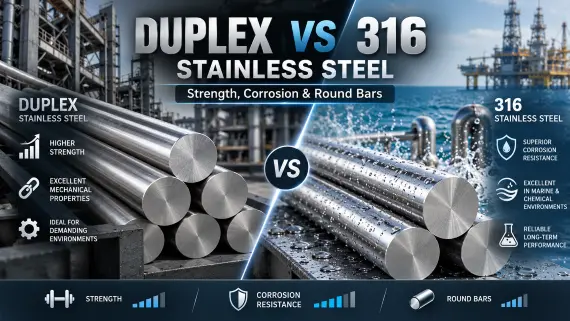
Duplex 2205 delivers roughly 2.2 times the yield strength of 316, significantly higher pitting resistance (PREN 34 to 38 vs 24 to 26), and superior resistance to chloride stress corrosion cracking. However, 316 / 316L remains the better choice for cryogenic service, severe cold forming, and applications where welding simplicity is critical. The two alloys are not interchangeable by default. They solve different problems.
This comparison gives you the technical data, practical considerations, and application guidance needed to specify the right grade, whether you are ordering 20mm round bars for a heat exchanger or 200mm bars for subsea fasteners.
Table of Contents
1. The Fundamental Difference Between Duplex vs 316 Stainless Steel
The distinction starts at the microstructure level.
316 / 316L is a fully austenitic stainless steel. Its crystal structure is face-centred cubic (FCC), stabilised by nickel and manganese. This gives it excellent ductility, toughness at cryogenic temperatures, and straightforward fabrication behaviour.
Duplex 2205 has a two-phase microstructure: roughly 50% austenite and 50% ferrite. The ferrite phase contributes high strength and resistance to chloride stress corrosion cracking. The austenite phase provides toughness and weldability. The balance between these two phases is tightly controlled during melting, hot rolling, and heat treatment of the bar.
This structural difference drives every other property gap between the two alloys.
2. Chemical Composition
| Element | 316 / 316L | Duplex 2205 |
|---|---|---|
| Chromium (Cr) | 16.0 to 18.0% | 22.0 to 23.0% |
| Nickel (Ni) | 10.0 to 14.0% | 4.5 to 6.5% |
| Molybdenum (Mo) | 2.0 to 3.0% | 3.0 to 3.5% |
| Nitrogen (N) | ≤0.10% | 0.14 to 0.20% |
| Manganese (Mn) | ≤2.0% | ≤2.0% |
| Carbon (C) | ≤0.08% (316) / ≤0.03% (316L) | ≤0.030% |
| Silicon (Si) | ≤1.0% | ≤1.0% |
| Copper (Cu) | Not specified | ≤0.5% |
What this means in practice:
- Duplex carries significantly more chromium and nitrogen, both of which boost pitting and crevice corrosion resistance.
- Duplex uses less nickel (5 to 6.5% vs 10 to 14%), which historically made it less sensitive to nickel price volatility, though this advantage has narrowed in recent years.
- 316L’s low carbon variant (≤0.03% C) exists primarily to prevent sensitisation during welding. Duplex 2205 is already low-carbon by specification.
3. Mechanical Properties of Round Bars (Solution-Annealed Condition)
This is where the comparison becomes most practically significant for design engineers selecting round bars for shafts, studs, tie rods, and load-bearing components.
| Property | 316 / 316L | Duplex 2205 |
|---|---|---|
| Yield Strength (0.2% offset), min | 205MPa (30ksi) | 450MPa (65ksi) |
| Tensile Strength, min | 515MPa (75ksi) | 620MPa (90ksi) |
| Elongation (in 50mm), min | 40% | 25% |
| Hardness, max (HB) | 217 | 293 |
| Density | 8.00g/cm³ | 7.80g/cm³ |
| Modulus of Elasticity | 193GPa | 200GPa |
| Impact Toughness (Charpy V, RT) | >100J | >100J |
| Impact Toughness (at -46°C) | Excellent | ≥27J (per EN 10088-3) |
The critical takeaway: Duplex 2205 delivers roughly 2.2 times the yield strength of 316. In a round bar application (shafts, tie rods, pump shafts, valve stems, stud bolts), this means you can often reduce the diameter by 20 to 30% while maintaining the same load capacity, saving material weight and cost.
However, duplex has lower elongation (25% vs 40%), meaning it is less forgiving in cold-forming operations. For round bars that will be heavily cold-worked, bent, or swaged, 316 remains the more ductile option.
4. Corrosion Resistance: Pitting, Crevice, and Stress Corrosion Cracking
Pitting Resistance Equivalent Number (PREN)
PREN = %Cr + 3.3 × %Mo + 16 × %N
| Alloy | Typical PREN |
|---|---|
| 316 / 316L | 24 to 26 |
| Duplex 2205 | 34 to 38 |
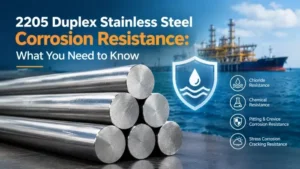
A PREN above 40 is generally considered “super” territory (super duplex, super austenitic). Duplex 2205 sits comfortably in the high-performance range, while 316 is in the standard range. For buyers evaluating the full range of duplex stainless steel round bars, PREN is one of the fastest ways to compare grades for a given chloride environment.
Practical corrosion differences
- Chloride pitting and crevice corrosion: Duplex 2205 withstands significantly higher chloride concentrations and temperatures before pitting initiates. In seawater (approximately 19,000ppm Cl⁻), 316 is at risk above 25 to 30°C. Duplex 2205 performs reliably up to around 50 to 60°C depending on geometry and flow conditions.
- Stress corrosion cracking (SCC): Austenitic grades like 316 are susceptible to chloride SCC above roughly 60°C in the presence of tensile stress. Duplex 2205 is highly resistant to chloride SCC due to its ferrite phase. This is one of the primary reasons oil and gas operators specify duplex for downhole and subsea components.
- General corrosion in acids: In reducing acids (sulphuric, phosphoric), 316 can outperform duplex because of its higher nickel content. In oxidising environments (nitric acid), both perform well, but 316 is the traditional choice.
- Intergranular corrosion: 316L and duplex 2205 are both low-carbon and resistant to sensitisation. However, duplex must be correctly solution-annealed and water-quenched after hot working to avoid sigma-phase precipitation, which degrades corrosion resistance.
5. Weldability and Fabrication
This is where procurement and fabrication teams need clear guidance before ordering material.
316 / 316L:
- Welds easily with all common processes: TIG (GTAW), MIG (GMAW), SMAW, SAW.
- No preheat required. No strict interpass temperature limit (though keeping it below 150°C is good practice).
- Filler metals: ER316L / E316L.
- Post-weld heat treatment generally not required.
- Very forgiving of minor procedure deviations.
Duplex 2205:
- Weldable, but demands controlled heat input (typically 0.5 to 2.5kJ/mm) and interpass temperature below 150°C.
- Too little heat input leads to excessive ferrite in the weld zone, reducing toughness and corrosion resistance.
- Too much heat input causes sigma phase, chi phase, and chromium nitride precipitation, leading to embrittlement and pitting susceptibility.
- Filler metals: ER2209 / E2209 (matching duplex composition with slightly higher nickel to promote austenite formation in the weld).
- Post-weld heat treatment is generally not recommended because it can cause sigma phase.
- Requires welders with specific duplex qualification and WPS / PQR documentation.
For round bar applications: If the bars are being used as machined components (shafts, studs, pins) with no welding, this section is less critical. If the round bars will be welded into fabricated assemblies (manifolds, pressure vessel internals, structural frames), the welding procedure specification must be established before material is ordered.
6. Cost Considerations
There is no single fixed price ratio because both alloys are sensitive to nickel, molybdenum, and chromium surcharges, which fluctuate quarterly. However, as a general guide:
- Duplex 2205 round bars typically cost 15 to 35% more per kilogram than 316 / 316L, depending on size, quantity, mill origin, and market conditions.
- Duplex uses less nickel (5 to 6.5% vs 10 to 14%), which partially offsets its higher chromium and nitrogen alloying costs.
- Because duplex’s yield strength is roughly double that of 316, the cost-per-unit-of-strength is often lower for duplex. If your design is strength-governed, you may need a smaller-diameter duplex bar than a 316 bar, reducing total material weight and cost.
- Availability: 316 / 316L round bars are stocked in a wider range of diameters globally. Duplex 2205 availability has improved significantly but may still involve longer lead times for very large diameters (above 250mm) or non-standard lengths.
Total installed cost should factor in: material cost, machining time (duplex is harder to machine), welding procedure qualification, NDT requirements, and expected service life. In aggressive chloride environments, the longer service life of duplex often justifies the upfront premium.
7. Machinability (Relevant to Round Bar Users)
If you are ordering round bars for CNC turning, milling, drilling, or threading:
- 316 / 316L is notoriously gummy and work-hardens. It requires sharp tooling, positive rake angles, and adequate coolant. It is not considered a free-machining grade.
- Duplex 2205 is harder (up to 293HB vs 217HB for 316) and has lower ductility. It demands more rigid setups, lower cutting speeds (roughly 20 to 30% lower than 316), and carbide tooling. However, its lower elongation means it produces shorter chips, which can actually improve chip evacuation in some operations.
- For high-volume machining, some buyers request 316 in a modified free-machining variant, or specify duplex bars in the solution-annealed condition for optimal machinability.
8. Applicable Standards for Round Bars
When ordering duplex or 316 round bars, ensure the material is certified to the correct standard:
| Standard | Coverage |
|---|---|
| ASTM A276 | Stainless steel bars (round, flat, hex), covers both 316 and 2205 |
| ASTM A479 | Stainless steel bars for boilers and pressure vessels |
| EN 10088-3 | European standard for stainless steel bars, rods, and wire |
| EN 10060 | Hot-rolled round steel bars, dimensions and tolerances |
| NORSOK M-650 | Qualification of duplex stainless steel for oil and gas (Norwegian sector) |
| API 6A / API 17D | Subsea and wellhead equipment (duplex commonly specified) |
| ASME SA-276 / SA-479 | ASME Boiler and Pressure Vessel Code equivalents |
| PED 2014/68/EU | Pressure Equipment Directive (relevant for EU-bound projects) |
Duplex 2205 round bars should be supplied in the solution-annealed and quenched condition with a ferrite balance of 35 to 65% (ideally 40 to 60%). Request a mill test certificate (MTC per EN 10204 3.1 or 3.2) that includes chemical analysis, mechanical properties, hardness, impact test results, and ferrite content.
9. When to Choose Which: Application Guidance
Choose 316 / 316L round bars when:
- The operating environment is mildly corrosive (atmospheric, fresh water, dilute acids, food-grade applications).
- Cryogenic service is required (316 retains toughness below -196°C; duplex does not).
- Extensive cold forming, bending, or swaging of the bar is needed.
- The project specifies austenitic stainless per existing design codes.
- Welding will be done in the field by teams without duplex-specific qualification.
- Budget is constrained and the environment does not demand high chloride resistance.
Choose Duplex 2205 round bars when:
- The service involves chlorides: seawater, brackish water, brine, produced water, or chloride-containing process streams.
- Chloride stress corrosion cracking is a risk (temperatures above 60°C with tensile stress in chloride media).
- Higher strength is needed to reduce component size or weight (pump shafts, valve stems, tie rods, fasteners).
- The application is in oil and gas upstream, subsea, desalination, chemical tankers, or offshore platforms.
- Design codes or client specifications call for a minimum PREN of 30 or above.
- Fatigue life is critical (duplex’s higher yield strength improves fatigue performance under cyclic loading).
For projects that require a lean duplex with moderate corrosion resistance and lower cost than 2205, Duplex 2304 round bars offer a practical middle ground between 316 and full duplex 2205.
10. Summary Comparison Table
| Parameter | 316 / 316L | Duplex 2205 |
|---|---|---|
| Crystal structure | Austenitic (FCC) | Approximately 50% austenite + 50% ferrite |
| UNS number | S31600 / S31603 | S32205 / S31803 |
| EN number | 1.4401 / 1.4404 | 1.4462 |
| Yield strength (min) | 205MPa | 450MPa |
| Tensile strength (min) | 515MPa | 620MPa |
| PREN | 24 to 26 | 34 to 38 |
| Chloride SCC resistance | Susceptible above approximately 60°C | Highly resistant |
| Cryogenic toughness | Excellent (usable below -196°C) | Limited (generally not below -50°C) |
| Weldability | Easy, forgiving | Requires controlled procedure |
| Formability / ductility | High (40% elongation) | Moderate (25% elongation) |
| Machinability | Difficult (gummy, work-hardens) | Moderate (harder, shorter chips) |
| Relative cost | Baseline | +15 to 35% |
| Common round bar standards | ASTM A276, EN 10088-3 | ASTM A276, EN 10088-3, NORSOK M-650 |
Frequently Asked Questions
How Much Stronger Is Duplex Stainless Steel Than 316?
Duplex 2205 has a minimum yield strength of 450MPa compared to 205MPa for 316, making it approximately 2.2 times stronger in yield. Tensile strength is about 20% higher (620MPa vs 515MPa). In round bar applications such as shafts, studs, and tie rods, this means a duplex 2205 round bar can carry the same load at a significantly smaller diameter, reducing weight and material volume.
Duplex Stainless Steel Fatigue Resistance: Is It Better Than 316?
Yes, duplex 2205 generally offers superior fatigue performance. Its higher yield strength raises the fatigue limit proportionally, and the two-phase microstructure impedes crack initiation more effectively than fully austenitic structures. In rotating components like pump shafts or valve stems machined from round bar, duplex 2205 typically delivers longer fatigue life under cyclic loading, particularly in corrosive environments where corrosion-fatigue interaction accelerates failure in 316.
Why Do Contractors Recommend Duplex Over Standard Stainless?
Contractors specify duplex 2205 primarily to mitigate chloride stress corrosion cracking, which is a common failure mode for 316 in warm, chloride-bearing environments. Duplex also allows thinner sections and smaller-diameter bars due to its higher strength, reducing structural weight. In oil and gas, desalination, and marine projects, the long-term reliability of duplex lowers maintenance costs and unplanned shutdowns, making it the lower total-cost-of-ownership choice despite a higher initial material price.
Is Duplex Stainless Steel Cheaper Than 316 Stainless Steel?
Per kilogram, duplex 2205 is typically 15 to 35% more expensive than 316 due to higher chromium and nitrogen content and tighter processing requirements. However, because duplex has roughly double the yield strength, a component designed in duplex may require 20 to 30% less material by volume. When you calculate cost per unit of load-bearing capacity, duplex can be competitive or even cheaper. The total project economics depend on design, fabrication complexity, and service conditions.
Does Duplex Stainless Steel Have Better Pitting Resistance Than 316?
Yes, significantly. Duplex 2205 has a PREN of 34 to 38 compared to 24 to 26 for 316. The higher chromium (22% vs 17%), molybdenum (3.2% vs 2.5%), and nitrogen (0.17% vs ≤0.10%) content give duplex a much higher threshold for pitting and crevice corrosion initiation. In seawater or chloride-rich process fluids, 316 may pit at 25 to 30°C, while duplex 2205 resists pitting well above 50°C.
Can 316 Stainless Steel Be Replaced by Duplex in Every Application?
No. Duplex 2205 is unsuitable for cryogenic service below approximately -50°C, where 316 retains excellent toughness. Duplex is also less formable, so applications requiring deep drawing, severe cold bending, or extensive swaging favour 316. In strongly reducing acids like hot concentrated sulphuric acid, 316’s higher nickel content provides better general corrosion resistance. Always verify the specific service environment, temperature, mechanical loading, and fabrication requirements before substituting one grade for the other.
Is Duplex Stainless Steel Heavier Than 316 Stainless Steel?
No. Duplex 2205 is actually slightly lighter, with a density of approximately 7.80g/cm³ versus 8.00g/cm³ for 316. The difference is about 2.5%, which is marginal for most calculations. However, because duplex’s higher strength allows smaller cross-sections, the actual installed weight of a duplex component is often noticeably lower than the equivalent 316 component designed for the same load.
Which Is Easier to Weld, 316 Stainless Steel or Duplex?
316 is considerably easier to weld. It is tolerant of a wide range of heat inputs, requires no preheat, and standard austenitic filler metals (ER316L) are readily available. Duplex 2205 demands controlled heat input (0.5 to 2.5kJ/mm), interpass temperatures below 150°C, and matching duplex filler (ER2209). Incorrect welding of duplex can produce excessive ferrite or harmful intermetallic phases. Welders need specific duplex procedure qualification, and NDT requirements are often stricter.
Does Duplex Stainless Steel Have Higher Yield Strength Than 316?
Yes. The minimum 0.2% proof (yield) strength of duplex 2205 is 450MPa, compared to 205MPa for 316 and 170MPa for 316L. This is the single most exploited advantage of duplex in structural and pressure-containing applications. For round bars used as studs, bolts, shafts, or load-bearing pins, the higher yield strength directly translates into higher allowable stress, smaller required diameter, and reduced weight.
Is Duplex 2205 a Direct Upgrade from 316L?
Not a direct drop-in replacement, but a performance upgrade for specific conditions. Duplex 2205 surpasses 316L in yield strength, pitting resistance, and chloride SCC resistance. However, it does not match 316L in cryogenic toughness, formability, or ease of welding. If your 316L application operates in warm chloride environments, suffers SCC failures, or is over-designed due to 316L’s low strength, duplex 2205 is an excellent upgrade. If the service is cryogenic, highly reducing, or involves severe cold forming, 316L remains the correct choice.
Final Note for Procurement and Engineering Teams
When requesting quotations for duplex 2205 or 316 / 316L round bars, specify the following to ensure you receive the correct material:
- Grade and UNS number (e.g., UNS S32205 / EN 1.4462 for duplex, S31603 / EN 1.4404 for 316L)
- Standard (ASTM A276, EN 10088-3, or both)
- Diameter range and length
- Surface condition (black, peeled, turned, ground, polished)
- Heat treatment condition (solution annealed and quenched for duplex)
- Testing and certification (EN 10204 3.1 or 3.2 MTC, impact test temperature, ferrite count for duplex)
- Any project-specific requirements (NORSOK, PED, NACE MR0175, third-party inspection)
Providing these details upfront avoids delays, rejections at inspection, and costly material substitutions mid-project.
Euro Steel Bars (ESB) stocks and supplies duplex stainless steel round bars, along with austenitic, super duplex, alloy steel, carbon steel, nickel alloy, and titanium round bars in a wide range of diameters and specifications for delivery to the Middle East, Southeast Asia, Europe, Turkey, Taiwan, South Africa, and other international markets. For technical guidance on grade selection or a tailored quotation, contact our sales engineering team.